These instructions apply to the Skoda Superb Mk3 (3V) 2015-Present.
For other models, please choose your vehicle here.
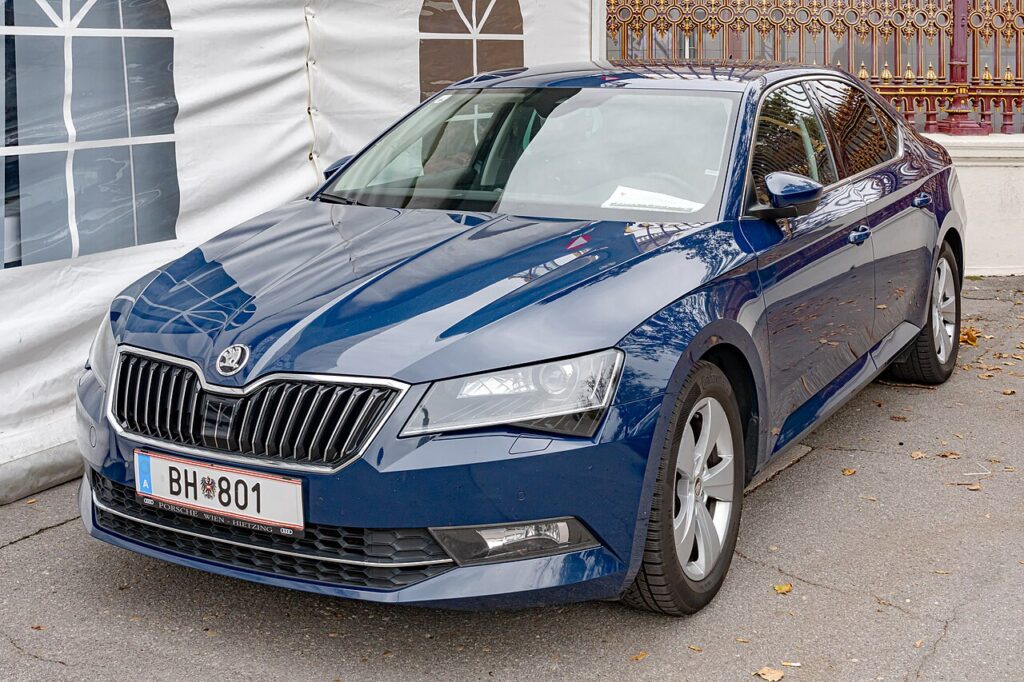
The Škoda Superb (Mk3, type 3V, 2015–present) was the first Škoda to use the electromechanical electronic parking brake (EPB), and it is fitted across the range with a small “P” switch on the centre console. To change the rear brake pads the screw-driven caliper pistons have to be wound fully back, and on the 3V that is an electronic-only operation. Be honest about it: there is no owner button trick that opens the calipers — you need a diagnostic tool that can command EPB service mode.
What service mode does and why you need a tool
Each rear caliper on the Superb 3V has its own motor and spindle that push the piston onto the disc. Because the piston is screw-actuated, it will not retract under hand pressure. Service mode commands both motors to wind the spindles fully back, parking the pistons clear of the disc and locking the EPB so it cannot re-clamp on a raised car. The factory route is VCDS or ODIS, but a generic OBD EPB tool (OBDeleven, Carista, Foxwell and similar) does the same job on the 3V — a coding/service dongle for the Superb 3V is widely available.
Retracting the calipers
- Park on level ground, chock the front wheels and select P (DSG) or first gear (manual), engine off.
- Connect a battery charger/maintainer — the EPB module is very voltage-sensitive and will abort if the battery dips.
- Switch the ignition ON without starting the engine, and turn Auto Hold off.
- Plug the OBD tool into the port below the steering column and open the EPB service function (VCDS: address 53 – Parking Brake, Basic Settings; app tools: the “Brake pad replacement” / “Open caliper” routine).
- Run the routine. Both rear motors wind back for about 20 seconds — wait for the tool to confirm the action is complete.
- Switch off and unplug. With the calipers retracted, lift the car, remove the wheels and fit the new pads.
Critical: never force the pistons back by hand
The piston in an EPB caliper is moved by the internal spindle motor. Never wind or push it back with a G-clamp or piston tool. Forcing it against the motor strips the spindle, damages the actuator gearbox or shears the motor — turning a pad change into a caliper replacement. Always retract electronically using the service-mode routine.
Exiting service mode and bedding in
With the new pads fitted and wheels back on, reconnect the tool, ignition ON, and run the close/reset step so the motors drive the pistons back out to clamp. Start the engine, then apply and release the EPB two or three times and confirm the warning lamp clears normally. Bed the pads in with 8–10 gentle stops from about 30–40 mph, leaving cooling gaps, and avoid hard braking for the first 100–200 miles.
Frequently Asked Questions
Do all Superb Mk3 cars have an electronic parking brake? Yes — the 3V was the first Škoda with EPB and it is fitted across the range, identified by the small “P” switch on the console rather than a handbrake lever.
Can I change the rear pads without any tool? No. The Superb 3V has no owner button-only service mode, so you need VCDS, ODIS or a generic OBD EPB tool to retract and then reset the calipers.
Is a cheap OBD tool enough, or do I need VCDS? A budget OBD tool with an EPB / brake-pad function works on the Superb 3V. VCDS and ODIS give the full dealer menu, but the retract-and-reset cycle is the same.
Why does the Superb need a battery charger connected? The EPB control module is sensitive to low voltage and will abort the routine mid-cycle if the battery sags, which can leave the calipers half-retracted. A maintainer keeps the supply steady throughout.
The warning light stays on after the job — what now? The reset step likely did not complete. Re-run it, cycle the EPB a few times, and if a fault stays stored, scan for codes before driving.
If a warning light or stored fault code appears during the job, you can look up what it means on autodtcs.com.
Independent guide — not affiliated with Skoda. Always follow your official service manual and safety precautions. Read our full disclaimer.