These instructions apply to the SsangYong Korando Mk4 (C300) 2019-2022.
For other models, please choose your vehicle here.
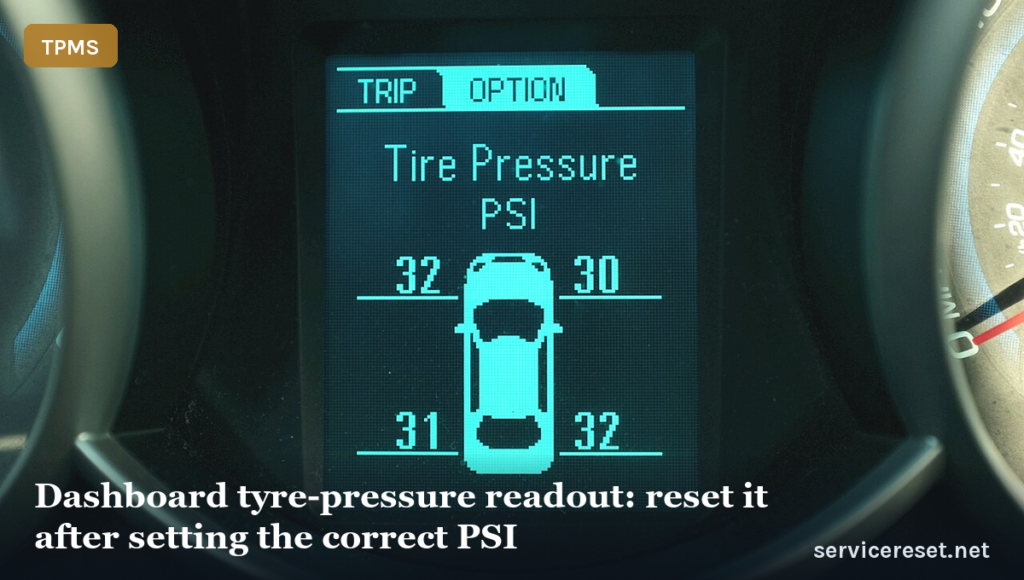
If the tyre-pressure warning has come on in your SsangYong Korando (C300, 2019–2022) after you’ve adjusted the pressures or changed a wheel, the system relearns by driving — there’s no button to press. This is normal housekeeping rather than a fault: the lamp stays lit until the Korando has settled at the corrected pressures and confirmed them over a short run. Set all four tyres accurately first and the wait-and-drive does the rest.

How the System Works on This Model
The Korando monitors the pressure at each wheel and compares it against a stored reference. When a tyre drops too low, or when you deliberately change the pressures, the warning lights and holds until the system has read the new values and locked them in. Because there’s no reset button, the relearn is triggered simply by inflating correctly, waiting, and driving — and the car will accept whatever pressures it finds, so it pays to get them exact before you set off.
Before You Begin
- Check the tyres cold, before driving or after only a short distance, so heat doesn’t inflate the readings.
- Use the placard figures on the driver’s door pillar for the load you’re carrying.
- Set all four corners, and the spare if it carries a sensor.
- Use an accurate gauge; forecourt airlines can read a psi or two out.
- Refit every valve cap so nothing leaks back out during the drive.
Completing the Procedure
- Park level and set all four tyres to the correct cold pressures.
- With the vehicle stationary, wait about 15 minutes.
- Start the engine and drive for about 10 minutes at over 30 km/h (18 mph).
- The new pressures are stored and the warning clears.
If the Warning Stays On
- Recheck every tyre — one corner still below spec keeps the lamp lit even when the rest are perfect.
- Complete the learn drive — a short crawl may not be enough; give it the full stationary wait then a clear 10-minute run.
- Just fitted different wheels? The system needs the wait and the drive to relearn the new set from scratch.
- Cold morning? Pressure falls about 1 psi per 5 °C drop, which can trip the warning overnight; top up to the cold figure.
- Watch for a slow puncture — a tyre that keeps needing air should be inspected rather than repeatedly reset.
- Correct pressures but still lit? A sensor may have a flat battery or fault — look up any stored code on autodtcs.com.
After the Reset
Once the corrected pressures are stored, the warning goes out and stays off for the trip and afterwards. A light that briefly returns on a very cold morning and clears as the tyres warm is normal thermal behaviour. A lamp that comes back on every drive, though, usually means one tyre is genuinely low or a sensor is failing, and is worth checking rather than resetting again.
Frequently Asked Questions
How do I reset the tyre pressure light on a SsangYong Korando?
Set all four pressures correctly to the cold placard figures, wait about 15 minutes with the vehicle stationary, then drive for about 10 minutes above 30 km/h. There’s no button — the wait and the drive are what let the system store the new values and clear the lamp.
Is there a reset button?
No — the system relearns automatically as you drive. There’s no dash menu or button to store the pressures manually; you inflate every tyre to spec, wait, and drive, and the Korando takes care of the rest.
Do I need a tool?
Not for a normal relearn. Adjusting pressures or swapping wheels needs only a gauge and the wait-and-drive above. A dedicated tool is only required when new pressure sensors are fitted and have to be registered to the vehicle.
How long is the learn drive?
About 10 minutes at over 30 km/h, after a 15-minute stationary wait with the vehicle at rest. If the warning hasn’t cleared by then, recheck the pressures cold rather than driving on — a tyre that’s still low will keep the lamp on however far you go.
Why did the light come on in cold weather?
Tyre pressure falls as the air inside cools, so a Korando set correctly in mild conditions can read low after a cold night and trip the warning. Top the tyres back up to the cold placard figure, then complete the wait and drive and the light should clear.
Is it safe to keep driving with the light on?
Take it as a prompt to check the tyres soon rather than a reason to stop straight away, but don’t leave it. A steady warning often means one tyre is genuinely low, which affects grip, braking and fuel use. Check all four at the next safe opportunity and reset once they’re correct.
If the warning came on together with other lights, decode the code on autodtcs.com.
Independent guide — not affiliated with SsangYong. Always follow your official service manual and safety precautions. Read our full disclaimer.