These instructions apply to the Suzuki Swift Mk3 (AZG/AZH) 2010-2017.
For other models, please choose your vehicle here.
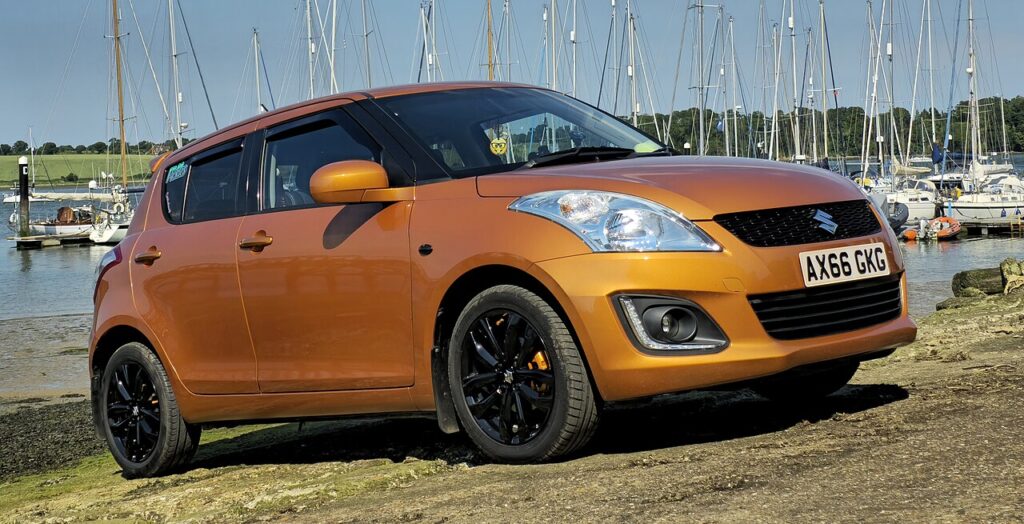
The third-generation Suzuki Swift (FZ/NZ chassis, 2010–2017) offered a tilt-and-slide electric sunroof on the SZ4, SZ-L and Sport trim levels. After the battery has been disconnected — for replacement, jump-starting from another car, or after a flat-battery event — the sunroof module loses its memory of the fully-open and fully-closed positions. The auto-close on remote-lock function stops working, the one-touch slide and tilt commands stop working, and the anti-pinch reverse may either over-trigger or fail to engage. Re-initializing the sunroof restores the lot in about a minute, with no tools and no scan equipment required.
Before you start
The Swift’s sunroof control panel is mounted in the headliner above the rear-view mirror. The switch is a single rocker that operates in two planes: pressing forward tilts the roof open at the rear; pressing back slides the roof rearward. Pressing again in either direction closes the roof. The motor and ECU are integrated and live in the headliner above the rear seats.
- Battery voltage must be healthy. A sagging battery will slow the motor at the seal and the module will read this as the closed end-stop in the wrong position. Aim for 12.4 V or higher at rest, and ideally run the engine for 5 minutes before starting the procedure.
- Clean the sunroof channels first. Leaves, grit and dried seal grease at the front corners cause the motor to bind, which can interrupt the calibration. A wet cloth wipe in the rails is enough.
- Park out of direct sun. The seals expand on a hot day and add motor load; the calibration is easier with the roof cool.
- Have the dashboard lights on. Ignition ON without engine running is the correct state. Don’t run the procedure with the engine cranking, and don’t run it on the engine ignition’s accessory position alone — the sunroof module requires the BCM to be fully awake.
Tools required
None.
Initialization procedure
- Switch the ignition ON. All dashboard warning lights illuminate briefly, then settle.
- Push the sunroof switch upwards to the maximum tilt position (the position you would normally use to pop the rear of the glass up for ventilation).
- Hold the switch for approximately 15 seconds. After 5–6 seconds the roof reaches its tilt limit and stops moving; keep holding. The module is recording the tilt end-stop and entering calibration mode.
- Release the switch. The roof stays in the tilted position.
- Press and hold the switch again — this time the roof will run through a self-test sequence: tilt down → slide open → slide close. The whole sequence takes around 25 seconds. Do not release the switch during this sequence.
- Keep holding until the roof has fully closed and stopped moving. Release.
- Test normal operation. A short press in tilt direction should pop the roof to tilt and stop. A short press in slide direction should slide it all the way to fully open. A short press from there should slide it fully closed.
How to verify it has worked
- One-touch tilt and slide operate from a brief press.
- The roof reverses by approximately 10 cm if you obstruct it during a close (test gently with a soft cloth — never your hand).
- Holding the remote lock button on the key fob (cars with this option) closes the sunroof automatically. If this function was set up before, it should work again now.
Troubleshooting
The roof moves but stops half-way through the self-test sequence. The motor has detected resistance higher than its protection threshold. Check that the runners are free of grit (push a soft brush along each side). If clean, the motor itself may be tired — a Swift sunroof motor typically lasts 8–10 years before the brushes wear.
The procedure runs but auto-close doesn’t work afterwards. The roof needs to see both end-stops correctly in the same calibration cycle. Repeat the procedure but extend step 3 to 20 seconds of held tilt.
The roof drips water at the front corners after initialization. This isn’t an initialization issue — the drain tubes in the front corners of the sunroof frame are clogged. Push a soft wire (a thin garden cable tie works) down each drain hole from the headliner side; you should hear water draining out from under the front wheel arches.
“AUTO” function fails — sunroof goes only as long as you hold the switch. The calibration didn’t take. Most common cause: weak battery causing motor speed to vary mid-sequence. Charge the battery overnight on a smart charger and re-run the procedure.
The sunroof closes a few millimetres further than before initialization, then squeaks against the seal. The closed end-stop is set too far. Tilt the roof back to maximum, then push the switch to close — the module re-samples. This usually self-corrects within a few cycles.
Frequently asked questions
Why does the Suzuki Swift need this procedure when other cars don’t?
Most cars with electric sunroofs need a similar procedure — it’s just usually not visible to the owner because manufacturers run a quick calibration on the first key cycle after a battery event. Suzuki opted to put the responsibility on the user, partly because the sunroof module is sleep-cycled aggressively to save standby current.
Will the sunroof still work without initialization?
Yes — it still opens and closes while you hold the switch. What you lose: one-touch, anti-pinch reverse calibration, and remote-key auto-close. You won’t damage anything by driving with an uncalibrated sunroof.
Does the procedure differ between the 1.2 K12B and the 1.6 M16A Sport?
No — the sunroof module and switch are identical across all Mk3 Swift trims that offered the sunroof option. The only difference is which trim level shipped with it.
My Swift has a panoramic roof, not just a single sunroof. Does the same procedure work?
The Mk3 Swift was never sold with a true panoramic roof — only the single tilt-and-slide unit. If your car has a larger glass panel it has been retrofitted; the module is non-OEM and may need a different procedure provided by the retrofit kit’s manufacturer.
I disconnected the battery briefly and the sunroof works fine without initialization. Did I get lucky?
Yes. If the battery interruption was shorter than the module’s RAM hold-up time (typically 200–300 ms via the on-board supercapacitor), the calibration survives. Anything longer than that and you’ll need the procedure.
For sunroof-related diagnostic trouble codes, see autodtcs.com.
Independent guide — not affiliated with Suzuki. Always follow your official service manual and safety precautions. Read our full disclaimer.