Most parts on a car give you plenty of warning before they fail. A timing belt is one of the few that often gives none — and when it lets go, it can wreck the engine in a fraction of a second. It is a cheap rubber part doing one of the most important jobs under the bonnet, which is exactly why it sits on a fixed replacement schedule instead of a “replace when worn” one. This guide explains what the belt does, how to tell whether your car even has one, how often it needs changing, and the warning signs worth taking seriously — illustrated with a real belt we caught just in time.
What a timing belt actually does
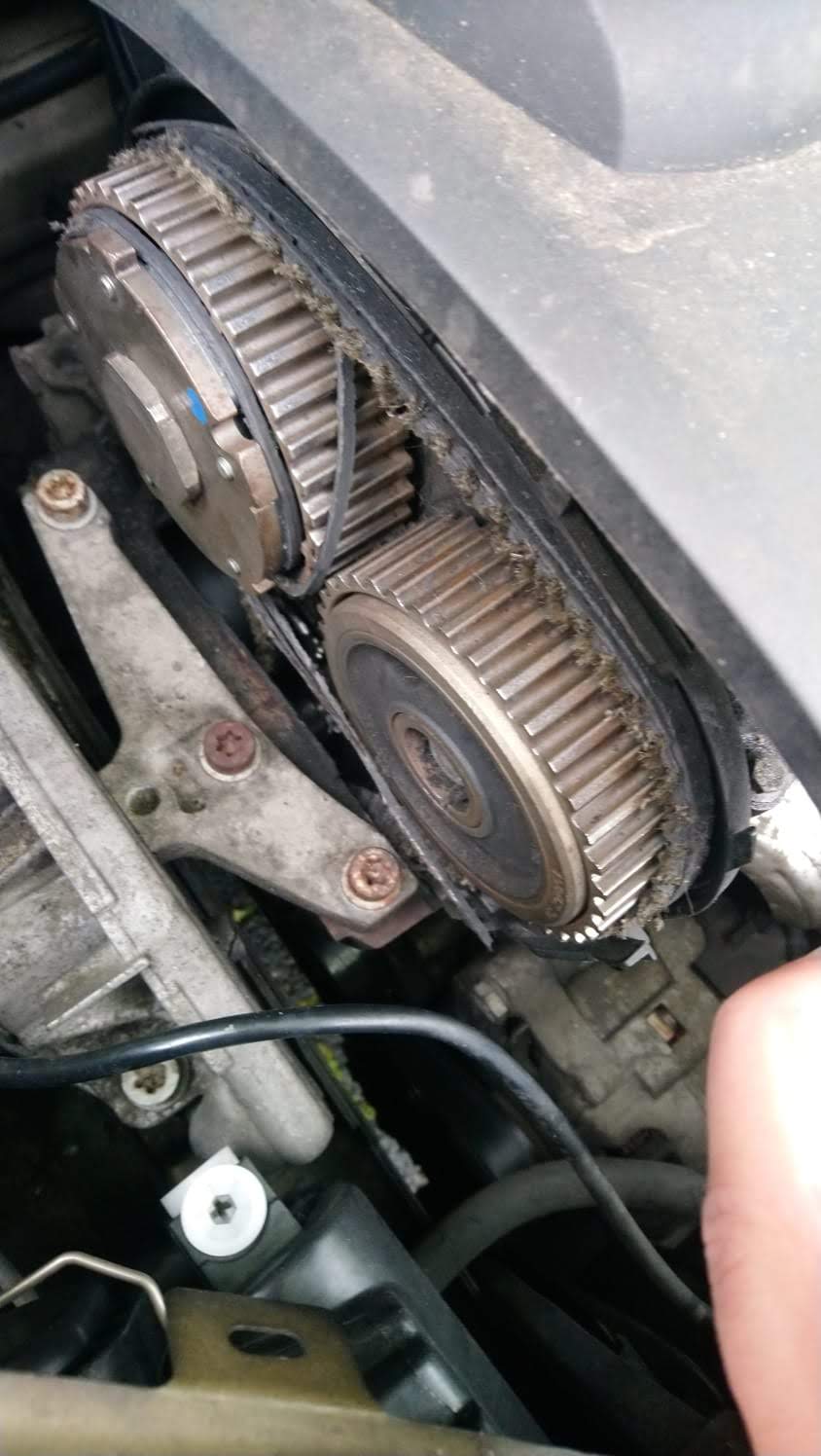
Your engine only runs cleanly if the valves open and close in perfect step with the pistons moving up and down. The timing belt is what keeps them synchronised: a toothed rubber belt that links the crankshaft (turned by the pistons) to the camshaft(s) (which operate the valves), so the two always turn in a fixed relationship. On many engines the same belt also drives the water pump. The teeth grip matching sprockets, and small alignment marks — you can see one on the belt and sprocket in the photo above — let a technician set the timing exactly when the belt is fitted.
Because it is rubber, the belt ages whether the car is driven hard or barely used at all. Heat, oil vapour and simple time make it harden, crack and lose grip on the teeth. That is why it is replaced on a schedule rather than left until it looks worn: by the time a belt looks bad, it is already living on borrowed time.
A real near-miss: caught just in time
The belt in the photo above came from a car that simply died at a set of traffic lights and refused to restart. There was no dramatic bang and no warning light in the days before — it just cut out and cranked over without firing. On inspection the cause was clear: a worn pulley had let the belt lose tension, and the belt had started to shed and skip its teeth, throwing the camshafts out of time with the crankshaft. With no synchronisation, the engine could not run.
Fitting a new belt and pulley brought it straight back to life, and it has run without a hint of trouble since. But that outcome was largely luck. Because the belt skipped and shed rather than snapping clean through — and because it happened at a standstill and was caught immediately — the valves and pistons escaped damage. Had that same belt let go completely at motorway speed, the ending could have been a bent set of valves and a four-figure engine bill. That is the whole case for changing a timing belt before it fails, not after.
Timing belt vs timing chain: how to tell which you have
Not every engine uses a belt. Many use a timing chain instead — a metal chain, much like a heavy-duty bicycle chain, that does the same job. The practical differences matter:
| Timing belt | Timing chain | |
|---|---|---|
| Material | Toothed rubber (reinforced) | Metal chain |
| Location | Behind a plastic cover on the front or side of the engine, run dry | Inside the engine, behind a metal cover, bathed in engine oil |
| Service life | Fixed interval — must be replaced | Often designed to last the engine’s life, but can stretch and wear |
| Warning it gives | Frequently none — hence the interval | Usually a rattle, especially on cold start-up, as it wears |
The quickest way to know which you have is your car’s service schedule or owner’s manual: if it lists a mileage or time interval for the “timing belt” or “cam belt”, you have a belt. If no belt change is listed, the engine most likely runs a chain. A plastic ribbed cover on the accessory end of the engine usually hides a belt; a chain sits behind a metal timing cover with no exposed belt at all. If you are unsure, quote your exact model and engine to a garage — they will know instantly.
One modern twist: some recent engines use a “wet” belt that runs inside the engine in oil. These still have a replacement interval, and if neglected they can break down and shed material into the oil system, so they are treated with the same respect as a traditional belt.
Interference vs non-interference: why the stakes vary
How badly a snapped belt hurts depends on the engine’s design:
- Interference engine: the valves and pistons pass through the same space at different moments. If the belt breaks and the camshafts stop while the crankshaft keeps spinning, open valves get struck by rising pistons — bending valves and sometimes damaging pistons or the cylinder head. Many modern engines, petrol and diesel, are of this type.
- Non-interference engine: there is always clearance between valves and pistons, so a broken belt simply stops the engine with no internal contact. You are stranded, but the engine itself is usually unharmed.
You cannot tell which you have by looking, and you should never gamble on it. Treating every timing belt as if a failure would destroy the engine is the safe assumption — and it keeps the fix in the “routine service” column rather than the “new engine” one.
When to replace a timing belt
There is no universal figure — the interval is set by the manufacturer and printed in the service schedule. As a rough guide, most belts fall somewhere in the region of every 60,000 to 100,000 miles (about 100,000–160,000 km), or every 5 to 10 years, whichever comes first. The time limit matters just as much as the mileage: a low-mileage car that has sat for years still needs the belt done, because the rubber degrades with age alone.
Two situations that should move a belt change up the list:
- Buying a used car with no history — if you cannot prove the belt has been done, budget to do it. It is cheap insurance against inheriting someone else’s overdue belt.
- Any sign of oil or coolant on the belt — a leaking cam or crank seal contaminates the rubber and can destroy a belt long before its interval.
Warning signs worth taking seriously
The uncomfortable truth is that many belts fail with no warning at all — which is precisely why the interval exists. But when there are symptoms, do not ignore them:
- A ticking, rubbing or light squealing noise from the timing cover area.
- An engine that cranks but will not start, or stalls and refuses to restart — a classic sign the belt has slipped or lost sync, exactly as in the story above.
- Rough running or misfires if the belt has jumped a tooth and the timing is now slightly out.
- Oil or coolant leaks near the belt covers, which soften and shorten the belt’s life.
- Visible cracking, glazing, fraying or missing teeth if a cover is removed for inspection.
A slipped or out-of-time belt will often set camshaft/crankshaft position or correlation trouble codes in the engine computer. If your check-engine light is on alongside any of the above, reading those codes points straight at the problem — you can look up what a specific code means on our sister site, autodtcs.com.
What a proper belt change includes
A timing belt is rarely replaced on its own. The parts around it wear at a similar rate, and — as our near-miss shows — a failed pulley can wreck a healthy belt just as surely as an old belt fails by itself. A thorough job normally replaces the belt together with:
- the tensioner and any idler pulleys, which spin constantly and can seize or throw the belt;
- the water pump, if it is driven by the timing belt — it is already exposed during the job, and a later pump failure would mean doing all the work again.
Because the timing has to be set precisely and access is often tight, this is a workshop job on most cars rather than a driveway one. Done properly with a full kit, though, it resets the clock for another interval and takes the single biggest “sudden death” risk off your engine.
After the job: reset the service reminder
A timing belt change is a major service item, and on many cars it is worth clearing or updating the service interval indicator afterwards so the reminder reflects the work that was done. If your dashboard shows a wrench or service light after the job, our step-by-step service-reset guides cover how to reset it for hundreds of makes and models.
The bottom line
A timing belt is a small, inexpensive part with an outsized ability to ruin an engine — and it usually gives no warning before it goes. Find out whether your car has a belt or a chain, check the interval in your service schedule, and if there is any doubt about when it was last done, do it. The car in the photo above was saved by luck and quick diagnosis. Replacing the belt on time removes the need for luck entirely.
