These instructions apply to the Hyundai i20 Mk2 (GB) 2014-2020.
For other models, please choose your vehicle here.
The ISG (Idle Stop & Go) system on the Hyundai i20 Mk2 (GB, 2014–2020) shuts the engine off at a standstill to save fuel and restarts it when you pull away. If you would rather keep the engine running — in heavy traffic, on hills, or on a cold morning — you can switch it off with one button.
Does your i20 have ISG?
ISG is fitted to European i20s (and some other markets), but not all cars have it — the Indian-market Elite i20 petrol, for example, has no ISG and therefore no ISG OFF button. If your dash has an ISG OFF button (usually low on the dash, left of the wheel), the steps below apply.
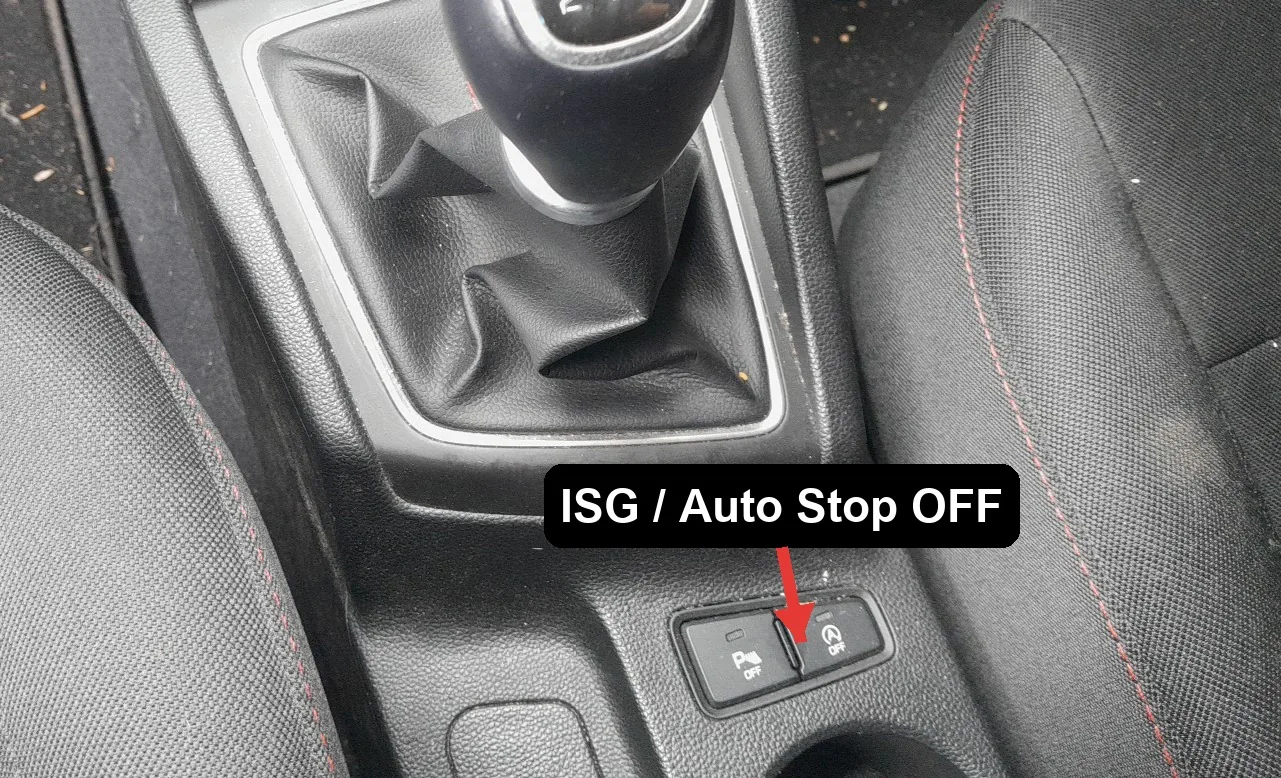
- With the engine running, press the ISG OFF button once. The light in the button comes on to show ISG is disabled — the engine will no longer auto-stop.
- To turn ISG back on, press the ISG OFF button again; the light in the button goes out.
Note: ISG switches itself back on every time you restart the car — there is no permanent-off setting, so press the button each drive if you prefer it off.
Frequently asked questions
Why won’t the engine auto-stop even though I haven’t turned ISG off?
ISG only works when conditions are met: the 12 V battery must be well charged and in good health, the engine warm, and cabin heating/cooling demand not too high. A tired battery is the most common reason ISG stops working.
Is it bad to switch ISG off?
No — it simply keeps the engine idling at stops. It uses a little more fuel but causes no harm.
The ISG OFF light stays on by itself — what does that mean?
If the light comes on without you pressing it, the system has disabled itself, often due to a weak battery or an ISG sensor fault. Have the battery tested first.
If an ISG or battery-related warning appears, look the exact dashboard symbol up on autodtcs.com before spending on parts.
Independent guide — not affiliated with Hyundai. Always follow your official service manual and safety precautions. Read our full disclaimer.