These instructions apply to the Hyundai i10 Mk1 (PA) 2008-2013.
For other models, please choose your vehicle here.
The Hyundai i10 (PA, 2008–2013) has two fuse boxes: one in the passenger compartment (behind a pull-off cover on the driver’s-side end of the dashboard) and one in the engine bay (beside the 12 V battery). The fuse map is printed on the inside of each lid — match the symbol on your lid to the tables below to find any fuse and its rating.
Verified on this vehicle: Hyundai i10 (PA) 1.2 Kappa, 2011, EU market, left-hand drive — both lids photographed on the car. (“PA” is Hyundai’s generation code for the 2008–2013 i10.) The lids carry labels in several languages; the English wording is used below.
Passenger-compartment (interior) fuse box
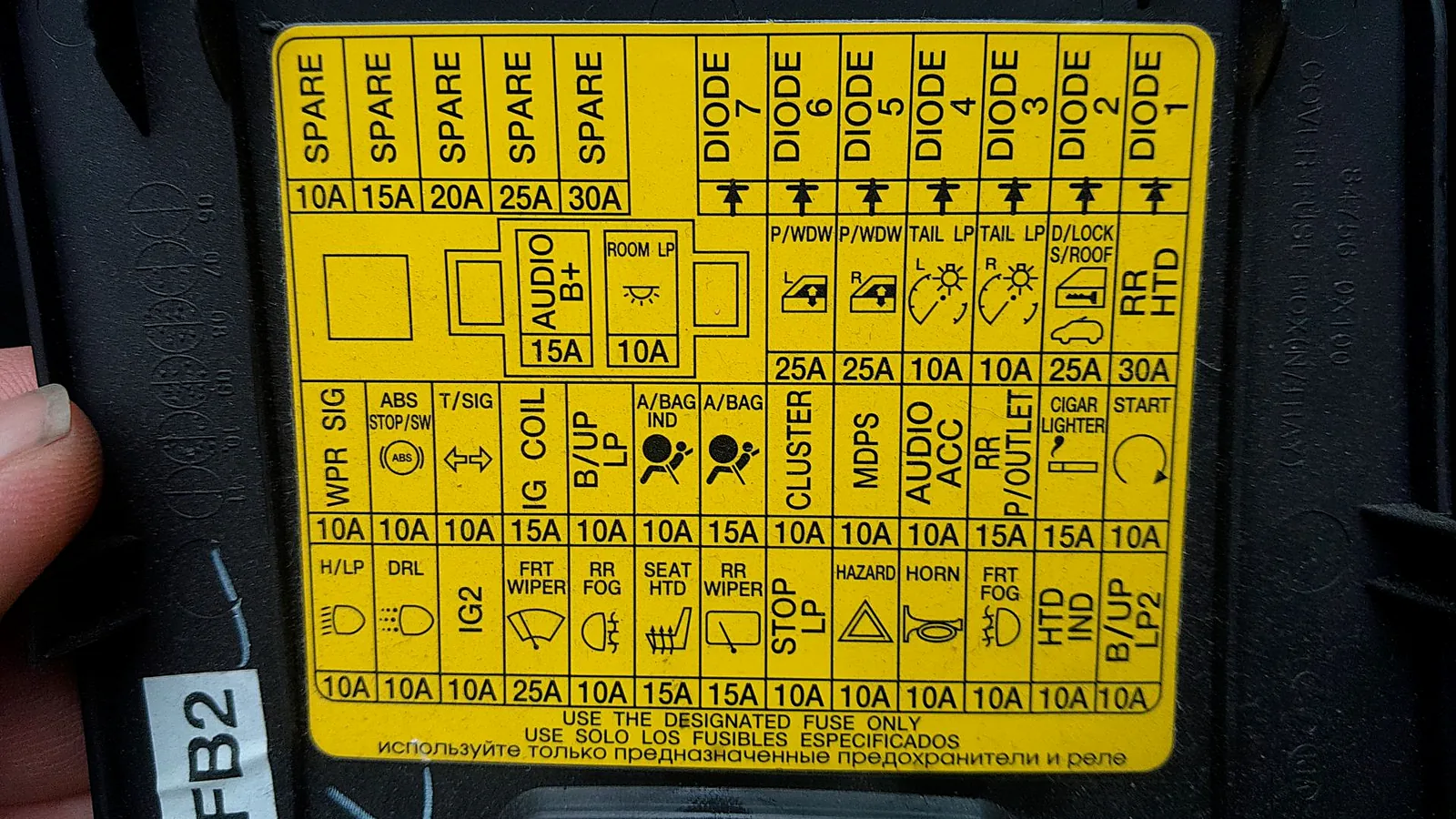
| Symbol | Fuse | Rating | Protects |
|---|---|---|---|
| — | AUDIO B+ | 15 A | Audio system (constant / memory feed) |
| ROOM LP | 10 A | Interior / room lamp | |
| P/WDW LH | 25 A | Power window, left | |
| P/WDW RH | 25 A | Power window, right | |
| — | TAIL LP LH | 10 A | Tail / side lights, left |
| — | TAIL LP RH | 10 A | Tail / side lights, right |
| D/LOCK, S/ROOF | 25 A | Central door locks and sunroof | |
| RR HTD | 30 A | Rear-window heater (demister) | |
| WPR SIG | 10 A | Wiper control signal | |
| ABS, STOP/SW | 10 A | ABS and brake-light switch | |
| T/SIG | 10 A | Turn signals (indicators) | |
| IG COIL | 15 A | Ignition coil | |
| — | B/UP LP | 10 A | Reversing (back-up) lamp |
| A/BAG IND | 10 A | Airbag warning indicator | |
| A/BAG | 15 A | Airbag / SRS system | |
| — | CLUSTER | 10 A | Instrument cluster |
| MDPS | 10 A | Electric power steering (control feed) | |
| — | AUDIO ACC | 10 A | Audio (switched / accessory feed) |
| RR P/OUTLET | 15 A | Rear 12 V power outlet | |
| CIGAR LIGHTER | 15 A | Cigarette lighter / front 12 V outlet | |
| START | 10 A | Starter control circuit | |
| H/LP | 10 A | Headlamp circuit (control) | |
| — | DRL | 10 A | Daytime running lights |
| — | IG2 | 10 A | Ignition 2 (accessory circuits) |
| FRT WIPER | 25 A | Front wiper motor | |
| — | RR FOG | 10 A | Rear fog light |
| SEAT HTD | 15 A | Heated front seats | |
| RR WIPER | 15 A | Rear wiper motor | |
| — | STOP LP | 10 A | Brake (stop) lights |
| HAZARD | 10 A | Hazard flashers | |
| HORN | 10 A | Horn | |
| — | FRT FOG | 10 A | Front fog lights |
| HTD IND | 10 A | Heated-mirror / rear-demister indicator | |
| — | B/UP LP2 | 10 A | Reversing (back-up) lamp (2) |
The blade-fuse colors here follow the standard code and are confirmed on this car — 10 A red, 15 A blue, 20 A yellow, 25 A clear, 30 A green. The box also carries five numbered SPARE fuses (10–30 A) and seven diodes; the diodes are not owner-serviceable.
Engine-compartment fuse box


| Symbol | Fuse | Rating | Protects |
|---|---|---|---|
| MAIN | 100/125 A | Main battery supply (varies by build) | |
| MDPS | 80/50 A | Electric power steering (varies by build) | |
| — | IG2 | 50 A | Ignition 2 feed |
| — | IG1 | 40 A | Ignition 1 feed |
| B+1 | 40 A | Battery feed 1 (to interior box) | |
| B+2 | 50 A | Battery feed 2 | |
| B+3 | 30 A | Battery feed 3 | |
| ECU1 | 30 A | Engine control / ignition | |
| — | R/FAN | 40 A | Radiator cooling fan |
| P/WDW | 40 A | Power windows feed | |
| ABS1 | 40 A | ABS system | |
| ABS2 | 40 A | ABS system | |
| BLOWER | 40 A | Heater / A-C blower feed | |
| F/PUMP | 15 A | Fuel pump | |
| A/CON SW | 10 A | Air-conditioning switch | |
| ECU2 | 10 A | Engine control (logic / sensors) | |
| INJECTOR | 15 A | Fuel injectors | |
| — | SENSOR1 | 10 A | Engine sensors |
| A/CON | 10 A | Air-conditioning compressor clutch | |
| H/LP LH | 10 A | Headlamp low beam, left | |
| H/LP RH | 10 A | Headlamp low beam, right |
The small fuses in the engine box are standard blade type (10 A red, 15 A blue, confirmed on this car). The higher-rated ones (30 A and up, shown with a grey rating) are J-case cartridge fuses and fusible links — these follow a different color code (on this car, 50 A salmon, 40 A green, 30 A pink), so go by the printed rating, not the color. The box also holds the main relays (fuel pump, main, diagnosis, headlamp, headlamp-high, A/C, blower, start and cooling-fan), which carry no rating and are not owner-replaceable fuses.
Variants & safety: verified on a 2011 EU 1.2 (LHD). The MAIN and MDPS links are marked “100 or 125 A” and “80 or 50 A” — the fitted rating depends on the build. Layouts and ratings vary by year, trim, engine and market, so always read the legend on your own lids, and never fit a fuse rated higher than the one marked. Spotted a mistake for your car? Tell us on the contact page.
How to change a fuse
- Switch off the ignition and the circuit that has failed.
- Find the fuse: match its symbol on the lid (or in the tables above) to its slot in the box.
- Pull it with the plastic puller clipped inside the engine-bay box — never a screwdriver or metal tool, which can short the terminals.
- Hold it up to the light: a blown fuse has a broken metal strip inside.
- Fit a new fuse of the same amperage (same color) and check the circuit works.
If the new fuse blows again there is a fault in that circuit — have it diagnosed rather than fitting a bigger fuse. A main-fuse or fusible-link failure, where nothing electrical works, needs a Hyundai dealer. If an electrical fault also lit a dashboard warning light, read the code free at autodtcs.com.
Independent guide — not affiliated with Hyundai. Always follow your official service manual and safety precautions. Read our full disclaimer.