These instructions apply to the Mitsubishi Eclipse Cross EV Mk1 (2025-present).
For other models, please choose your vehicle here.
Full specifications for the Mitsubishi Eclipse Cross EV (first generation, on sale from late 2025) — the brand’s first fully electric SUV for Europe. The column below covers the 87 kWh, 218 hp version. These figures describe the electric Eclipse Cross, which is a different vehicle from the earlier petrol and plug-in-hybrid Eclipse Cross.
Each column is one specific vehicle — a single engine or motor and, where shown, body style. Dimensions and several weights are specific to that body and drivetrain; other body or powertrain versions differ, so match the column to your own vehicle.
| 87 kWh 218 hp (6AM-40)EU | |
|---|---|
| Length | 4,468 mm |
| Width (excl. mirrors) | 1,864 mm |
| Height | 1,572 mm |
| Wheelbase | 2,784 mm |
| Track (front / rear) | — |
| 87 kWh 218 hp (6AM-40)EU | |
|---|---|
| Kerb weight | 1,901 kg |
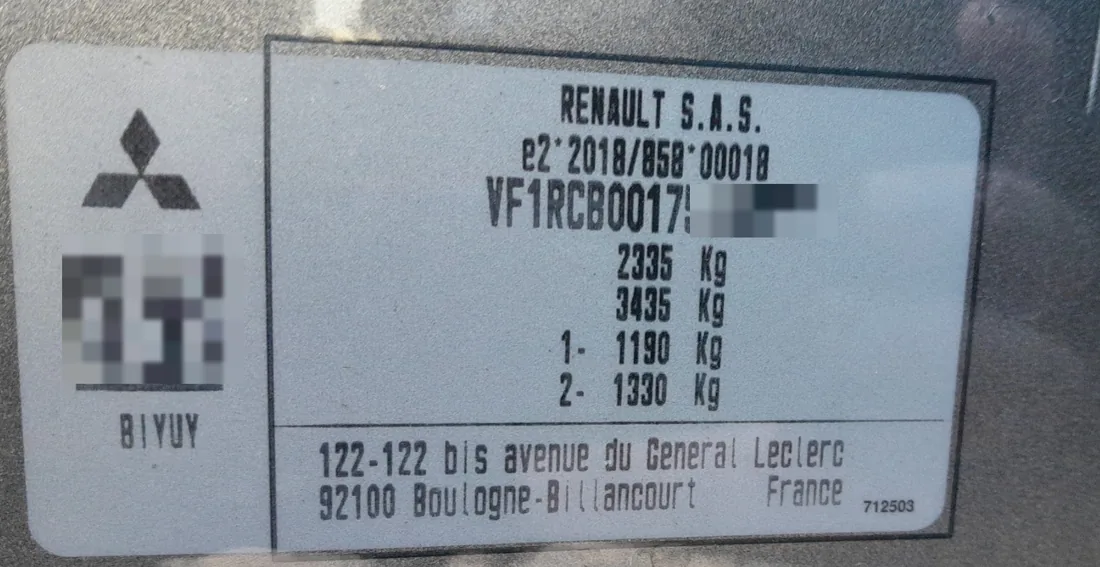
| Gross vehicle weight | 2,335 kg |
| Payload (approx.) | 434 kg |
| Max axle load, front | 1,190 kg |
| Max axle load, rear | 1,330 kg |
| Towing (braked trailer) | 1,100 |
| Gross combined weight (GCWR) | 3,435 |
| 87 kWh 218 hp (6AM-40)EU | |
|---|---|
| Emission standard | Zero-emission (BEV) |
| 87 kWh 218 hp (6AM-40)EU | |
|---|---|
| Electric motor(s) / layout | Single motor, front axle |
| Electric motor power | 160 kW (218 hp) |
| Electric motor torque | 300 Nm |
| Traction battery (type) | Lithium-ion, NMC |
| Battery capacity (usable) | 87 kWh kWh |
| Battery capacity (total) | 92 kWh (gross) kWh |
| Electric range (EPA) | — |
| Electric range (WLTP) | Up to 600 km (373 miles) |
| Energy consumption | — |
| Heat pump | — |
| 87 kWh 218 hp (6AM-40)EU | |
|---|---|
| AC charging (onboard) | Up to 22 kW (Type 2) |
| DC fast-charge (peak) | Up to 150 kW (CCS Combo 2) |
| DC charge 10–80% | 15-80% in about 37 min (150 kW) |
| Charge port | CCS Combo 2, front right wing |
| Vehicle-to-load (V2L) | Yes, up to 3.7 kW / 16 A (V2L); V2G-capable |
| 87 kWh 218 hp (6AM-40)EU | |
|---|---|
| 0–100 km/h (0–60 mph) | 7.9 s (0-100 km/h) |
| Top speed | 170 km/h (106 mph) |
| Drive | Front-wheel drive |
| Transmission | Single-speed automatic |
| 87 kWh 218 hp (6AM-40)EU | |
|---|---|
| Drive-by noise | 64 dB(A) |
| 87 kWh 218 hp (6AM-40)EU | |
|---|---|
| Front brakes | — |
| Rear brakes | — |
| Tyre sizes | 205/55 R19 97H or 235/45 R20 100H/V |
| Rim sizes | — |
| Tyre pressures, normal (front / rear) | 205/55 R19: 2.4 bar (35 psi) all round; 235/45 R20: 2.1 bar (30 psi) all round |
| Tyre pressures, laden (front / rear) | 205/55 R19: 2.5 front / 2.8 rear bar (36/40 psi); 235/45 R20: 2.3 bar (33 psi) |
| Wheel-nut torque | — |
| 87 kWh 218 hp (6AM-40)EU | |
|---|---|
| Coolant | — |
| 12 V battery | — |
| Air-con refrigerant | — |
Sources: Owner's manual. Where an owner’s manual or homologation figure exists it takes precedence; workshop data fills only what those omit.
Battery and range
The Eclipse Cross EV uses an 87 kWh usable (92 kWh gross) lithium-ion NMC battery driving a single 160 kW (218 hp) motor on the front axle. Mitsubishi quotes up to about 600 km (373 miles) on the WLTP cycle.
Expect less in real-world use — roughly 450–500 km in mixed driving, and noticeably less in cold weather or at sustained motorway speed. A heat pump (where fitted) helps protect winter range.
Charging
On AC the car accepts up to 22 kW through its Type 2 inlet; on DC rapid chargers it takes up to 150 kW via the CCS Combo 2 port, giving a 15–80% top-up in about 37 minutes. The charge port sits on the front right wing.
It also supports Vehicle-to-Load (V2L), delivering up to 3.7 kW (16 A) to power external devices. For the full plug-in, scheduling and cable-release procedure, see the charging guide.
Towing, payload and weights
The Eclipse Cross EV is rated to tow 1,100 kg braked and 750 kg unbraked, with a maximum tow-ball download of 75 kg. Kerb weight in running order is about 1,901 kg, leaving roughly 434 kg of payload up to the 2,335 kg gross vehicle weight.
Boot space
Luggage capacity is 545 litres with the rear seats up, rising to about 1,670 litres with them folded.
Is it a rebadged Renault?
Yes. The electric Eclipse Cross is built by Renault in France and is based on the Renault Scénic E-Tech (CMF-EV platform), sharing its battery, motor and running gear. That is why its controls — the electronic parking brake, the card key, the indirect tire-pressure system and one-pedal driving — follow Renault’s electric-vehicle design, and why our step-by-step guides reflect that.
Frequently Asked Questions
What is the range of the Eclipse Cross EV?
Up to about 600 km (373 miles) on the WLTP cycle from the 87 kWh battery. In everyday driving expect closer to 450–500 km, and less in cold weather or at higher speeds.
How fast does it charge?
Up to 150 kW on a DC rapid charger, which takes the battery from 15% to 80% in around 37 minutes. On a 22 kW AC supply a full charge takes roughly four to five hours.
How big is the boot?
545 litres with the seats up and about 1,670 litres with the rear seats folded.
How much can the Eclipse Cross EV tow?
1,100 kg with a braked trailer and 750 kg unbraked, with a 75 kg maximum nose weight. A tow bar must be fitted by a dealer.
Is the Mitsubishi Eclipse Cross EV a Renault?
Mechanically, yes — it is built by Renault on the Scénic E-Tech platform and shares that car’s 87 kWh battery and 160 kW front motor, wearing Mitsubishi styling and badges.
What size battery does it have?
87 kWh usable (92 kWh gross), a lithium-ion NMC pack.
Disclaimer: Figures are typical for the generation and may vary by market, trim and options. A dash (—) means we have not yet verified that figure, not that it does not exist. Always confirm critical figures (weights, towing, tire sizes) against your own vehicle’s documents.
Servicing your car? Browse the full set of Mitsubishi Eclipse Cross EV guides.
Independent guide — not affiliated with Mitsubishi. Always follow your official service manual and safety precautions. Read our full disclaimer.