These instructions apply to the Mitsubishi Outlander Mk3 PHEV (GG2W) 2014-2021.
For other models, please choose your vehicle here.
The EV System Service Required message means your Outlander PHEV’s electric drive system has logged a fault and wants attention — often with a “stop the vehicle in a safe place” prompt. It looks alarming, but it rarely means the main drive battery has failed. Here’s what it really means and what to check first.
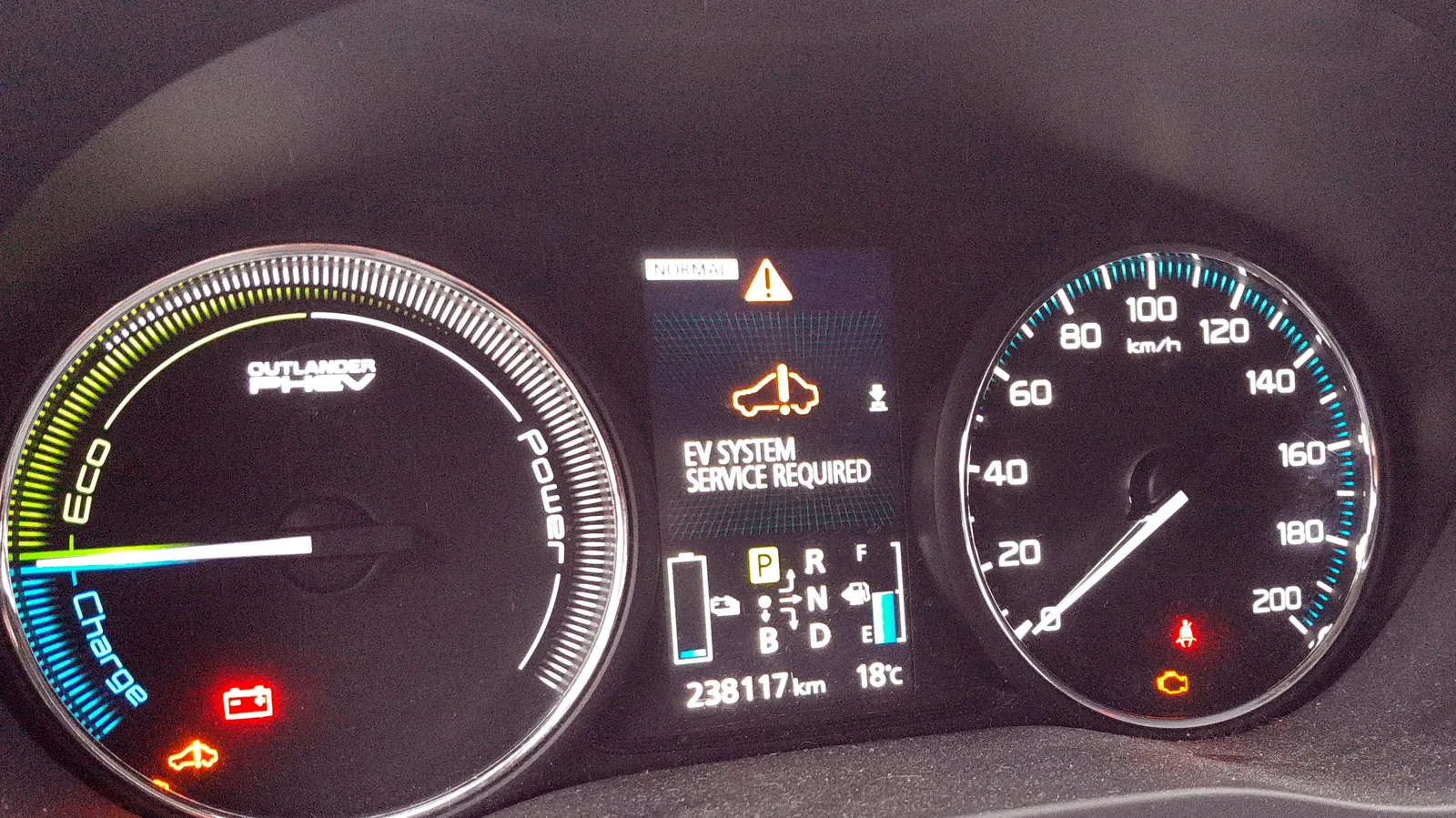
What the warning actually means
The message is the car telling you its hybrid/EV control system has stored a diagnostic trouble code. It lights the amber master-warning triangle and a car-with-exclamation symbol, and adds “stop safely” if it appears while you are driving.
The code most often behind it is P3000 — a general battery-control-system fault. Importantly, P3000 does not automatically mean the expensive traction (drive) battery has failed. It is a broad flag that something in the high-voltage control chain is unhappy, and the stored code has to be read to know exactly what.
On the dashboard this is the Plug-in Hybrid EV System warning lamp — the car-with-exclamation symbol. Mitsubishi’s own handbook says that when it comes on you should avoid high-speed driving and have the vehicle inspected by an authorized service point as soon as possible.
The most common cause: a weak 12-volt battery
On this generation the single most commonly reported trigger is the humble 12-volt auxiliary battery — the small conventional battery, not the big traction pack. The PHEV’s controllers are very sensitive to voltage: when the 12 V supply drops (a tired battery, a cold morning, or the car sitting unused), it can throw a whole “Christmas tree” of warnings at once — ABS, brake, 12 V battery and EV-system lights together — before settling on the EV message.
That is exactly what the cluster above shows: the EV-system warning alongside a lit red 12 V battery light and the engine check light. When several unrelated systems complain together, a weak 12 V supply is the first suspect.
Mitsubishi’s handbook makes the same link: it notes that starting the car with insufficient auxiliary-battery voltage can bring these warnings up, and that once the battery is properly charged they should go back out. In other words, confirm a healthy 12 V battery before assuming anything worse.
It is not a high-mileage-only problem. A 12 V battery can sag at 60,000 km just as easily as at 240,000 km, so do not assume the car is “worn out” just because the message appeared.
Other things that can trigger it
- Charging interrupted or faulty — some owners see the message right after a charge stops unexpectedly.
- Traction-battery or battery-management (BMU) fault — genuine high-voltage issues do happen, which is why the code must be read rather than guessed.
- A sensor or wiring fault somewhere in the hybrid system.
Can you still drive?
It depends on the fault. The car may keep going in a reduced-power (“limp”) mode, or run on the petrol engine even with charge still showing in the battery. If it tells you to stop the vehicle in a safe place, take that literally: pull over somewhere safe, switch off, wait a moment and restart.
If the message clears you can drive on gently to get it checked. If it stays on, or power is badly reduced, do not force it — arrange to have it looked at.
What to do
- Read the stored code first. Be aware a cheap generic OBD-II reader usually only talks to the petrol engine and cannot see the PHEV’s high-voltage or battery-management codes. To tell the cheap 12 V side from a real high-voltage fault you normally need a Mitsubishi dealer scan or a PHEV-aware tool (for example the PHEV Watchdog app on an OBD adapter). Never open or probe the orange high-voltage system yourself.
- Check the 12-volt battery. Have its voltage and health tested — a healthy 12 V battery rests at about 12.4–12.6 V with the car switched off, and a proper load or charge test tells you more than resting voltage alone. If it is weak or several years old, replacing it is the cheapest and most common fix. If the 12 V is flat, see our PHEV jump-start guide.
- Then clear the code. Fixing the cause does not always switch the light off by itself — see below.
How the warning is cleared
This is not a light you reset from a menu. Once the underlying fault is fixed — most often a fresh 12 V battery — the stored code is cleared with a scan tool. Many owners find a simple code-clear after a 12 V replacement is all that is needed. A message that persists or keeps coming back means the real fault is still present and needs a Mitsubishi technician with the factory tool.
Frequently Asked Questions
Does “EV System Service Required” mean my main battery is dead?
Not necessarily. The usual code (P3000) is a general battery-control fault, and on this generation a weak 12-volt battery is the most common and cheapest cause. Only reading the stored code confirms whether the main traction battery is actually involved.
Can I reset the EV System Service Required message myself?
No — there is no owner menu to clear it. You fix the cause (often the 12-volt battery) and then clear the stored code with an OBD scan tool. If it comes back, the fault is still there.
Is it safe to drive with the warning on?
Briefly and gently, yes, if the car still drives normally — but get it scanned soon. If it says “stop safely”, power is cut, or the engine runs constantly, stop and have it checked rather than continuing.
How much does it cost to fix?
If it is the 12-volt battery, it is an inexpensive battery plus a code-clear. A genuine high-voltage or battery-management fault is far more involved — which is exactly why reading the code first can save you a lot of money.
Disclaimer: This is general guidance for the 2014–2021 Outlander PHEV. The exact cause depends on the stored trouble code — always have it read before replacing parts. The photo shows an example owner’s vehicle.
More help with your PHEV: fix charging that won’t start, full specifications, or browse all Outlander PHEV guides.
Independent guide — not affiliated with Mitsubishi. Always follow your official service manual and safety precautions. Read our full disclaimer.