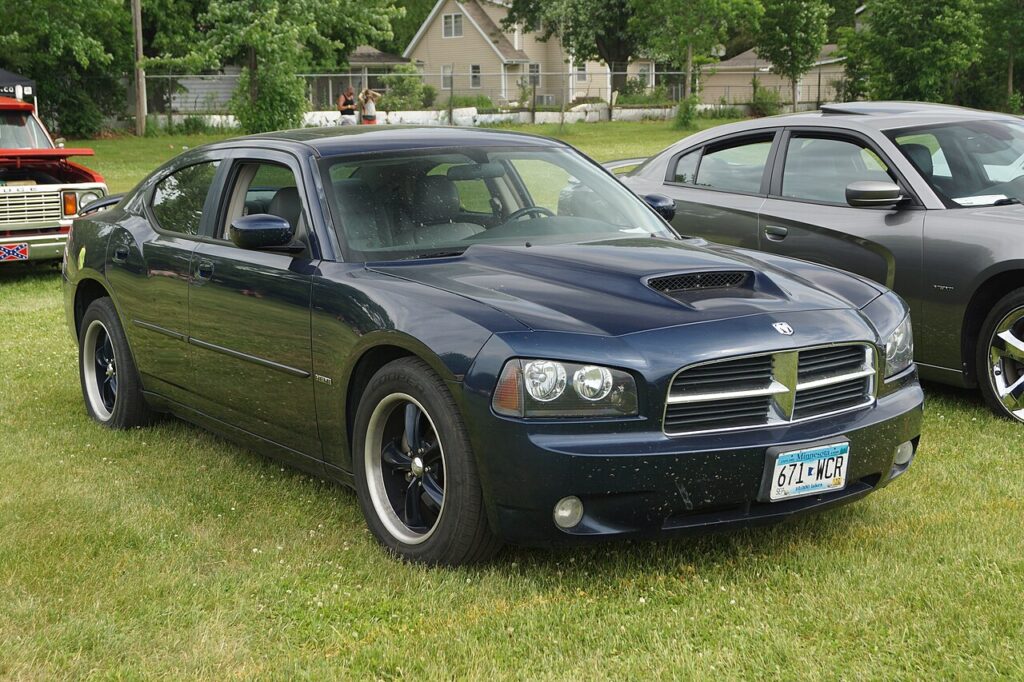
These instructions apply to the Dodge Charger Mk6 (LX) 2006-2010.
For other models, please choose your vehicle here.
The Dodge Charger (2006–2010, LX) mounts its main battery in the trunk, but provides remote jump-start terminals under the hood. Use these posts to jump-start the car safely — you don’t need to access the trunk battery. Follow the steps below to avoid sparks, ECU damage, or cable overheating.
What You Need
- Good quality jumper cables (8 AWG / 10 mm² or thicker) or a portable jump pack
- A donor vehicle with a healthy 12 V battery (engine size similar or larger), or a fully charged jump pack
- Eye protection and gloves
Find the Under-Hood Jump Points
- Positive (+) post: Under the hood, look for a red plastic cap covering the remote positive terminal.
- Engine/body ground (–): A designated ground stud or clean, unpainted metal on the engine block/strut tower. Do not use the negative post on the dead battery.

Jump-Start Procedure (with donor car)
- Park the donor vehicle close enough for cables, but not touching. Both ignitions OFF, lights and accessories off.
- Open the Charger’s hood and remove the red cap from the positive post.
- Connect cables in this exact order:
- Red clamp → Charger + remote post.
- Red clamp → donor battery +.
- Black clamp → donor battery –.
- Black clamp → Charger engine/body ground (clean unpainted metal), not the battery – post.
- Start the donor vehicle and let it idle for 2–3 minutes to pre-charge the Charger’s system.
- Attempt to start the Charger. If it doesn’t start within 10 seconds, stop, wait 30–60 seconds, and try again.
- Once started, keep both vehicles idling for 2–3 minutes.
- Disconnect in reverse order (careful of moving parts):
- Black from Charger ground.
- Black from donor –.
- Red from donor +.
- Red from Charger + post (refit the red cap).
- Let the Charger idle or drive gently for 15–20 minutes to replenish charge.
Jump-Start Procedure (with a jump pack)
- Switch the jump pack OFF. Connect red + to the Charger’s + remote post, and black – to a solid engine/body ground.
- Power the pack ON, wait a few seconds, then crank for up to 10 seconds.
- Once the engine starts, turn the pack OFF and remove the clamps (– first, then +). Replace the red cap.
Important Safety Notes
- Do not reverse polarity. Double-check clamp colors and posts before connecting.
- Keep cables clear of belts, fans, and exhaust components.
- Avoid jumping a frozen or damaged battery (bulging case, acid leak). Replace instead.
- If the Charger cranks slowly or not at all, wait a few minutes of donor idling to build surface charge, then retry.
- Frequent dead batteries indicate an underlying issue (aging battery, parasitic draw, weak alternator). Test/replace as needed.
When It Won’t Cooperate
- Clicking only: Poor clamp contact or insufficient charge. Clean clamp bite points and try again after 2–3 minutes of donor idling.
- No crank, dash resets: Extremely low battery. Pre-charge longer (5–10 minutes) or use a higher-output jump pack.
- Starts then stalls: Loose clamp during removal or low fuel/other faults. Reconnect securely and try again.
- Security/immobilizer light on: Lock/unlock with the key fob, then retry. Check that the key is recognized.
After a Successful Jump
- Let the engine idle several minutes; avoid heavy electrical loads (rear defogger, blower on high) until voltage stabilizes.
- If the battery is over 4–6 years old or repeatedly goes flat, have it load-tested and consider replacement.
- Check for loose/dirty terminals at the trunk battery and the under-hood ground points; clean and tighten as needed.
Disclaimer: This guide is for general information. Always follow safe jump-start practices and your vehicle’s official safety guidance. Perform repairs at your own risk.
Independent guide — not affiliated with Dodge. Always follow your official service manual and safety precautions. Read our full disclaimer.