These instructions apply to the Nissan Juke Mk1 (F15) 2010-2019.
For other models, please choose your vehicle here.
The Nissan Juke F15 (2010–2019) — Nissan’s first compact crossover with the famously polarising styling, built in Sunderland (UK) for European markets across pre-facelift (2010–2014) and facelift (2014–2019) variants — uses a short, time-sensitive cluster reset that’s identical across every F15 engine (1.6 HR16DE petrol, 1.6 DiG-T turbocharged petrol HRA2DDT, 1.5 dCi K9K diesel, and the 1.6 DIG-T NISMO RS performance variant). No diagnostic tool needed and no pedal sequence — but the procedure has a critical 5-second window at ignition-on that catches most people out the first time.
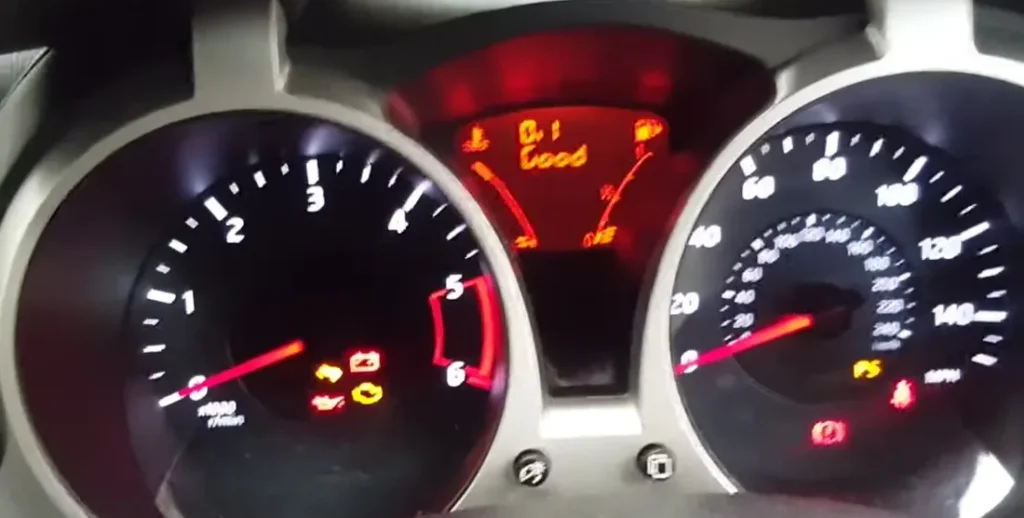
When to Reset the Service Indicator
- After completing an oil and filter change.
- If the spanner / wrench symbol with “SERVICE” or maintenance-required message appears at startup.
- If you bought the Juke second-hand and the previous owner didn’t clear the indicator.
⚠️ On the F15 Juke the service indicator tracks the oil-change distance counter. Other items (brake fluid every 2 years, coolant every 5 years / 60,000 miles, CVT fluid on Xtronic-equipped trims) aren’t tracked by the cluster — those follow the printed service schedule.
Before You Begin
- Park on a level surface with the engine off. Complete the actual oil and filter change before the reset.
- Locate button (2) on the cluster. On the F15 Juke this is the cluster-mounted multi-function button at the bottom-right of the instrument cluster face (not the steering-wheel buttons, which are for cruise control on most trims). It’s a small black button labelled with a vehicle / settings icon.
- The reset has a strict timing requirement — you have 5 seconds from ignition-on to start the hold. Be ready before you turn the key.
What You’ll Need
None for the reset itself. For the oil change: fresh Nissan-spec oil — 5W-30 ACEA C2 / Nissan Genuine 5W-30 for the 1.6 HR16DE petrol and the 1.6 DiG-T turbo, 5W-30 ACEA C3 / Renault RN0710 for the 1.5 dCi diesel (the K9K is the same engine used across the Renault-Nissan alliance, so Renault-spec oil works); a new spin-on filter (different parts for HR16, HRA2, and K9K engines); a 17 mm sump-plug socket (petrol) or 19 mm (K9K); torque about 35 Nm (petrol) or 25 Nm (K9K — the K9K plug torque is notably low, easy to over-tighten and strip).
Service Indicator Reset — Step-by-Step
- Make sure the ignition is OFF. Have your finger ready on the cluster button (2) before turning the key.
- Turn the ignition ON (key position II on key-start, or two presses of START/STOP without a foot on the brake on Smart Key trims).
- Within 5 seconds of ignition-on, press and hold button (2).
- Keep holding until the cluster display changes. The standard driver-information view switches to a settings / service view.
- The service reset display appears.
- Press button (2) again (short presses now) to cycle through the available reset displays.
- Continue pressing until “Oil Level Display” appears on the cluster.
- Once “Oil Level Display” is shown, turn the ignition OFF. The act of switching off while on this screen commits the reset.
- The system is reset.
Verify the Reset Worked
Wait 30 seconds with the ignition off, then turn it back on. The spanner / SERVICE warning at startup should be gone. Cycle through the cluster’s information screens — the service-distance readout should now show the full new interval (typically 10,000 miles / 15,000 km or 12 months for European-spec Juke petrol cars, or 12,500 miles / 20,000 km or 24 months for the 1.5 dCi diesel).
If Something Goes Wrong
- I missed the 5-second window. The most common failure on the F15 Juke. The countdown starts the moment the cluster wakes up — pressing the button at 5.5 seconds doesn’t work. Turn the ignition off, wait 10 seconds, and try again with your finger already on the button before turning the key.
- The cluster display doesn’t change after I hold the button. Three causes: (a) you pressed too late (see above); (b) the ignition is in ACC instead of full ON (on key-start, turn one more click); (c) on push-button-start Jukes, you’ve cranked the engine accidentally — press the button without a foot on the brake.
- “Oil Level Display” never appears in the cycle. The F15’s cluster has multiple display modes depending on trim level. On the basic Visia trim, the cycle is shorter (only 2-3 screens). On Tekna trims with the more comprehensive trip computer, it can be 5+ screens — press button (2) repeatedly until you’ve cycled past every option. “Oil Level Display” usually appears between the trip-computer screens and the warning-acknowledgements screen.
- Reset works but the spanner reappears after a few miles. 12V battery condition is the usual cause. The F15 Juke cluster, particularly post-2014 facelift variants with the larger driver-info display, is sensitive to voltage drops during cranking. Load-test; replace if older than 5 years.
- I drive a NISMO RS — same procedure? Yes. The Juke NISMO RS (2014–2019, 218hp tuned 1.6 DiG-T) shares the F15 cluster and the same reset procedure as standard Jukes. The shorter NISMO service interval (typically 9,000 miles for the higher-output engine) means the warning appears more frequently, but the reset is identical.
- 2014 facelift Juke — same procedure? Yes. The 2014 facelift updated the front bumper and added the colour TFT driver-info display on higher trims, but the cluster firmware and reset path are unchanged. Procedure works on every F15 from 2010 to 2019.
- Juke with Xtronic CVT — same procedure? Yes. The CVT trim adds menu entries to the trip computer for the CVT fluid temperature but doesn’t change the reset path.
Frequently Asked Questions
What does the spanner symbol on the Nissan Juke mean?
On the F15 Juke the spanner / wrench icon is the oil-change reminder. It’s a mileage timer — when the distance since the last reset reaches the configured interval, the icon illuminates at startup. The icon does not indicate an engine fault. The orange Master Warning lamp (an exclamation in a triangle, different shape) is for body-control warnings like low washer fluid or bulb-out, separate from the spanner.
How often does the F15 Juke service indicator come up?
Nissan’s official European-market schedule for the F15 Juke:
- 1.6 HR16DE petrol: 10,000 miles (15,000 km) or 12 months.
- 1.6 DiG-T turbo petrol: 9,000 miles (15,000 km) or 12 months — slightly shorter for the turbo.
- 1.5 dCi K9K diesel: 12,500 miles (20,000 km) or 24 months.
- NISMO / NISMO RS: 9,000 miles (15,000 km) or 12 months.
UK severe-service / short-trip driving typically halves the petrol interval to 5,000 miles or 6 months.
Does the reset clear engine fault codes?
No. The reset zeros the maintenance counter only. Engine fault codes are stored in the engine ECU and need a scan tool. For DTC interpretation see autodtcs.com.
What about the new Juke F16 (2019+)?
The second-generation Juke (F16, 2019 onwards) uses the new NissanConnect cluster and a menu-driven reset through the central infotainment screen: Vehicle Settings → Maintenance → Engine Oil → Reset. Different procedure — we’ll publish a dedicated F16 guide.
Is the procedure similar to the Nissan Qashqai J11?
No. The Qashqai J11 uses a multi-button menu-driven reset (Settings → Maintenance Mode → Service → Reset). The Juke F15 has a different cluster generation with the simpler “hold button → cycle → switch off on right screen” approach. See our Qashqai J11 guide for that procedure.
I have a Juke with the 1.5 dCi diesel — does the DPF need separate clearing?
The DPF (diesel particulate filter) warning on the 1.5 dCi Juke is a separate system handled by the engine ECU, not the cluster reset. Active regeneration happens automatically during motorway driving. If the DPF lamp persists despite long drives, that’s a different issue — forced regen with a scan tool, DPF cleaning, or sensor replacement.
Will resetting the indicator extend my Nissan warranty?
No. Nissan’s 3-year / 60,000-mile warranty depends on actual service work being performed with documented service-book stamps, not on what the cluster reports. The cluster reset is purely a convenience reminder for the owner.
For DTC code interpretation on Nissan vehicles see autodtcs.com.
Independent guide — not affiliated with Nissan. Always follow your official service manual and safety precautions. Read our full disclaimer.