These instructions apply to the Nissan Qashqai Mk2 (J11) 2014-2021.
For other models, please choose your vehicle here.
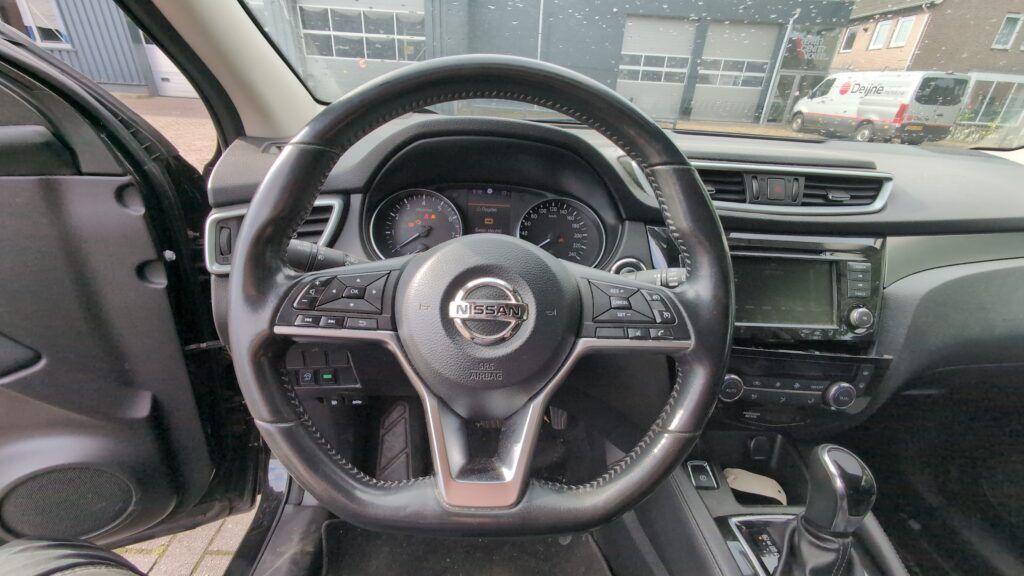
The steering angle sensor (SAS) on the second-generation Nissan Qashqai (J11 chassis, 2014–2021 — also Rogue Sport in the US) feeds wheel-position data to the ABS, VDC (Vehicle Dynamics Control), and electric power-steering (EPS) modules. After a battery disconnection, a wheel alignment, suspension work, or steering-rack replacement, the SAS often loses its reference. Symptoms include the ABS and VDC warning lamps staying on, the steering wheel feeling slightly off-centre when driving straight, and occasionally the lane-departure warning (on Tekna trim with that feature) misinterpreting lane lines. The fix is a manual lock-to-lock procedure with no scan tool needed.

Before you start
The J11’s SAS is integrated into the steering column near the electric power-steering motor. It reports an absolute angle reading over the chassis CAN bus. The ABS/VDC module cross-checks this against the lateral acceleration sensor and the wheel-speed sensors; when the readings disagree (e.g., after a battery event when the SAS lost its centre reference), the warning lamps illuminate.
- Park on level ground. A slope changes the lateral-G baseline that the VDC cross-checks against the SAS — re-zeroing on a slope sometimes leaves the system in a marginal state.
- Tyres at correct pressure. Mismatched pressures cause the car to drift slightly when driving straight, which makes the post-procedure verification drive give an unreliable centre reading.
- Wheels actually pointing straight ahead. Check visually: look at the front wheels from outside the car, and at the steering-wheel emblem (the Nissan badge should be horizontal). If the wheel is straight but the car steers off-centre, you have a tracking / alignment problem — get a four-wheel alignment before doing the SAS re-zero.
- Smooth, slow steering inputs during the procedure. Jerky sweeps confuse the encoder; aim for about 3 seconds per direction from straight to full lock.
Tools required
None for the standard manual procedure. Optional:
- CONSULT III+ or a Nissan-aware aftermarket scan tool (Carista with the Nissan subscription, or compatible OBD-II tool with chassis-module support) — only needed if the manual procedure refuses to take after multiple attempts, or if the ABS module has logged a “SAS calibration required” code.
When this procedure is needed
- After disconnecting or replacing the 12-volt battery.
- After a wheel alignment / four-wheel tracking adjustment.
- After replacing the steering rack, the EPS motor, or any column component.
- After suspension repairs that involve removing or adjusting the steering linkage.
- When ABS, VDC, or EPS warning lamps remain illuminated and a scan reads “SAS not centered” or “SAS calibration required”.
Re-initialization procedure
- Park on level ground with the wheels visibly pointing straight ahead.
- Start the engine and let it idle. The Qashqai’s EPS module needs alternator voltage above approximately 13 V to enter calibration-ready state — ignition-only doesn’t satisfy the gate on this car. Wait until the dashboard has finished its self-test (5 seconds) and the EPS warning lamp has extinguished.
- Slowly turn the steering wheel fully to the left stop. Don’t rush — the encoder needs to count smoothly. Aim for about 3 seconds from straight to full lock. Don’t bump the stop hard; gentle approach.
- Slowly turn the steering wheel fully to the right stop. Same speed.
- Return the steering wheel to the centre position. Don’t overshoot in either direction during the return.
- Switch the ignition OFF by pressing the START button. The calibration is committed during the shutdown sequence.
- The SAS re-initialization is now complete.
- Verify with a short drive: 200 m of straight-line driving above 30 km/h, then a few gentle turns. The ABS and VDC warning lamps should remain off.
How to verify it has worked
- ABS, VDC, and EPS warning lamps are not illuminated on the next start.
- The steering wheel sits straight when driving straight on a level road (no drift correction needed).
- VDC intervenes correctly on a low-grip surface — try gentle acceleration on wet tarmac; the dash icon should flash briefly to indicate intervention.
- Lane-keep / lane-departure warning (on Tekna trim with this feature) interprets lane lines correctly during a test on a marked road.
- If you have a scan tool, SAS live data should read 0° ± 2° when the wheel is straight.
When It Won’t Cooperate
ABS / VDC warning lamps remain on after the procedure. The module has logged a stored fault code that won’t clear via manual re-zero. Read with a Nissan-aware scan tool. The typical pattern is “implausible SAS signal” (the SAS reading disagreed with the wheel-speed-derived yaw rate during the verification drive) which clears once the manual re-zero settles. Sometimes a scan-tool clear is needed in addition to the manual procedure.
Steering pulls to one side after the procedure. Not an SAS issue. The SAS only records the wheel position; if the front wheels are out of alignment, the car still pulls. Get a four-wheel alignment.
ABS / VDC warning flashes intermittently on cornering. The SAS is reporting an angle that doesn’t match what the yaw sensor expects. Most common on high-mileage J11s: the SAS itself is failing (rare but possible). A scan tool will identify whether the SAS or the yaw sensor is at fault.
Warning lights clear briefly then return after 10 minutes of driving. The dynamic verification has failed — the SAS reading isn’t matching the wheel-speed-derived yaw rate during normal driving. This usually points to a tracking problem (the wheels aren’t actually straight when the steering wheel is centred). Get an alignment check.
Manual procedure doesn’t take — re-zero seems to do nothing. On some 2017+ facelift J11 cars with the upgraded ABS module, a scan-tool-initiated calibration is needed in addition to the lock-to-lock sweep. CONSULT III+ has a dedicated “SAS Calibration” function under the chassis module.
Frequently asked questions
Does this procedure work on the Rogue Sport (US-market J11)?
Yes — Qashqai J11 and Rogue Sport are the same car. SAS hardware and the manual re-zero procedure are identical.
Why does the Qashqai need the engine running when older Nissans didn’t?
The J11’s EPS module won’t enter calibration mode without confirmed alternator voltage above 13 V. Older Nissans (Note E12, Pulsar C13) with hydraulic-assist steering didn’t have this gate. The shift to all-electric steering moved the calibration gate upstream.
Will this procedure clear the “Around-View Monitor” warning on Tekna trim?
No. AVM has its own calibration that requires a scan tool (CONSULT III+) and a specific target setup in the workshop. The SAS re-zero won’t affect it.
How often will I need to do this?
Only after specific events: battery disconnect, suspension work, alignment, or replacing the SAS itself. A normal J11 in normal use never needs the manual re-zero.
Can I do this procedure with the engine cold?
Yes — engine temperature doesn’t affect the SAS reading or the EPS calibration gate. The engine just needs to be running so the alternator is at output voltage.
Related: Qashqai J11 battery disconnect and reconnect. For ABS / VDC / EPS diagnostic trouble codes that won’t clear after the manual procedure, see autodtcs.com.
Independent guide — not affiliated with Nissan. Always follow your official service manual and safety precautions. Read our full disclaimer.