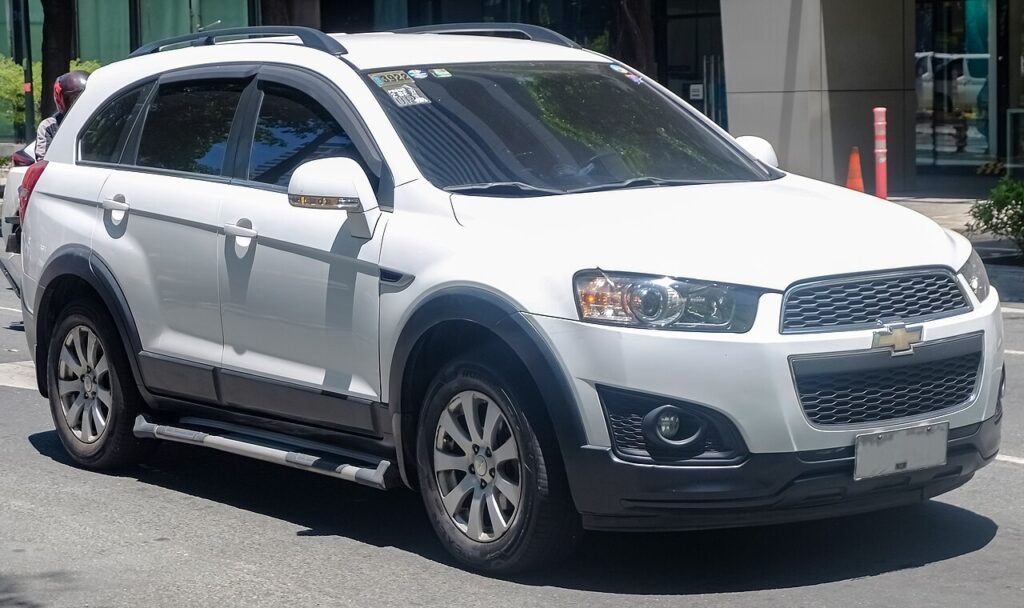
These instructions apply to the Chevrolet Captiva (C140) 2011-2018.
For other models, please choose your vehicle here.
If the remote for your Chevrolet Captiva (C140, 2011–2018) only locks the car from arm’s length, needs several presses to respond, or has stopped working altogether, the cause is almost always the little coin cell inside the key rather than anything wrong with the car. The facelifted C140 Captiva is fitted with a folding “flip” remote — the type where a metal blade springs out of a plastic head at the press of a chrome button — and the transmitter, buttons and blade all share one small housing that pops apart in a minute or two. Here is exactly which battery it takes, how to open the flip key without cracking it, and why cutting or coding a brand-new key is the one part of this job you can’t finish at home.
How to Tell the Fob Battery Is Dying
- Shrinking range. You find yourself standing right beside the Captiva — or holding the fob up against the door — before it will lock or unlock. A steadily falling range is the classic first warning.
- The buttons need several presses. A cell that still has a little life left will work intermittently, firing on the second or third press before it gives up entirely.
- Weak or missing LED. The small indicator light on the remote dims or stops flashing on a button press once the voltage drops — a quick way to confirm the fob, not the receiver, is at fault.
- Worse in the cold. A near-flat lithium cell struggles at low temperature, so the remote often plays up on frosty mornings and seems to recover once the day warms up.
A coin cell in a Captiva remote typically lasts two to four years. If yours is around that age and showing any of these signs, fit a fresh cell before you start suspecting the immobiliser or the car’s receiver.
The Battery You Need
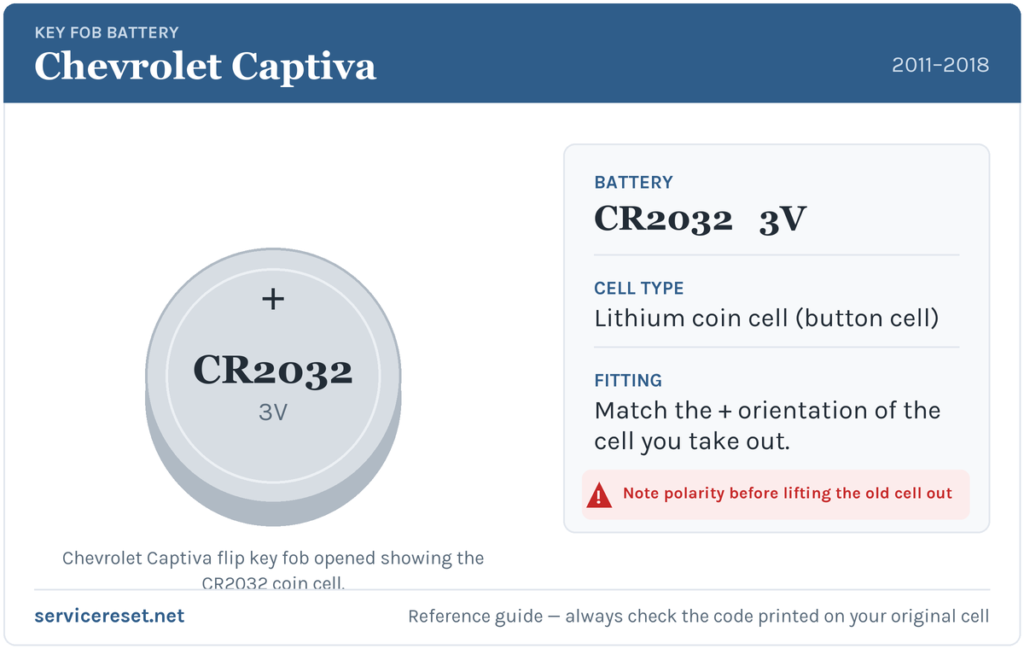
The C140 Captiva flip remote uses a single CR2032 — a 3-volt lithium coin cell about 20 mm across, and the most common fob battery there is. You’ll find it in any supermarket, hardware shop or petrol station. Buy a good-quality branded cell: cheap coin cells sag under the brief burst of current the transmitter draws and can give poor range even when they read as “new” on a meter. One battery does the whole job — there’s nothing else to buy.
How to Change the Battery — Flip Remote
- Flip the blade out. Press the chrome release button on the head of the key so the metal blade springs open. Holding the blade extended relaxes the internal catch and makes the cover far easier to lift.
- Open the housing. Slip a small flat-blade screwdriver — or a thin coin — into the seam between the two halves of the plastic head, near the blade hinge, and twist gently to pop the back cover off. The C140 remote clips together rather than using a screw, so you’re just releasing plastic tabs; work slowly around the seam so you don’t snap one.
- Note how the old cell sits, then lift it out. Before you disturb anything, look at which face of the coin cell — the flat “+” side or the rimmed side — is pointing up at you. Ease the old cell out from under its retaining clip with a fingernail or the tip of the screwdriver, trying not to touch the circuit board.
- Fit the new CR2032 the same way round. Drop the fresh cell in so it sits exactly as the old one did, then press it down until it’s firmly under the clip against clean contacts. Handle it by the edges — skin oil on the faces can weaken the connection.
- Click it back together. Line up the two halves and squeeze until every tab snaps home, then fold the blade back in. Test all the buttons before you walk away.
⚠️ Get the polarity right. Published guides for Chevrolet flip keys disagree on whether the cell faces positive-up or positive-down, because it varies with the exact housing — so don’t rely on a rule of thumb. Copy the orientation of the cell you removed. A coin cell fitted the wrong way round won’t power the transmitter and can slowly discharge, leaving you thinking the “new” battery is faulty.
Confirm It Worked
Stand back a few metres and lock, then unlock, the Captiva. Full range should return straight away and the indicator LED should flash cleanly on each press. If it works right next to the car but not from a distance, the cell is probably in the wrong way round or not seated firmly — open it back up and check.
If a Fresh Cell Doesn’t Fix It
- Re-check the orientation and seating. An upside-down or loose cell is by far the most common reason a “new” battery does nothing. Make sure it’s the right way up and clipped down tight.
- Clean the contacts. Wipe the terminals and both faces of the cell with a dry cloth — a smear of grease or light corrosion is enough to cause dropouts.
- Confirm the cell is good. A brand-new CR2032 from a long-stored multipack can be flat; if you have a meter it should read close to 3 volts.
- Rule out the car’s own battery. If the Captiva is slow to wake or the fault appeared right after a jump-start or flat-battery episode, a tired 12 V vehicle battery can mimic key faults — check that before condemning the fob.
New Key or Spare — Why It’s a Dealer Job
Swapping the coin cell doesn’t touch the fob’s coding, so the remote keeps working the instant the new battery is in — there’s nothing to reprogram. Adding a spare or replacing a lost key is a different matter: the Captiva’s immobiliser has to be accessed with diagnostic equipment, the blade cut to the car’s lock code, and a blank remote ordered against the VIN and then paired to the car — a job for a Chevrolet dealer or an auto-locksmith. Keep the battery in your spare key fresh too, so you’re never down to a single working remote.
Frequently Asked Questions
What battery does a Chevrolet Captiva key fob take?
A single CR2032 3-volt lithium coin cell. It’s the standard size for the C140 Captiva’s folding flip remote and is sold almost everywhere.
Which way up does the battery go?
Match the cell you removed. Guides for Chevrolet flip keys quote both positive-up and positive-down depending on the housing, so the reliable method is to note the old cell’s orientation before you take it out and fit the new one identically.
Does the Captiva key need a screw to open?
No. The flip remote clips together. Flip the blade out, then gently prise the two halves of the plastic head apart at the seam near the hinge with a small flat tool — there’s no screw to undo.
Do I have to reprogram the remote after changing the battery?
No. A battery swap leaves the coding untouched, so the fob works immediately. Only a brand-new or replacement key needs pairing to the car.
How long should a Captiva key battery last?
Usually two to four years. Frequent locking and unlocking, or a fob that lives right next to the car and gets woken constantly, will shorten that.
Can I still drive the Captiva if the fob is completely dead?
Yes. Use the metal blade folded inside the remote to unlock the driver’s door manually, then start the car with the key in the ignition as normal. A flat fob battery stops the remote buttons working but doesn’t immobilise the car.
If your remote died suddenly rather than fading — especially just after the 12 V battery was disconnected or went flat — the trigger may be a stored electrical fault rather than the coin cell; you can look up what a logged code means on autodtcs.com.
Independent guide — not affiliated with Chevrolet. Always follow your official service manual and safety precautions. Read our full disclaimer.