These instructions apply to the NIO EL7 (2022-2024).
For other models, please choose your vehicle here.
If the tyre-pressure warning has come on in your NIO EL7 (2022–2024) after you’ve adjusted the pressures or changed a wheel, the system relearns by driving — there’s no button to press. Here’s how it works.
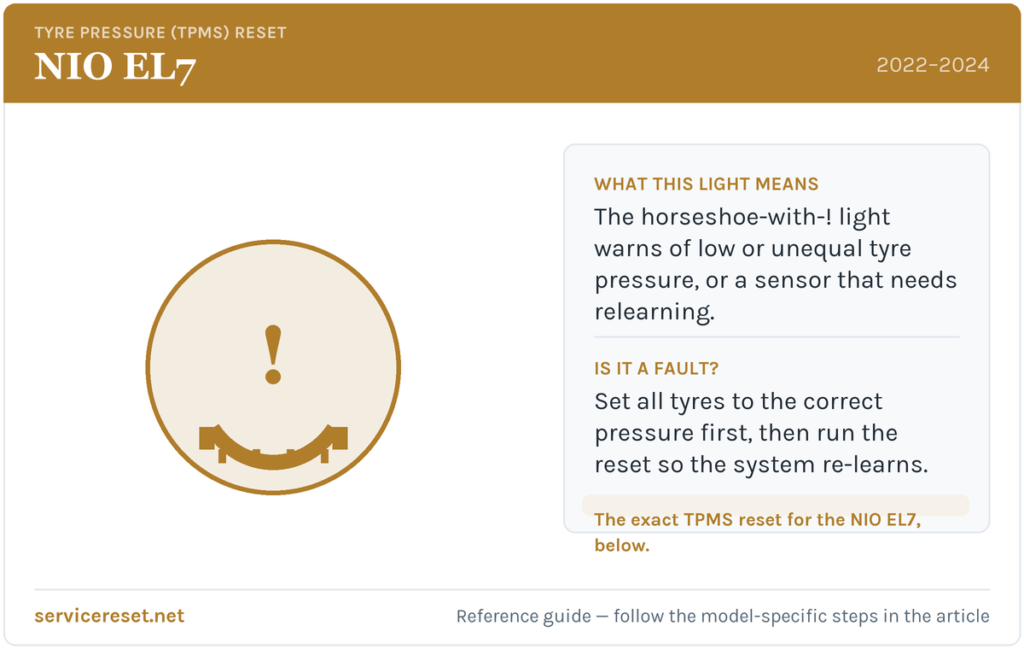
On this electric SUV the amber tyre symbol is an alert, not a fault warning: it means the system has seen a pressure fall below its stored reference — usually a genuinely soft tyre, sometimes just a cold morning or a recent wheel change. It is doing its job. Once the real cause is dealt with and the car has read the corrected pressures, the light goes out on its own.
How the TPMS Works on the EL7
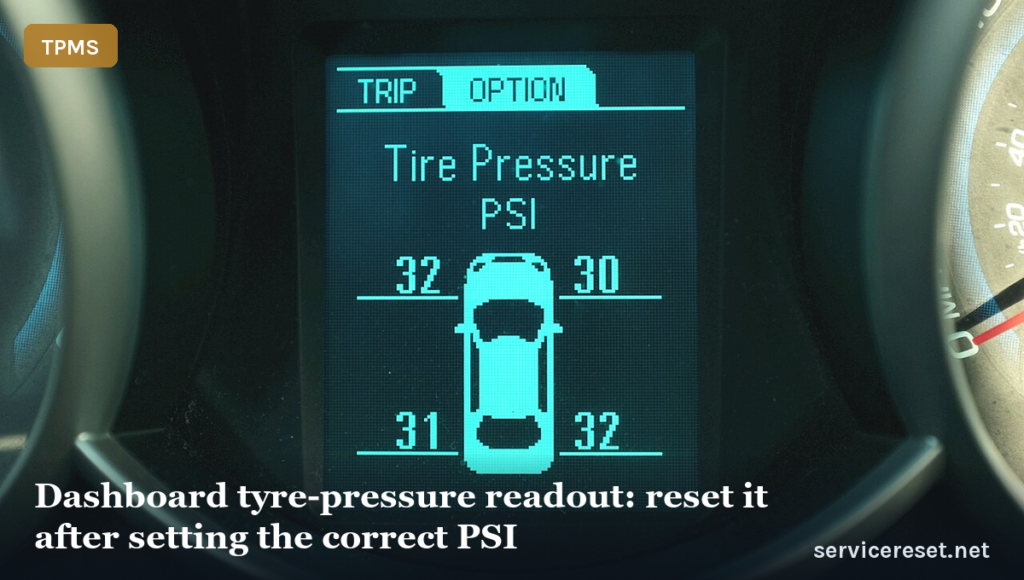
The EL7 uses a direct system: each wheel has its own pressure sensor, which is why you can see a live figure for every corner on the central touchscreen. Because the readings come from inside the wheels rather than from wheel-speed comparisons, there is no separate “reset” needed for everyday driving — the car simply relearns the correct baseline as the sensors report the new, corrected pressures on the move.
Before You Begin
- Check pressures cold — before driving, or after the car has stood a few hours.
- Set every tyre to the figure on the driver’s door-pillar label (it may list a higher “full load” value for a laden SUV).
- Don’t forget the tyre that triggered the alert — a single soft corner keeps the warning lit.
- Have the touchscreen tyre-pressure page open so you can watch the live values.
- Refit and hand-tighten every valve cap to keep the sensor valves clean and sealed.
When It Relearns
- After checking or adjusting the tyre pressures.
- After changing one or more wheels or tyres.
Completing the Procedure
- Park level and set all four tyres to the correct cold pressures.
- Drive the vehicle for about 10 minutes at over 25 km/h (15 mph).
- The warning clears once the system has read the corrected pressures (you can watch live pressures on the touchscreen).
If the Warning Stays On
- Recheck every tyre with a known-good gauge. One corner a few psi low is enough to keep the light on.
- Finish the learn drive. A couple of minutes of stop-start traffic may not let the sensors report — keep going for the full ten.
- Check the spare or space-saver if you’ve just fitted it — it may not carry a sensor, or may need its own pressure set.
- Rule out a slow puncture. If one tyre keeps dropping over a day or two, the alert is correct — inspect for a nail or a leaking valve.
- Cold snap? Pressures fall roughly 1 psi per 5 °C. Top up to the label figure when the tyres are cold.
- After a wheel swap the sensor positions can take a short drive to re-sort — the live readings on screen confirm when each corner is reporting again.
- Still lit with everything correct? A sensor battery is sealed inside the unit and lasts years, but eventually fails; a stored fault code points to which one.
After the Reset
Once the sensors have reported the corrected pressures, the amber symbol goes out and stays off for the rest of the journey and beyond. The live per-corner readings on the touchscreen are the quickest confirmation that everything is being monitored. If the light returns after a day or so, treat it as a real low-pressure warning rather than a glitch and look for a slow leak.
Frequently Asked Questions
How do I reset the tyre pressure light on a NIO EL7?
There is nothing to press. Set all four tyres to the correct cold pressures, then drive for about ten minutes at over 25 km/h. The direct sensors report the corrected values as you go and the warning clears itself. You can watch each corner update live on the central touchscreen.
Is there a reset button?
No — the EL7 relearns automatically as you drive, so there is no menu item or physical button to hold. The only action you take is setting the pressures correctly first; the car handles the rest during the next short drive.
Do I need a tool?
Not for a normal relearn after inflating or a wheel change — a short drive is all it takes. A workshop tool is only needed when brand-new pressure sensors are fitted and have to be registered to the car, which is not something you do for a routine top-up.
How long is the learn drive?
About ten minutes of steady driving above 25 km/h (15 mph) is usually enough. Continuous road speed works better than crawling in traffic, because the sensors need to transmit while the wheels are turning. If it hasn’t cleared, a slightly longer run normally finishes the job.
Why did the light come on when it’s cold?
Tyre pressure falls as temperature drops, so a cold night can push a correctly set tyre just under the threshold. Check and top up to the door-pillar figure while the tyres are cold, then drive briefly. If it only appears on cold mornings and settles, low pressure from the temperature is the likely cause.
The light stayed on after I changed a wheel — is that normal?
Briefly, yes. After a wheel or tyre change the system needs a short drive to read the new pressures, and if a fitted spare has no sensor the car flags it. Set the pressures, drive for ten minutes, and confirm each corner is reporting on the touchscreen. If one corner never appears, that sensor may need attention.
If the warning came on alongside other alerts, or a fault code is stored, decode it on autodtcs.com.
Independent guide — not affiliated with NIO. Always follow your official service manual and safety precautions. Read our full disclaimer.