These instructions apply to the Renault Clio Mk5 (XJA) 2019-Present.
For other models, please choose your vehicle here.
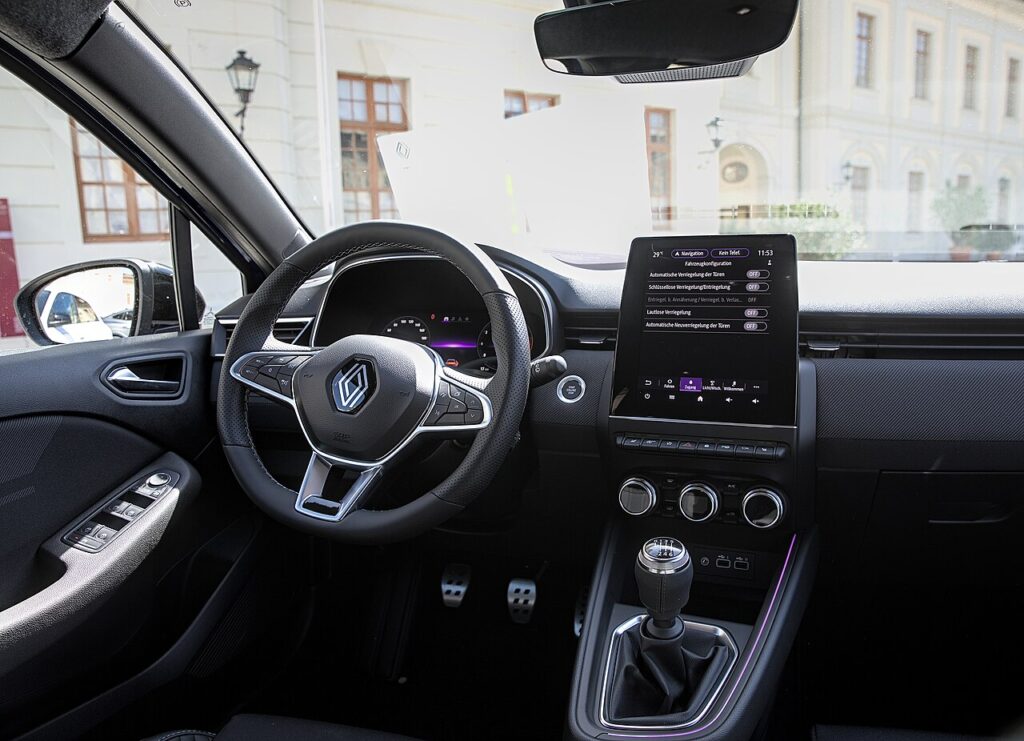
Renault Clio (Mk5, 2019–Present) uses Renault’s hands-free keycard with push-button start across the range, so there is no dashboard card slot to drop the card into. That changes how you start the car when the card battery dies. The card’s starting chip is passive and needs no battery of its own, so even a completely flat card will still start the engine, you just have to present it to the START button by hand instead of letting the car detect it from your pocket.
The usual warning is a “Keycard battery low” message in the driver display. It often appears well before the card stops working, so use it as a prompt to fit a new cell.
Starting the Clio Mk5 with a dead keycard
The Mk5 has no card slot, so the procedure is to hold the card against the START button.
- Get into the car using the emergency key (see below) if the remote will not unlock the doors.
- Sit in the driver’s seat with the keycard in hand.
- Press the brake pedal fully and hold it.
- Hold the keycard flat against the START/STOP button so the card touches it directly.
- Press the START button. The car’s antenna powers the card chip and the engine starts.
- Leave the engine running until you have fitted a fresh battery, because the car may not detect the card to restart it.
Unlocking the door with the emergency key
When the card battery is flat the remote buttons stop working, so use the integrated metal key.
- Slide the small catch on the keycard and pull out the emergency key blade.
- On the Clio Mk5 the emergency lock is on the front passenger door, hidden under a cap on the rear edge of the handle.
- Pop the cap off to reveal the lock barrel.
- Insert the blade and turn to unlock. This can trigger the alarm, which stops once you start the car with the card.
- Slide the blade back into the card before driving.
How the keycard transponder works
The keycard holds a battery-powered radio for the remote lock and unlock buttons, plus a separate transponder chip that needs no battery. When you hold the card on the START button, the car’s antenna emits a short-range field that powers that chip and reads its security code. That is why a dead card still starts the Clio but can no longer lock or unlock it remotely.
Replacing the keycard battery
The Clio Mk5 card uses a single CR2032 3V coin cell.
- Pull out the emergency key blade to release the card cover.
- Unclip the back cover at the tab to reach the battery.
- Remove the old CR2032 and fit the new cell with the polarity shown on the cover.
- Refit the cover and push the blade back in.
- Stand by the car and press a card button four times to re-sync it. The warning clears at the next engine start.
Frequently Asked Questions
The Clio Mk5 has no card slot, so how do I start it? Hold the card flat against the START/STOP button with your foot on the brake, then press the button. The car powers the card chip through the button.
Can the emergency key start the engine? No. The blade only unlocks the door. The card must be at the START button for the immobiliser to allow starting.
Which battery does the Clio Mk5 keycard use? A CR2032 3V lithium coin cell.
Where is the emergency lock on the Mk5? On the front passenger door, under a small cap on the rear edge of the door handle.
Will I be able to restart after switching off? If the card is truly dead, present it to the START button again. To avoid hassle, fit a new CR2032 before turning the engine off.
If a warning light or stored fault code appears after the keycard goes flat, you can decode it on autodtcs.com.
Independent guide — not affiliated with Renault. Always follow your official service manual and safety precautions. Read our full disclaimer.