These instructions apply to the Suzuki Vitara Mk4 (LY) 2015-2024.
For other models, please choose your vehicle here.
The Suzuki Vitara (Mk4/LY, 2015–2024) uses Suzuki’s keyless smart entry with a START/STOP button on SZ5 and Keyless trims, while lower SZ4 trims have a remote flip key turned in an ignition barrel. When the smart fob’s coin cell dies, the remote-lock and proximity functions stop, but the immobiliser still recognises the key — on push-button cars by holding the fob against the start switch, on flip-key cars via the blade in the barrel.
Start a keyless Vitara Mk4 with a dead fob
If your Vitara has the START/STOP button:
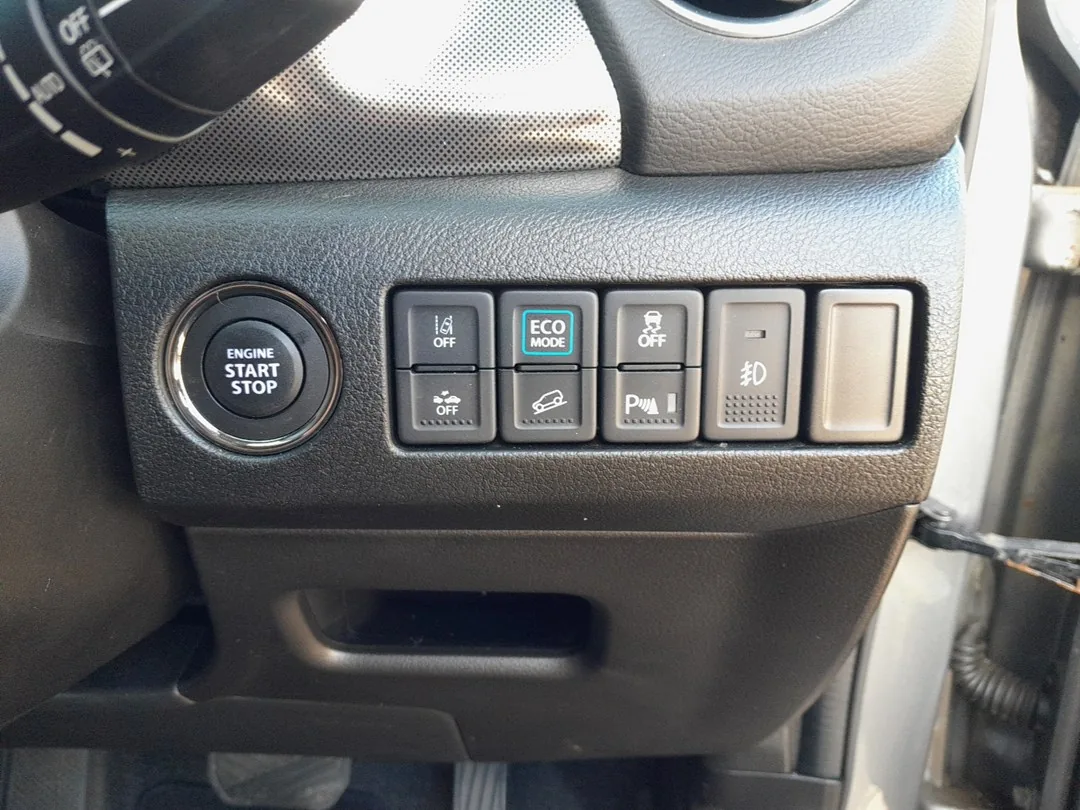
- Unlock and enter the car with the emergency blade first (next section), then sit in the driver’s seat and pull the door shut.
- Press and hold the brake pedal with the selector in N (manual) or P (auto).
- Hold the flat back of the smart fob directly against the START/STOP button — the button has a short-range coil that reads the fob when its battery is too weak to broadcast.
- Keeping the fob pressed to the button, push the START/STOP button. The engine starts.
- If nothing happens, reposition the fob flush against the button and repeat — a nearly-flat cell needs the fob touching the switch.
Turn-key Vitara Mk4 — the blade starts it
On an SZ4 with a conventional ignition barrel, a flat fob disables only the remote buttons. Pull the blade from the flip key, unlock the driver’s door, slide the key into the barrel and start as normal. The transponder in the key head is energised by the barrel, so a dead coin cell does not prevent starting.
Unlock the Vitara Mk4 with the emergency key blade
- On the smart fob, slide the release catch on the back and pull the metal blade out of the body.
- At the driver’s door, insert the blade into the lock barrel in the handle and turn to unlock.
- The alarm may chirp until the engine is started; running the car clears it.
Immobiliser note
The Vitara’s immobiliser checks a passive RFID transponder in the key rather than the fob battery. On a keyless car the back-up reader sits in the START/STOP button; on a turn-key car the ring around the barrel reads the chip. The car powers the reader, so the engine authorises even with a fully dead fob. If a key or immobiliser light stays on after starting, treat it as a genuine fault, not just a flat cell.
Replace the fob battery
The Vitara Mk4 smart fob uses one CR2032 3V lithium coin cell. Slide out the emergency blade, then separate the case halves at the seam left behind — a coin or thin flat screwdriver in the slot pops them apart. Fit the new cell + side up, click the case shut and refit the blade. Remote functions return immediately.
Frequently Asked Questions
Does my Vitara Mk4 have keyless start?
SZ5 and Keyless trims do, with a START/STOP button. SZ4 cars use a flip key in an ignition barrel and just need the blade.
Where do I hold the fob to start a keyless Vitara?
Directly against the START/STOP button. There is no separate slot or column reader on this generation; the back-up coil is in the button.
Does the AllGrip 4×4 Vitara use the same method?
Yes. AllGrip changes the driveline, not the key system, so the dead-fob start is identical — hold the fob to the button and press while on the brake.
Which battery does the Vitara Mk4 fob take?
One CR2032 coin cell, widely available at supermarkets and hardware shops.
Why did the alarm sound when I used the blade?
Mechanical entry registers as a possible break-in until the transponder is read. Starting the engine cancels the alarm.
If a dashboard warning light stayed on after the no-start, look it up on autodtcs.com to confirm it was just the fob and not an immobiliser code.
Independent guide — not affiliated with Suzuki. Always follow your official service manual and safety precautions. Read our full disclaimer.