These instructions apply to the Ford Kuga Mk3 (CX482) 2020-Present.
For other models, please choose your vehicle here.
The Ford Kuga (Mk3, 2020–present) includes the same owner-accessible instrument cluster Self-Diagnostic Mode found across modern Fords, sometimes called engineering test mode. On this generation, with its large digital cluster, you open it using the steering-wheel OK button and the ignition — no diagnostic tool — for a gauge sweep, display check, live engine data and stored cluster fault codes.
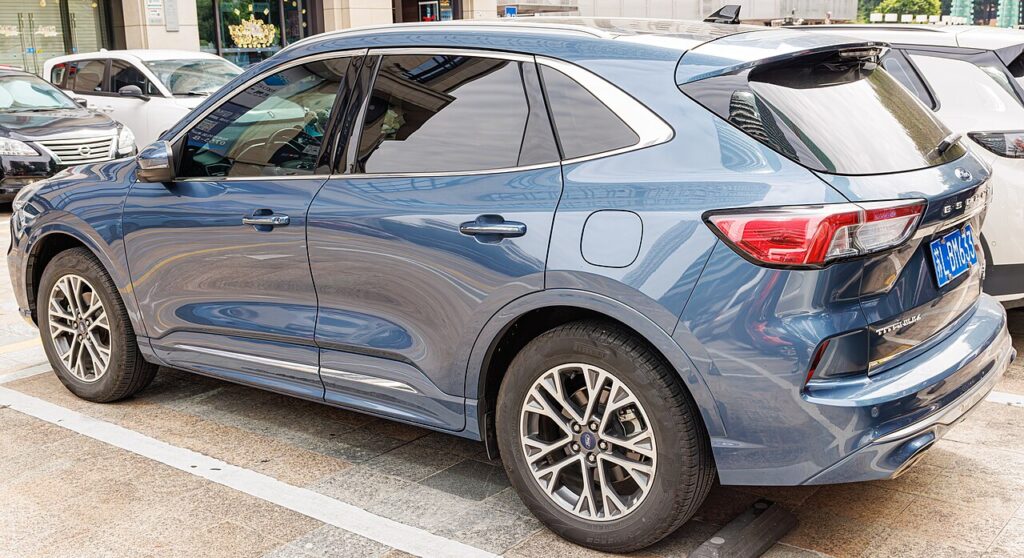
What the self-test is and what it shows
This hidden routine puts the Kuga’s cluster into a self-check sequence: a needle/gauge sweep, an LCD test that exercises the display, and a warning-lamp check. It then steps through diagnostic and live-data screens covering:
- Road speed and engine speed (RPM)
- Engine coolant temperature as a numeric value
- Battery voltage measured at the cluster
- Fuel level and fuel flow
- Stored cluster Diagnostic Trouble Codes (DTCs)
It is the cluster reporting on itself and the sensors feeding it — a quick, free first check before booking diagnostics, and a good way to confirm the digital cluster’s own health.
How to enter the hidden diagnostic menu
- Sit in the driver’s seat with the doors closed and the ignition fully OFF.
- Press and hold the OK button on the steering-wheel control cluster.
- While holding OK, switch the ignition from position 0 to position II (ON). On the keyless Kuga, press START once without pressing the brake so accessories power up only — do not start the engine.
- Keep OK held, letting the welcome / seatbelt screen pass, until TEST appears.
- Release OK once TEST is shown.
Reading the gauges, voltage and codes
Use the steering-wheel OK and arrow buttons to step through and skip tests. Start with the gauge sweep, LCD test and warning-lamp check — a missing element or unlit lamp points to a cluster hardware fault rather than a sensor. Continue to the live-data screens for road speed, RPM, coolant temperature, fuel flow and battery voltage. With the engine off, a healthy 12 V battery reads around 12.4–12.7 V; the Kuga mild-hybrid and PHEV variants also rely on this auxiliary battery, so a low reading here is worth investigating. The DTC screen lists any stored cluster codes; note them before exiting.
How to exit
Turn the ignition to OFF to leave Self-Diagnostic Mode. The cluster returns to normal at the next start and nothing you viewed has been altered.
Frequently Asked Questions
Does it work on the Kuga hybrid and plug-in hybrid? Yes. The Self-Diagnostic Mode reports on the instrument cluster and its 12 V auxiliary system, so the same OK-button entry applies regardless of the hybrid drivetrain.
The screen shows a welcome graphic first — should I let go? No, keep OK held through the welcome and seatbelt screens. TEST appears after they clear; release only then.
Will this reset the service indicator? No. The self-test only reads and displays data; the service reminder and trip meters are untouched.
Are these the same as a check-engine scan? Not exactly — they are cluster-level codes. If a powertrain warning lamp is lit, follow up with a full OBD-II scan of the engine ECU.
Why won’t TEST appear at all? The usual cause is the engine being started instead of stopping at position II, or releasing OK before TEST shows. Power up accessories only and keep OK held until TEST appears.
To decode any cluster trouble codes you record and gauge how serious they are, visit autodtcs.com.
Independent guide — not affiliated with Ford. Always follow your official service manual and safety precautions. Read our full disclaimer.