Hyundai’s EcoShift dual-clutch transmission (DCT) is a dry-clutch automated gearbox used across much of the range — the i20, i30, Kona, Tucson and Veloster among others. It shifts for you like an automatic, but because it uses real clutches rather than a torque converter it behaves differently and shows its own warning messages. This guide explains those messages and the normal DCT quirks owners ask about, based on Hyundai’s own DCT information.
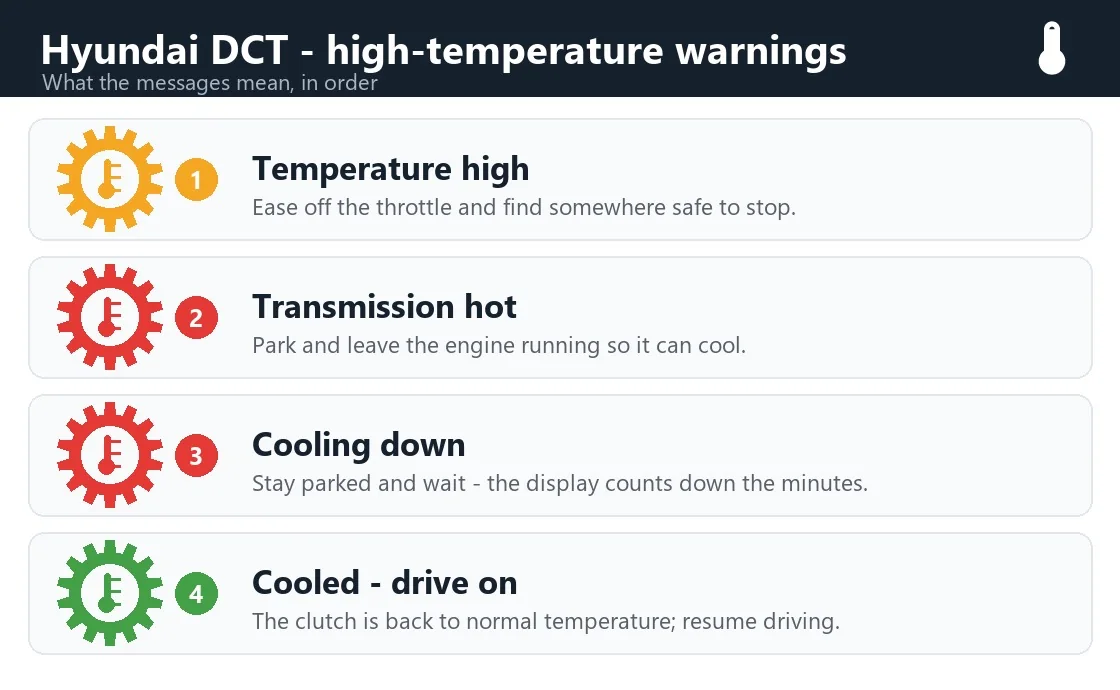
The DCT high-temperature (overheating) warning messages
Under hard use — repeated launches on steep grades, or holding the car still on a hill with the accelerator — the dry clutch can overheat. A protection mode then engages: a message appears on the cluster with a chime, and shifting may not feel smooth.
The messages appear in this order as the clutch heats up and then cools:
- “Transmission temp. is high! Stop safely” (amber) — the early warning. Ease off and find somewhere to stop.
- “Trans Hot! Park with engine on” (red) — stop, park, and leave the engine running.
- “Trans Cooling. Remain parked for XX min.” (red) — wait with the engine running while it cools; the display counts down.
- “Trans cooled. Resume driving” — the clutch is back to normal temperature and you can drive on.
The key point is to leave the engine running while it cools — the transmission cooling works with the engine on. Do not switch off and walk away. When you leave the car idling to cool, put it in Park with the parking brake on, and be mindful of local rules on idling and of leaving a running car unattended.
Ignoring the warnings can disable the clutch until it cools, and repeated overheating can damage the transmission, so treat the amber message as your cue to stop rather than pushing on to the red one. If the warnings keep appearing in normal driving, or the car drops into a reduced-power “limp” mode, have the transmission checked — Hyundai has also released software updates that improve DCT heat handling and low-speed smoothness on some models and model years.
Is the clicking or ticking noise normal?
Yes. When you turn the engine on or off you may hear light clicking sounds as the DCT runs a self-test and sets its clutches. This is a normal part of how the transmission works and is not a fault.
Why does it feel juddery or jerky at low speed?
The dry clutch transfers torque directly, which gives a more connected feel than a conventional automatic with a torque converter. It is most noticeable when pulling away from a stop or crawling at low speed, where a torque-converter automatic would creep smoothly. A little hesitation, a slight judder or a firmer take-up pulling away is normal DCT behavior, not a problem.
How to hold the car on a hill
Hold the car on a hill with the foot brake or the parking brake — never by balancing it on the accelerator. “Riding” the accelerator to stay still slips the dry clutch against the engine, which is exactly what overheats it and can damage the transmission. When the road is steep, cover the brake, not the throttle.
Which Hyundais have the DCT?
The EcoShift dual-clutch gearbox is the dry-clutch EcoShift unit fitted to turbocharged petrol Hyundais — typically the 1.0 and 1.6 T-GDI engines in the i20, i30, Kona, Tucson, i40, Ioniq and Veloster. (Some larger or higher-performance models use a different wet-clutch DCT, which is not the dry EcoShift described here.) The warnings and behavior above apply to all of them; always check your own owner’s manual for model-specific detail.
Frequently asked questions
What does DCT mean on a Hyundai?
DCT stands for dual-clutch transmission — an automated gearbox that shifts for you using two clutches instead of a torque converter. Hyundai brands its version EcoShift; the smaller turbo-petrol cars use a dry-clutch DCT, which is the one this guide covers.
What does “Trans Hot! Park with engine on” mean?
The dual-clutch has overheated and entered protection mode. Stop somewhere safe, park, and leave the engine running so the transmission can cool — the display will tell you when it is ready again.
Why leave the engine running when the DCT is hot?
The transmission’s cooling works while the engine runs. Switching off stops the cooling, so the clutch takes much longer to recover. Keep it running until the “Trans cooled” message appears.
Is the DCT clicking sound a problem?
No. Clicking when you start or switch off is the DCT’s normal self-test. It only needs attention if it is accompanied by a warning message or a clear change in how the car drives.
Why is my Hyundai DCT jerky pulling away?
A dry dual-clutch takes up drive more directly than a torque converter, so low-speed manoeuvres can feel firmer or slightly hesitant. It is a characteristic of the gearbox; persistent harsh jerking or a warning light, though, is worth having checked.
Can I hold the car on a hill with the accelerator?
No — that overheats the clutch. Use the foot brake or parking brake to hold still on a slope.
