These instructions apply to the Honda Jazz Mk4 (GR) 2020-Present.
For other models, please choose your vehicle here.
The Honda Jazz (Mk4/GR, 2020–Present) is a keyless car — sold in Europe only as the e:HEV hybrid, it has Smart Entry and a red push-button start as standard. When the fob’s coin cell dies you lose remote locking and the dash flags a low-key warning, but the car has a built-in fallback that gets you driving in seconds.
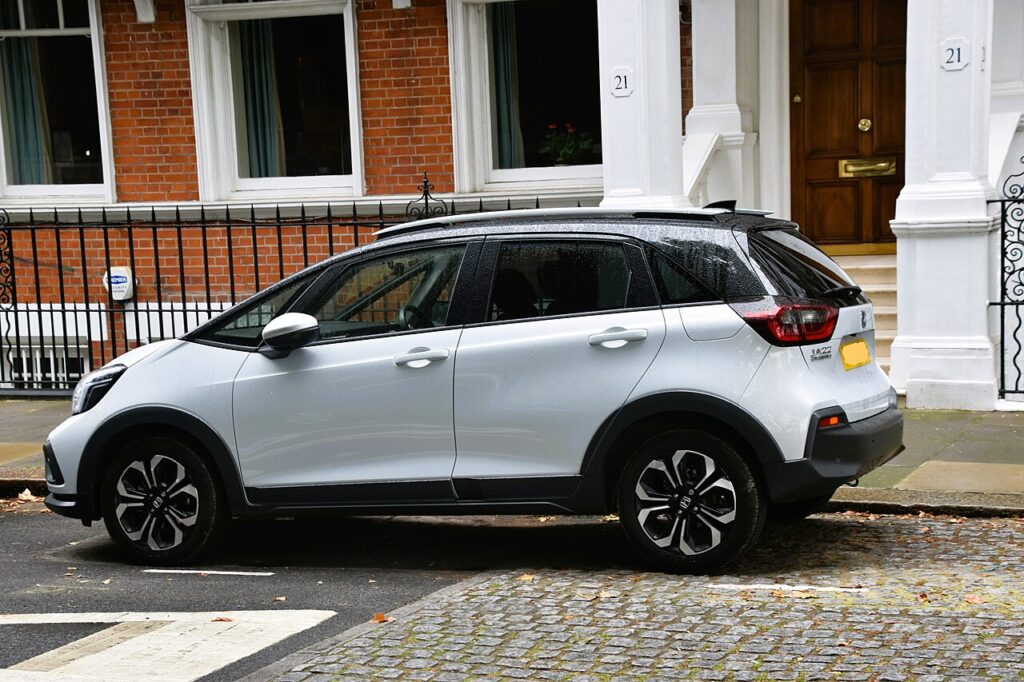
Start the Mk4 Jazz With a Dead Fob
The fob normally talks to the car over a short-range radio link. When the battery dies that link drops and the START button ignores you. The immobiliser can still read the passive transponder chip inside the fob at point-blank range, so you take the fob to the button.
- Get in first using the emergency key (steps below) and sit in the driver’s seat.
- Press the brake pedal fully and keep it pressed.
- Hold the back of the smart key — the flat side opposite the buttons, with the H badge — against the START/STOP button.
- Press the button while the fob is touching it. The car powers up. If it doesn’t come to READY first time, press START twice in quick succession with the fob still held there.
The coil behind the button reaches only a couple of centimetres, so square the flat back of the fob over the switch if the first try does nothing.
Unlock the Door With the Emergency Key
A dead fob won’t unlock the doors by radio, so the Mk4 fob hides a metal blade.
- Press the release catch by the key-ring loop and slide the emergency key out of the fob.
- At the driver’s door the lock cylinder sits in the handle, usually under a small cap. Lever the cap off with the blade tip to expose the keyhole.
- Insert the key and turn to unlock. The alarm may chirp — powering the car up clears it.
Why Touching the Fob to the Button Works
Behind the START switch is a small induction antenna. Holding the fob there lets the immobiliser energise the coil and read the transponder chip in the key — the same chip a dealer programmer talks to. The chip needs no battery; the antenna’s field powers it. A completely flat coin cell therefore still leaves the security handshake working, which is exactly why Honda designs this backup into every Smart Entry Jazz.
Replace the Coin Cell
Use the trick above to get going, then change the battery the same day.
- Slide the emergency key out to expose the seam in the fob.
- Twist the two halves apart with the slot the key leaves, or a coin.
- The Mk4 smart key uses a CR2032 3V lithium coin cell. Note which way up the old one sits — positive (+) usually faces the back cover — and fit the new one the same way.
- Avoid touching both faces of the new cell with bare fingers and clip the halves together until they click.
No reprogramming is needed; the buttons work again straight away.
Frequently Asked Questions
My Mk4 Jazz won’t come to READY after touching the fob to the button. Confirm the brake is pressed fully and that you used the flat back of the fob over the button. Press START twice quickly while holding it against the switch — on a hybrid the dash shows READY rather than cranking an engine.
Which battery does the Mk4 fob take? A CR2032 3V lithium coin cell — the larger flat type. Read the marking on the spent cell to confirm before buying.
Can the emergency key start the car? No. The blade only unlocks the door; there is no ignition barrel. Starting always uses the push button with the touch method.
The car is a hybrid — does the dead fob affect the drive battery? No. The dead coin cell only affects the key’s radio link; the high-voltage and 12V systems are separate. The 12V auxiliary battery sits in the boot floor area.
Could a weak 12V battery be the real problem? Yes. If a fresh coin cell doesn’t restore keyless operation and the car won’t power up, suspect the 12V auxiliary battery instead.
If a warning light stayed on after you got going, you can look up the exact fault code on our sister site autodtcs.com to see whether it relates to the smart-key system or something unrelated.
Independent guide — not affiliated with Honda. Always follow your official service manual and safety precautions. Read our full disclaimer.