These instructions apply to the Hyundai i20 Mk1 (PB) 2009-2014.
For other models, please choose your vehicle here.
The Hyundai i20 PB (2009–2014) uses a 12V lead-acid battery to power all vehicle electronics — the ECU, infotainment, airbag modules, and convenience features. Disconnecting it for replacement or any extended electrical work is straightforward, but several systems lose stored data and need re-initialisation when the battery comes back online. Follow the order below to avoid accidental shorts and to minimise the post-reconnect setup time.
Before You Start
- Switch the ignition OFF and remove the key from the ignition switch.
- Switch off all electrical consumers: lights, radio, HVAC, heated rear screen.
- If your i20 has the optional audio with security code, locate the code (in the owner’s pack or via Hyundai dealer) — without it, the radio locks after disconnect.
- Wait at least 3 minutes before disconnecting to let the airbag and seatbelt-pretensioner systems fully power down their capacitors.
- Use insulated tools — a slip across both battery terminals at once can weld a spanner to the body and ruin your day.
Tools and Supplies
- 10 mm spanner or socket for the battery-clamp nuts.
- 12 mm spanner for the hold-down bracket (if removing the battery completely).
- Optional: memory saver that plugs into the OBD-II port to preserve settings during the swap.
- Wire brush and battery-terminal cleaner for any corrosion.
- Petroleum jelly or dielectric grease for the terminals after refit.
Battery Location
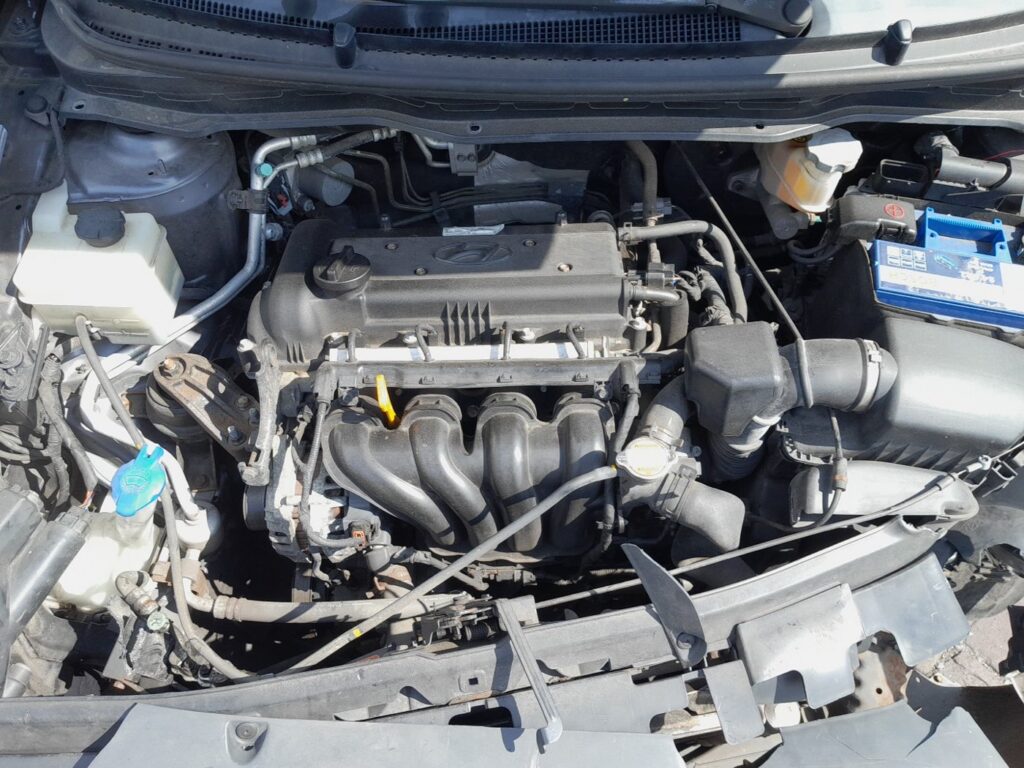
The 12V battery sits in the engine bay on the left-hand side of the engine compartment (driver’s side on LHD vehicles, passenger’s side on RHD UK / Ireland market i20s). It’s secured by a metal hold-down clamp that wraps over the top of the battery.
How to Disconnect the Battery
- Confirm the ignition is OFF and the key is out.
- Open the bonnet and remove any plastic terminal covers.
- Loosen and remove the negative (–) terminal first using the 10 mm spanner. Tuck the cable to one side so it can’t fall back onto the post.
- Loosen and remove the positive (+) terminal next.
- If removing the battery completely: undo the 12 mm hold-down bracket nut, lift the bracket clear, then lift the battery out with both hands — i20 batteries weigh around 12 kg and are awkwardly shaped, so use both hands and brace your back.
How to Reconnect the Battery
- Position the battery correctly in the tray with the terminals facing the correct way (the cables only reach the right terminals one way round).
- Refit the hold-down bracket and tighten — snug but not enough to crack the casing.
- Connect the positive (+) terminal first and tighten the clamp.
- Connect the negative (–) terminal last and tighten.
- Verify the clamps are tight and the cables are properly seated.
- Refit any terminal covers.
After Reconnecting — What to Re-Initialise
- Clock and date — reset on the infotainment / cluster.
- Radio presets — re-enter and save your preferred stations.
- Radio security code — enter if prompted.
- Power windows — close each window fully, hold the switch up for 2 seconds; then fully open, hold down for 2 seconds. Repeat for each window with auto-up/down.
- Electric sunroof (if equipped) — open and close the sunroof once completely using the switch.
- Trip computer — reset Trip A / Trip B as desired.
- Climate control — confirm normal operation; the actuators relearn their end positions on first power-up.
- Stop-start (ISG) — if your i20 has Idle Stop & Go, the auto stop/start won’t reactivate straight after a reconnect. Park it, close the doors and bonnet, leave it about 4 hours, then start, stop and restart the engine to reinitialise the system.
- Take a short drive and check all warning lights extinguish.
Safety Tips
- Always disconnect negative first, reconnect negative last.
- If the vehicle will sit unused for more than 2 weeks, use a memory saver or trickle charger to keep the battery from going flat.
- Battery acid burns skin and damages paint — rinse with plenty of water if spilled, neutralise with baking soda for serious spills.
- Don’t smoke or use open flames near the battery — flooded lead-acid batteries vent hydrogen gas during charging, which is flammable.
Troubleshooting
- Engine struggles to start after reconnect. Check both terminal clamps are tight and clean. Corrosion on the contact area causes voltage drop even with a fully-charged battery. Use the wire brush on both the cable clamp and the battery post.
- Radio shows “CODE” and won’t play. Enter the 4-digit security code from your owner’s pack. If lost, your local Hyundai dealer can retrieve it for free with proof of ownership (V5 / registration document).
- ABS, ESC, or airbag warning lights stay on. Some are normal for the first drive cycle. If they persist past 50 km of driving, scan-tool diagnostics are required.
- Power windows lost auto-up. Run the window initialisation — close each window fully, hold up for 2 seconds; fully open, hold down for 2 seconds. Most often only the driver’s window needs this.
- Engine starts but cuts out repeatedly. Check that no battery cable is grounded against the body of the car or chafed against the bonnet support arm. The i20 has a known wear point at the strut tower where the positive cable can rub through its insulation.
Frequently Asked Questions
How long should an i20 PB battery last?
Typically 4–6 years for the OEM-spec battery. Replacements vary by brand: budget batteries often fail within 2–3 years; premium AGM-conversions can last 7–8. Climate matters more than brand — hot summers shorten battery life regardless of cost.
What size battery does the i20 PB take?
The i20 PB uses a Group 47 (DIN 545) battery with 45–55 Ah capacity for petrol trims and 60–65 Ah for diesel. Check the existing battery’s label for the exact spec, and match the cold-cranking-amp (CCA) rating when replacing. Common sizes from Bosch S4, Varta Blue Dynamic, and Yuasa Silver all fit.
Will replacing the battery affect the engine ECU?
The ECU’s permanent fuel-trim adaptations are stored in non-volatile EEPROM and survive a disconnect. Short-term fuel adaptations (idle, transient throttle response) are stored in RAM and reset on disconnect — these relearn within 20–30 minutes of mixed driving. You may notice slightly rough idle for the first few km after a battery change; that’s the short-term adaptations rebuilding.
Can I jump-start the i20 from a running car?
Yes, with normal cautions. Modern alternators are sensitive to voltage spikes; connect in the standard order (positive to dead positive, positive to live positive, negative to live negative, negative to chassis ground on the dead car — not the dead battery’s negative terminal), run the live car for 5 minutes before trying to start, and disconnect in reverse order. Avoid jump-starting with another i20 already in jump-mode (sometimes called daisy-chaining) — that can damage both cars’ alternators.
Does the i20 have a Battery Monitoring System (BMS)?
Pre-facelift i20 PB (2009–2012) doesn’t. The 2012–2014 facelift can have an intelligent BMS on higher trims that adjusts charging based on temperature and load. If your i20 has the BMS, a battery replacement may need a scan-tool “battery change registration” so the BMS recognises the new battery’s age — most independent garages can do this for around €15.
(Additional i20 procedure guides are in progress — window initialise, service reset and TPMS articles will follow.)
Independent guide — not affiliated with Hyundai. Always follow your official service manual and safety precautions. Read our full disclaimer.