These instructions apply to the Hyundai i30 Mk2 (GD) 2012-2017.
For other models, please choose your vehicle here.
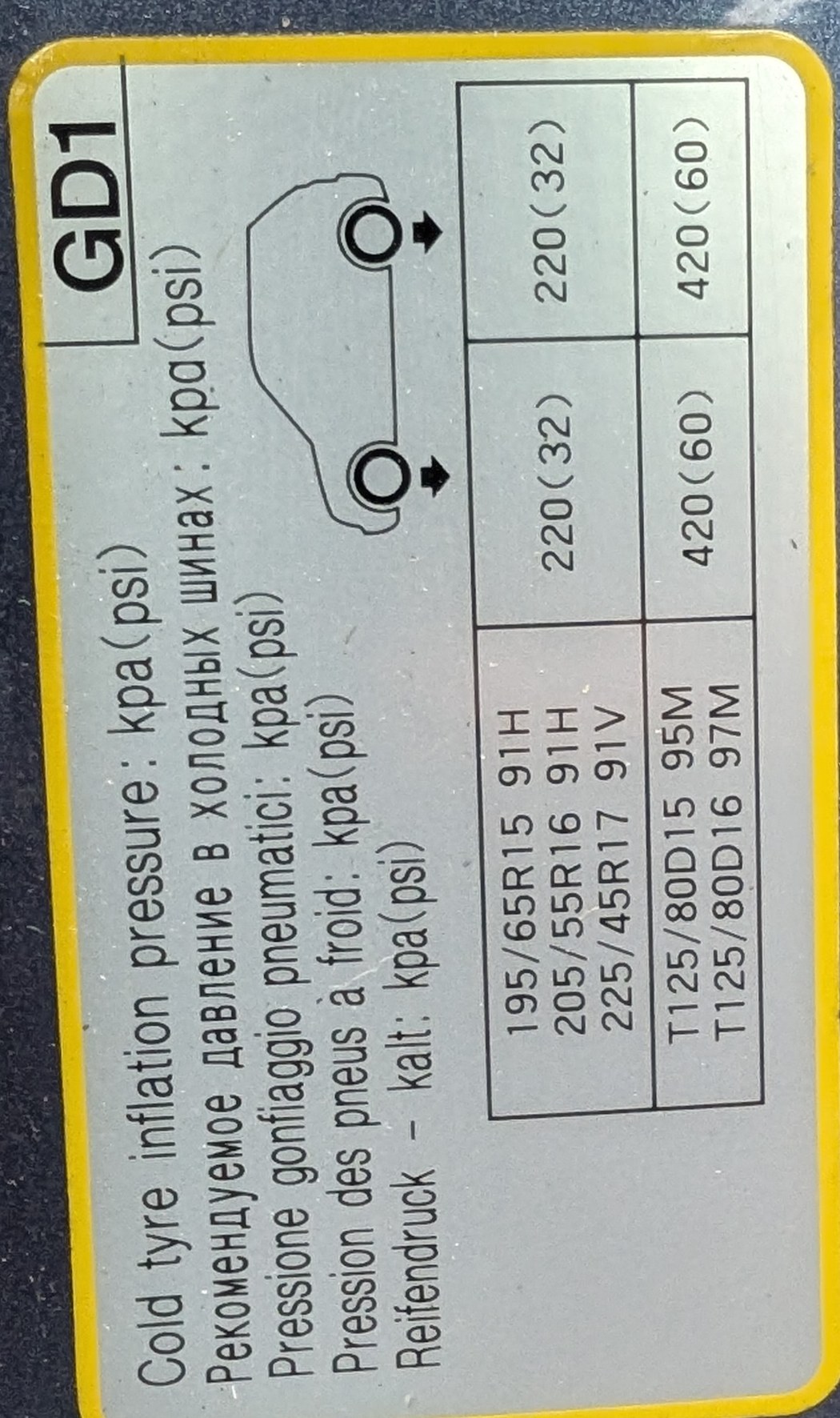
Most Hyundai i30 Mk2 (GD, 2012–2017) models run 220 kPa (32 psi) front and rear on the standard tire sizes. When the tire-pressure warning light comes on, it usually just means a tire is low or the pressures need correcting. The i30 GD uses a direct system with a sensor in each wheel, so once the pressures are right the light clears itself after a short drive — there is no reset button.
Hyundai i30 Tire Pressures (GD, 2012–2017)
Cold pressures from this car’s door placard and the owner’s handbook. “Normal” is up to three people; use the “fully laden” figures with a full load of passengers and luggage.
| Tire size | Normal load (front / rear) | Fully laden (front / rear) |
|---|---|---|
| 185/65 R15 | 2.2 / 2.2 bar — 220 / 220 kPa (32 / 32 psi) | 2.4 / 2.6 bar (35 / 38 psi) |
| 195/65 R15 | 2.2 / 2.2 bar — 220 / 220 kPa (32 / 32 psi) | 2.4 / 2.6 bar (35 / 38 psi) |
| 205/55 R16 | 2.2 / 2.2 bar — 220 / 220 kPa (32 / 32 psi) | 2.4 / 2.6 bar (35 / 38 psi) |
| 225/45 R17 | 2.2 / 2.2 bar — 220 / 220 kPa (32 / 32 psi) | 2.4 / 2.6 bar (35 / 38 psi) |
| Compact spare (T125/80 D15–D16) | 4.2 bar — 420 kPa (60 psi) | |
Always set pressures cold (before driving, or after the car has stood a few hours). The authority for your exact car is the placard in the driver’s door aperture — check it against the table above.
How the i30 GD TPMS Works
The GD uses a direct tire-pressure monitoring system: each wheel has its own sensor fitted inside the tire behind the valve stem, so the car measures real pressure. A position display can show which tire is low. The compact spare has no sensor.
Because it reads the sensors directly, there is no SET button and no menu relearn for the owner. Correct the pressures and the low-pressure warning clears on its own within a few minutes of driving. A separate steady “TPMS” malfunction light (as opposed to the low-pressure warning) points to a sensor or system fault, not a flat tire.
How to Clear the i30 TPMS Light
- Check and adjust all four tire pressures (cold) to the figures in the table above.
- Switch on and drive the car for about 20 minutes.
- Keep the speed above roughly 25 km/h (15 mph) for part of that drive so the sensors report and the system settles.
- The warning light goes out once the system confirms all four pressures are correct.
There is nothing to press inside the car — correcting the pressures and driving is the whole procedure.
Light Won’t Go Out? Work Through This
- A tire is genuinely low: the system is doing its job — find and fix the leak, re-inflate, then drive again.
- You didn’t drive long enough: allow about 20 minutes, including some time above 25 km/h.
- The spare is fitted: the compact spare has no sensor, so the TPMS malfunction light may come on until the sensored wheel is refitted.
- Cold snap: pressure drops about 1 psi per 5 °C, so a cold morning can set off the warning — re-inflate to the placard figure.
- Steady TPMS fault light: a sensor battery may have died (they last several years) — the car can store a code you can look up on autodtcs.com.
Frequently Asked Questions
What tire pressure does a Hyundai i30 GD take?
220 kPa (32 psi) front and rear on the standard 15-, 16- and 17-inch sizes when lightly loaded, rising to 2.4 bar front / 2.6 bar rear (35 / 38 psi) fully laden. The compact spare takes 4.2 bar (60 psi).
Is there a TPMS reset button in the i30 GD?
No. It’s a direct-sensor system, so there’s no button or menu reset. Correct the pressures and drive for about 20 minutes and the light clears itself.
Why does the light return after a few days?
Either a tire is slowly losing air or it was a little low when you set it. Re-check all four cold pressures against the table.
Can cold weather trigger it?
Yes — pressure falls as the temperature drops, so a cold spell can set off the warning. Re-inflate to the placard figure and drive to clear it.
After tire or seasonal-wheel work it’s worth confirming the service reminder is clear — see our Hyundai i30 service indicator reset guide.
Independent guide — not affiliated with Hyundai. Always follow your official service manual and safety precautions. Read our full disclaimer.