These instructions apply to the Kia Sportage Mk3 (SL) 2010-2016. For other models, please choose your vehicle here.
Last updated:
The Kia Sportage Mk3 (SL/SLE, 2010–2016) — the third-generation Sportage compact SUV, the first true global success for Kia and built in Žilina (Slovakia) for European markets — uses a menu-driven service indicator reset accessed through the cluster’s MENU and OK buttons on the multifunction steering wheel. There’s no diagnostic tool needed and no pedal sequence; the entire reset happens through the cluster’s central LCD readout. The procedure is identical across every Mk3 Sportage engine (1.6 GDi, 2.0 petrol; 1.7 / 2.0 CRDi diesel) and consistent between pre-facelift (2010–2014) and facelift (2014–2016) cars.
When to Reset the Service Indicator
- After completing an oil and filter change.
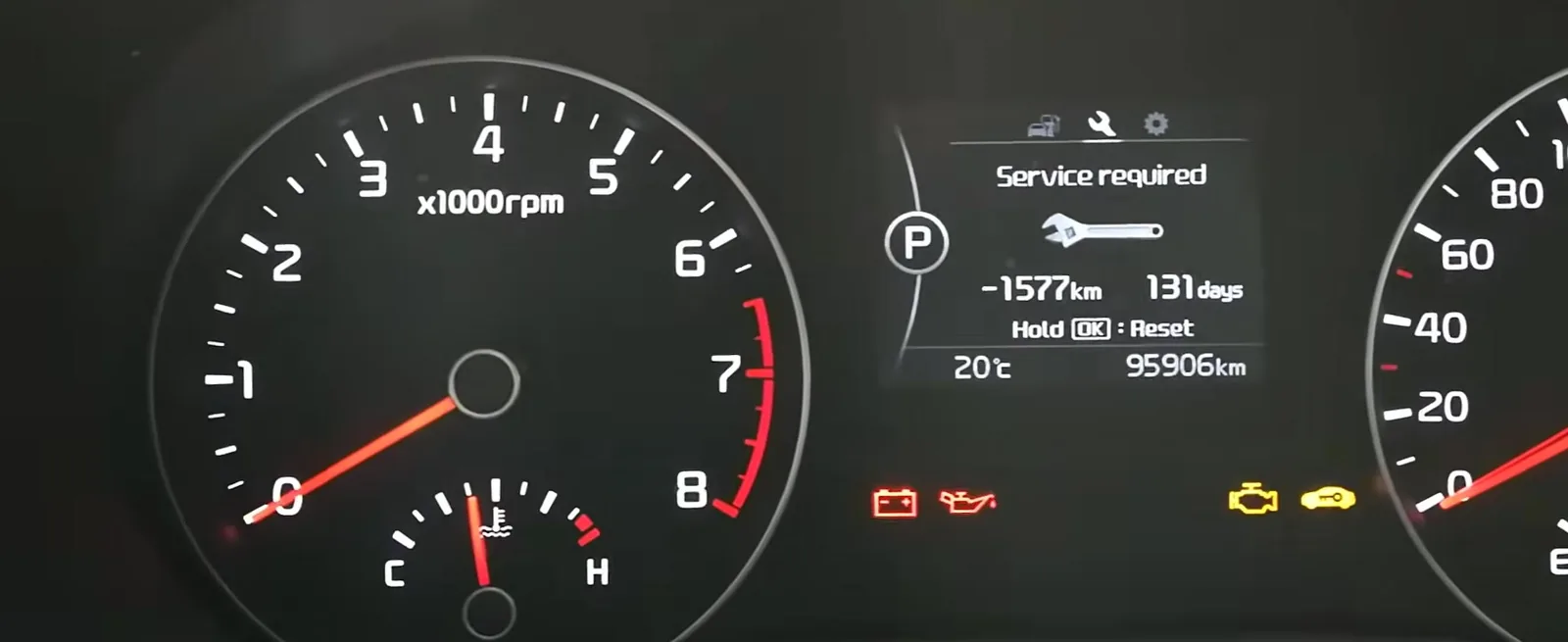
- If the spanner / wrench symbol with “SERVICE INTERVAL” or “Service due” appears on the cluster at startup.
- If you bought the Sportage second-hand and the previous owner didn’t clear the indicator.
⚠️ On the Mk3 Sportage the service indicator tracks the oil-change distance counter. Other items (brake fluid every 2 years, coolant at the manufacturer’s interval, timing belt at 90,000 miles on the CRDi diesels) aren’t tracked by the cluster — those follow the printed service schedule.
Before You Start
- Park on a level surface with the engine off. Complete the actual oil and filter change before the reset.
- Locate the MENU and OK buttons on the steering wheel. On the Mk3 Sportage’s multifunction wheel, MENU is on the left spoke and OK is on the right spoke. Lower trims without multifunction controls use the cluster-mounted MENU/OK buttons at the bottom-right of the instrument cluster face.
- If your Sportage has no MENU button at all (very basic 1.6 GDi base trim), see Method 2 below — there’s an alternative path that uses just the cluster scroll buttons.
Tools and Supplies
None for the reset itself. For the oil change you’ll need fresh Kia-spec oil — 5W-30 ACEA A5/B5 for the 1.6 / 2.0 GDi petrol engines, 5W-30 ACEA C2/C3 for the 1.7 / 2.0 CRDi diesels (with DPF), a new spin-on oil filter (different parts for each engine family), a 17 mm sump-plug socket (1.6 GDi) or 21 mm (CRDi diesel), and a torque wrench rated to about 35 Nm (1.6 GDi sump plug) or 50 Nm (CRDi).
Method 1 — Multifunction Steering Wheel (Most Mk3 Sportage Trims)
- Turn the ignition ON with the engine off. On key-start trims that’s key position II; on Sportage trims with the Smart Key button, press START/STOP without a foot on the brake — the engine only cranks with a pedal depressed.
- Wait a moment for the cluster to fully wake.
- Press the MENU button on the steering wheel.
- The cluster’s central display switches to the menu navigation view.
- Scroll through the top-level menu (using the up/down rocker or the MENU button repeatedly depending on trim) until “USER SETTING” mode is highlighted.
- Select USER SETTING.
- Scroll through the sub-menu until “SERVICE INTERVAL” is highlighted.
- Press the OK button.
- Press and hold the OK button for 2 seconds.
- Release the button. The cluster shows a confirmation message and the service indicator resets to the full new interval.
- Switch the ignition off to exit.
Method 2 — Cluster-Mounted Buttons (Basic Trim Without Multifunction Wheel)
On the most basic Mk3 Sportage trim levels, MENU is not on the steering wheel but on the cluster face. The reset shortcut is shorter on these:
- Turn the ignition ON.
- Scroll through the cluster’s central display menu using the up/down or trip-recorder button.
- Highlight “SERVICE INTERVAL”.
- Press and hold the cluster’s OK button for 2 seconds.
- Release. The service indicator clears and the cluster shows the new interval.
- Switch the ignition off.
Verify the Reset Worked
Switch the ignition off, wait 30 seconds, then cycle ignition back on. The spanner / SERVICE INTERVAL message should be gone. Re-open the menu (MENU → USER SETTING → SERVICE INTERVAL) — the remaining-distance value should now show the full new interval (typically 10,000 miles / 15,000 km or 12 months for European-spec Mk3 Sportage petrol, or 12,500 miles / 20,000 km or 24 months for CRDi diesel).
Troubleshooting
- USER SETTING isn’t an option in the menu. Some Mk3 Sportage trims (mostly very early 2010 production) ship with the menu labelled “Settings” or “My car” rather than USER SETTING. The sub-menu structure is the same — look for SERVICE INTERVAL inside whichever top-level menu is the user-customisation one.
- The OK long-press doesn’t trigger the reset. The Mk3 Sportage requires the hold to be a full 2 seconds — shorter holds are interpreted as a regular selection. Count “one-thousand-one, one-thousand-two” while holding. Releasing at 1.5 seconds will not commit.
- Reset works but the warning comes back after a few miles. 12V battery is marginal. The Mk3 Sportage cluster, like most Kia/Hyundai clusters of the era, is sensitive to voltage drop during cranking. Load-test and replace if older than 5 years.
- I have a 1.7 CRDi diesel — same procedure? Yes. The procedure is identical between petrol and diesel Mk3 Sportage variants. The diesel does have an additional DPF regen reminder that’s separate from the service interval — that one is handled by the engine ECU and clears itself after a successful active regen on the motorway.
- 2014 facelift — does the menu still match? Yes. The 2014 facelift updated the front-end styling and added some interior trim revisions but the cluster firmware and menu structure are unchanged from pre-facelift cars.
- I see “OIL CHANGE INTERVAL” rather than “SERVICE INTERVAL” in the menu. Same item, different label. Earlier 2010–2011 Mk3 Sportages shipped with “OIL CHANGE INTERVAL”; the 2012 firmware update renamed it to “SERVICE INTERVAL”. Reset the same way.
Frequently Asked Questions
What does the spanner symbol on the Kia Sportage mean?
On the Mk3 Sportage the spanner / wrench icon is the oil-change reminder. It’s a mileage timer set by the cluster — when the distance since the last reset reaches the configured interval, the icon illuminates at startup with a “SERVICE INTERVAL” message. It does not indicate an engine fault. Engine faults trigger the orange check-engine light (a separate engine-outline icon).
How often does the Mk3 Sportage service indicator come up?
Kia’s official European-market schedule for the Mk3 Sportage (SL):
- 1.6 GDi petrol: 10,000 miles (15,000 km) or 12 months.
- 2.0 GDi petrol: 10,000 miles (15,000 km) or 12 months.
- 1.7 CRDi diesel: 12,500 miles (20,000 km) or 24 months.
- 2.0 CRDi diesel: 12,500 miles (20,000 km) or 24 months.
UK severe-service / short-trip driving typically halves the petrol interval to 5,000 miles or 6 months.
Does the reset clear engine fault codes?
No. The reset zeros the service-distance counter only. Engine fault codes are stored in the engine ECU and need a scan tool. For DTC interpretation see autodtcs.com.
Is the procedure the same as on the Hyundai ix35?
The Hyundai ix35 (2010–2015) is the Sportage’s platform-sister car — same engines, same chassis, same Kia/Hyundai cluster generation. The reset path is essentially identical. The same procedure works on both, with minor cosmetic differences in the cluster menu labelling. We’ll publish a dedicated ix35 guide.
What about the Mk4 Sportage (QL/QLE, 2016–2022)?
The Mk4 Sportage moved to a newer supervision cluster (or full 7-inch TFT on GT-Line / Premium trims) and the reset path moves into a deeper menu hierarchy: User Settings → Service Interval → Reset → Hold OK. Same logic, slightly different labels. We’ll publish a dedicated Mk4 guide.
And the Mk2 Sportage (KM, 2004–2010)?
The Mk2 Sportage uses an older cluster with a manual button-and-ignition sequence rather than the menu reset. Different procedure entirely — see our forthcoming Mk2 Sportage guide.
I drive a Sportage with the 4WD all-wheel-drive system — same procedure?
Yes. The drivetrain mode doesn’t affect the cluster reset. The 4WD selector adds menu entries elsewhere in the cluster but doesn’t change the maintenance reset.
For DTC code interpretation on Kia / Hyundai vehicles see autodtcs.com.
Disclaimer: The information on this page is provided for general guidance only. Always follow your official service manual and safety precautions when working on your vehicle. We are not responsible for errors, omissions, or any damage resulting from the use of this information.
This website is an independent resource and is not affiliated with, endorsed by, or sponsored by Kia. All trademarks and brand names belong to their respective owners.