These instructions apply to the Mazda CX-5 Mk1 (KE) 2012-2017.
For other models, please choose your vehicle here.
When the tyre-pressure warning light comes on in your Mazda CX-5 Mk1 (KE, 2012–2017), it usually just means the system needs to store your current pressures as the new reference after a check, top-up or wheel change. On the CX-5 you reset it with the TPMS button (or, on cars without one, by re-running the routine after setting pressures). This guide shows how.
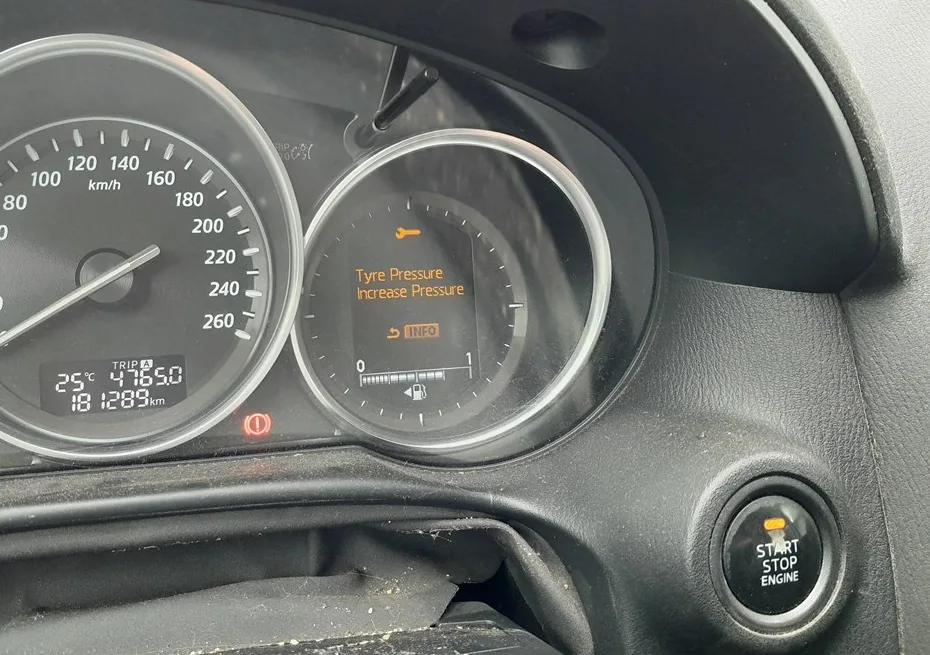
When to Reset
- After checking or adjusting the tyre pressures (including seasonal changes).
- After changing one or more wheels or tyres, or repositioning them.
- After disconnecting or renewing the battery.
Set Your Pressures First
The reset stores whatever pressures are in the tyres at that moment, so they must be correct first. Park on level ground and set all four (cold) to the figures on the placard in the driver’s door aperture, using the laden column for a full load. Never reset with a tyre already low.
Recommended Tire Pressures (225/65 R17)
On the factory 225/65 R17 tires, the Mazda CX-5 (KE) runs 2.3 bar (33 psi) front and rear for everyday driving with up to three people, rising to 2.6 bar (38 psi) front and 2.8 bar (41 psi) rear when fully loaded. Set them cold, then run the reset above.
| Load | Front | Rear |
|---|---|---|
| Normal (up to 3 occupants) | 2.3 bar / 33 psi | 2.3 bar / 33 psi |
| Fully loaded (4–5 occupants) | 2.6 bar / 38 psi | 2.8 bar / 41 psi |
These are the figures from the label in the driver’s door aperture on this car. If your CX-5 wears a different wheel size (for example the optional 225/55 R19) or carries a space-saver spare, always use the figures on your own door-pillar placard.
How to Reset the CX-5 TPMS

- Make sure all four tyres are at the correct cold pressure and the car is on level ground.
- Turn the ignition on (engine can be off).
- Press and hold the TPMS “SET” button until a confirmation signal sounds and the TPMS warning light flashes twice.
- The button location differs by market — it is low on the dash to the right of the wheel on right-hand-drive cars, or to the left on left-hand-drive cars.
- Release the button. The new pressures are now stored.
The system finishes learning over the first few miles, so the light can take a short drive to confirm it has cleared.
Light Won’t Go Out? Work Through This
- A tyre is genuinely low: the system is doing its job — find and fix the leak, re-inflate, then reset.
- Reset not confirmed: you should hear a beep and see the light flash twice — if not, check the ignition is on and you held the SET button long enough.
- Light flashes then stays on (not a low tyre): a flashing TPMS light points to a sensor fault, often a flat sensor battery. A code may be stored that you can look up on autodtcs.com.
Frequently Asked Questions
Where is the TPMS reset button on a CX-5?
Low on the dashboard near the steering wheel — right of the wheel on RHD cars, left on LHD cars. Hold it (ignition on) until you hear a beep and the light flashes twice.
Do I have to drive after resetting?
A short drive lets the system confirm the stored pressures, after which the warning light goes out.
Why does the light come back a few days later?
Either a tyre is slowly losing air, or it was a little low when you reset. Re-check all four cold pressures and reset again.
Do I need to reset after just topping up the air?
Yes — any pressure change shifts the reference the system relies on, so reset after any adjustment.
After tyre or seasonal-wheel work it is worth confirming the service reminder is clear — see our Mazda CX-5 service indicator reset guide.
Independent guide — not affiliated with Mazda. Always follow your official service manual and safety precautions. Read our full disclaimer.