These instructions apply to the Suzuki Swift Mk2 (RS) 2004-2010.
For other models, please choose your vehicle here.
The instrument cluster in the Suzuki Swift Mk2 (RS, 2004–2010) uses colored warning and indicator lights to report the car’s condition. This guide explains the real telltales this generation has, what each one means, and what Suzuki says to do — grouped by color so you can judge how urgent it is.
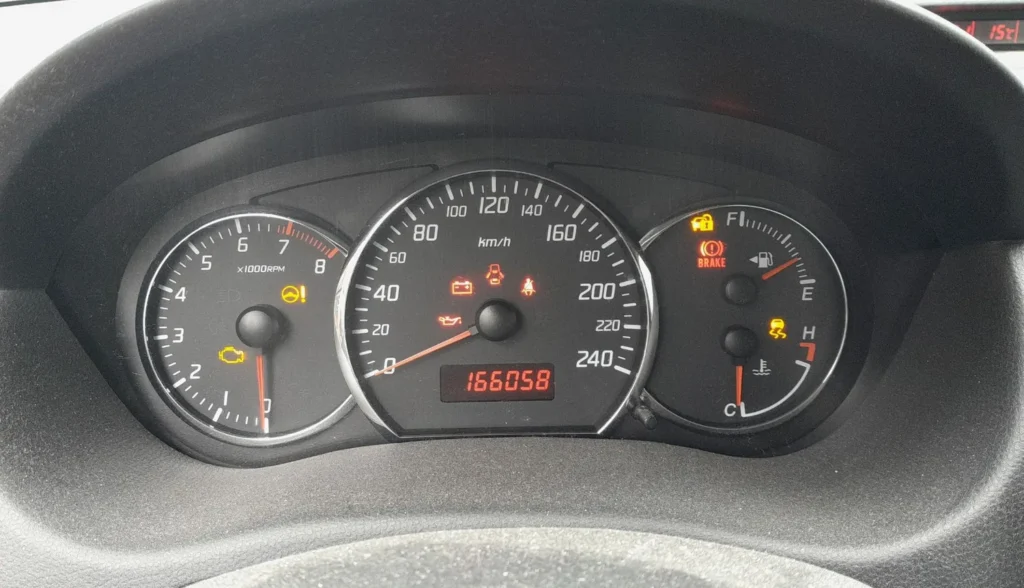
As a rule, most lights come on briefly when you turn the ignition to “ON” as a working check, then go out once the engine starts. A light that stays on, or comes on while driving, is the one to act on.
Red warning lights (stop)
A red light means stop safely and investigate — these point to brakes, oil pressure, charging, safety systems, or an open door.
- Brake system warning light — Comes on with the parking brake applied, and also if the brake fluid is below the minimum level. If it stays on after you start the engine and fully release the handbrake, or comes on while driving, pull over and have the brake system inspected. Stopping distances can be longer, so brake gently to a safe spot.
- Oil pressure light — Comes on with the ignition and goes out once the engine starts. If it stays on or comes on while driving, there may be insufficient oil pressure. Pull off the road as soon as it is safe and stop the engine. Check the oil level and top up if needed; running the engine with this light on can cause severe engine damage. Do not rely on it as an oil-level gauge — check the dipstick regularly.
- Charging (battery) light — Comes on with the ignition and goes out once the engine starts. If it comes on while the engine is running, the battery charging system should be inspected immediately.
- SRS “AIR BAG” light — Blinks or comes on for a few seconds at ignition “ON” as a self-check. If it does not come on at all, stays on for more than 10 seconds, or comes on while driving, the airbag or seat-belt pretensioner system may not work properly and needs inspection.
- Seat belt reminder light — Blinks as a reminder until the driver’s seat belt is buckled. Fasten the belt and it clears.
- Immobilizer / security light (if equipped) — Comes on at ignition “ON” and goes out once the engine starts. If it blinks with the ignition on, there may be a fault in the immobilizer system; have it inspected. A key that is not recognized can prevent the engine from starting.
- Open door warning light — Stays on until all doors, including the tailgate, are fully closed.
Amber/yellow warning lights
Amber lights are cautions — you can usually drive on carefully, but the system flagged should be checked soon.
- ABS warning light — Comes on briefly at ignition “ON” as a check. If it stays on or comes on while driving, there may be a fault in the anti-lock braking system. Normal braking still works, but the ABS function may not. If the ABS light and the red brake light come on together, both the anti-lock function and the rear brake-force control may be affected — have the system inspected.
- ESP / traction control light (a car with wavy skid-mark lines) — Flashes briefly when the stability and traction control is actively working on a slippery surface. If it stays on steadily, ESP may have been switched off with the ESP OFF button, or there may be a fault to have checked. Not every Swift trim has ESP.
- Check engine light (malfunction indicator light) — Part of the emission control system. It comes on at ignition “ON” and goes out once the engine starts. If it comes on while the engine is running, there is a problem with the emission system. Continuing to drive can damage the system and affect economy and driveability, so have the fault read and corrected.
- Electric power steering light (if equipped) — Comes on briefly at ignition “ON” as a bulb check. If it comes on while driving, the power steering may not work properly and should be inspected. Steering still works but will feel heavier.
- Transaxle warning light (if equipped, automatic) — Comes on for a few seconds at ignition “ON” as a check. If it blinks, there is a fault in the automatic transaxle; have it inspected.
- Low fuel warning light — Comes on when the fuel level is low; fill the tank as soon as possible. The exact point it triggers varies with slopes and cornering because fuel moves in the tank.
- Oil-change / service “spanner” reminder — This is a maintenance reminder, not a fault. It is separate from the red oil-pressure light: it lights at the set service interval to tell you an oil-and-filter change is due (every 15,000 km / 12 months on the normal schedule). After the service, it is cleared with the trip/odometer button — see our Suzuki Swift service light reset guide.
Green/blue indicators
Green and blue lights are informational — they confirm a system is switched on, not that anything is wrong.
- Turn signal indicators (green) — The left or right green arrow flashes with the matching turn signal. With the hazard switch on, both arrows flash together. An unusually fast flash often means a turn-signal bulb has blown.
- Main beam / high beam indicator (blue) — Comes on in blue when the headlight high beams are switched on.
- A/T selector position indicator (green, if equipped) — Shows the current gear selector position on automatic-transaxle cars when the ignition is on.
- Keyless start system indicator (blue/red, if equipped) — On cars with the keyless start system, this lights blue when you can start without inserting the key, or red when the key is required. A red flash reminds you the remote is not in the car.
Frequently Asked Questions
What is the spanner / oil light on my Suzuki Swift?
If you mean the wrench-shaped “spanner” symbol, that is the service/oil-change maintenance reminder — it simply means a scheduled service is due and is reset with the trip button after the oil change. The separate red oil-pressure light is a warning: if it stays on, stop and check the oil level, because low oil pressure can quickly damage the engine.
Why is the check engine light on in my Swift?
The check engine (malfunction indicator) light reports a problem in the emission or engine management system — anything from a loose fuel cap or a sensor fault to a misfire. The car stores a trouble code that pinpoints the area. Have the code read before assuming the worst; a steady light is usually fine to drive to a workshop, but a flashing light means stop.
Is it safe to drive with the ABS light on?
With only the amber ABS light on, normal braking still works — you just lose the anti-lock function, so the wheels can lock under hard braking. Drive carefully and get it checked soon. If the red brake warning light is on as well, do not keep driving: stop safely and have the brakes inspected.
If any warning light stays on, the quickest way to know what is wrong is to read the stored fault code with an OBD-II scanner. Look up what the code means at autodtcs.com before paying for repairs.
This guide is for general information only and is based on the Suzuki Swift (RS) owner’s manual. Lights and equipment vary by model year, engine, and market. Always follow your own vehicle’s handbook and consult a qualified mechanic for any warning that does not clear. We are not affiliated with Suzuki.
Independent guide — not affiliated with Suzuki. Always follow your official service manual and safety precautions. Read our full disclaimer.