These instructions apply to the Tesla Model S (2012-2021).
For other models, please choose your vehicle here.
If the one-touch (auto up/down) function on your Tesla Model S (2012–2021) has stopped working — usually after the 12 V battery was disconnected or went flat — the windows just need re-initialising. It’s a quick job with no tools.
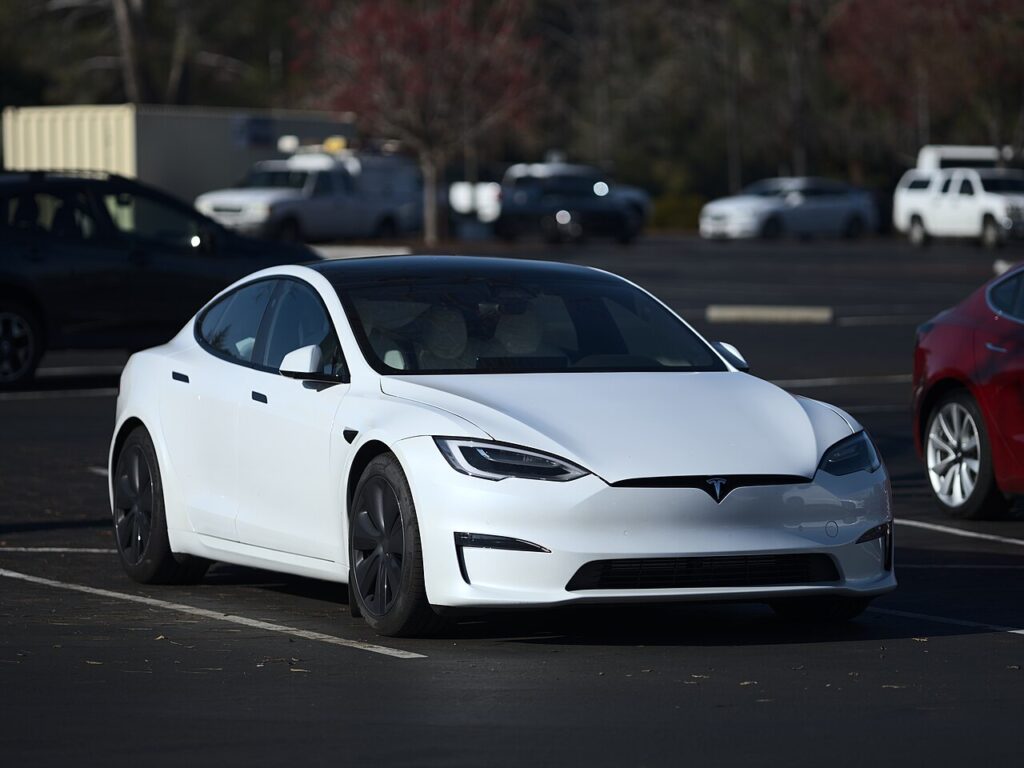
Every door on the Model S has a frameless window that drops a few millimetres as you open the door and rises to seal as you close it, so precise position control matters more here than on a framed window. Each window motor stores its fully-up and fully-down positions and uses them for one-touch travel and for the anti-pinch reverse. Losing that memory after the 12 V battery is disconnected is expected behaviour, not a fault — the glass simply reverts to moving only while you hold the switch.
How It Works on This Model
The window control module in each door learns the exact travel between the fully-closed and fully-open stops. From those references it knows when to cut the motor, how to feather the auto-drop and auto-seal on the frameless glass, and how much resistance means an obstruction. Disconnecting or flattening the 12 V battery clears that stored calibration, so the module falls back to manual hold-to-move until you cycle the window to both stops and let it relearn.
Before You Start
- Wake the car so the low-voltage system is live and the windows have power.
- Sit inside with the door closed — the frameless glass calibrates on its correct seated line.
- Keep hands and objects out of the aperture during the cycle.
- Do each affected window from its own switch, one at a time.
- Make sure the 12 V supply is healthy if you’ve just done battery work, so the relearn isn’t interrupted.
When You Need This
- After disconnecting or replacing the 12 V battery.
- If a window only moves while you hold the switch and won’t auto-close or auto-open.
Re-initialising the Windows
- Close the doors and sit in the driver’s seat with the door closed.
- Using the window switch, raise the window fully until the motor stops.
- Lower the window fully until the motor stops.
- Raise the window fully again until the motor stops — the procedure is complete.
Repeat for any other window that has lost its one-touch function.
If It Won’t Stay Set
- Let the motor stop on its own at each end before changing direction — releasing early leaves the limit unlearned.
- Complete the full up/down/up cycle; a partial cycle won’t register.
- Re-seat the 12 V battery connections if you’ve just done battery work.
- Check the 12 V battery’s health — a tired or low auxiliary battery can drop out mid-relearn; charge or replace and retry.
- Keep the door shut during the cycle so the frameless glass calibrates against its true seal line.
- Clear any drag in the channel — friction can trip the anti-pinch reverse and stop auto-up holding.
- A motor or module fault can store a code — look it up on autodtcs.com.
What to Expect After
Once relearned, a single tap runs the glass fully up or down, the frameless auto-drop and auto-seal behave normally as you use the door, and anti-pinch protection is active again. The calibration is stored, so you won’t need to repeat it unless the 12 V battery is disconnected or goes flat once more.
Frequently Asked Questions
Why did my Model S windows stop auto-closing?
Disconnecting or flattening the 12 V battery clears the stored travel each window motor relies on, so it drops into a safe manual mode that only moves while you hold the switch. Cycling the glass fully up, down and up again teaches the module its limits and restores one-touch operation and the frameless auto-seal.
Do I need a tool?
No. The up/down/up cycle with the door switch does everything — there is no touchscreen menu, service tool or fuse-pull needed. Just wake the car so the windows have power, then run each affected window to both stops in turn.
Do I have to do all the windows?
Only the ones that lost one-touch. Each window is calibrated separately by its own module, so relearning the driver’s window doesn’t recalibrate the others. Work through each affected door, using that door’s switch, until every window auto-runs again.
What does the up/down/up cycle do?
Each direction runs the glass to a physical end stop, and holding until the motor halts registers that limit with the module. The up/down/up sequence captures both stops and confirms the travel, which is what restores one-touch movement and lets the anti-pinch feature judge resistance correctly.
Do the frameless windows need anything extra?
No extra steps, but keep the door closed during the cycle. The glass drops slightly on opening and rises to seal on closing, so it must learn its travel against the correct seated line. Calibrating with the door shut ensures the auto-drop and auto-seal line up properly afterwards.
It reverses just before closing — what’s wrong?
That is the anti-pinch sensor reacting to friction, usually a dry or dirty channel, or an incomplete relearn. Clean the runs, check nothing is in the aperture, and repeat the up/down/up cycle. If a clean, free window still reverses at the top, have the motor or module checked.
If you’ve just reconnected the battery, see our Model S 12V battery guide. A stored window-module fault can be decoded on autodtcs.com.
Independent guide — not affiliated with Tesla. Always follow your official service manual and safety precautions. Read our full disclaimer.