When the air conditioning stops blowing cold, the cause is usually one of a handful of things — and the exact symptom is a strong clue to which. This guide runs through the common patterns, what each one typically means, and what you can safely do yourself versus what needs a workshop. A quick reminder first: a healthy A/C system is sealed and holds its gas for years, so if cooling has faded, something has genuinely changed.
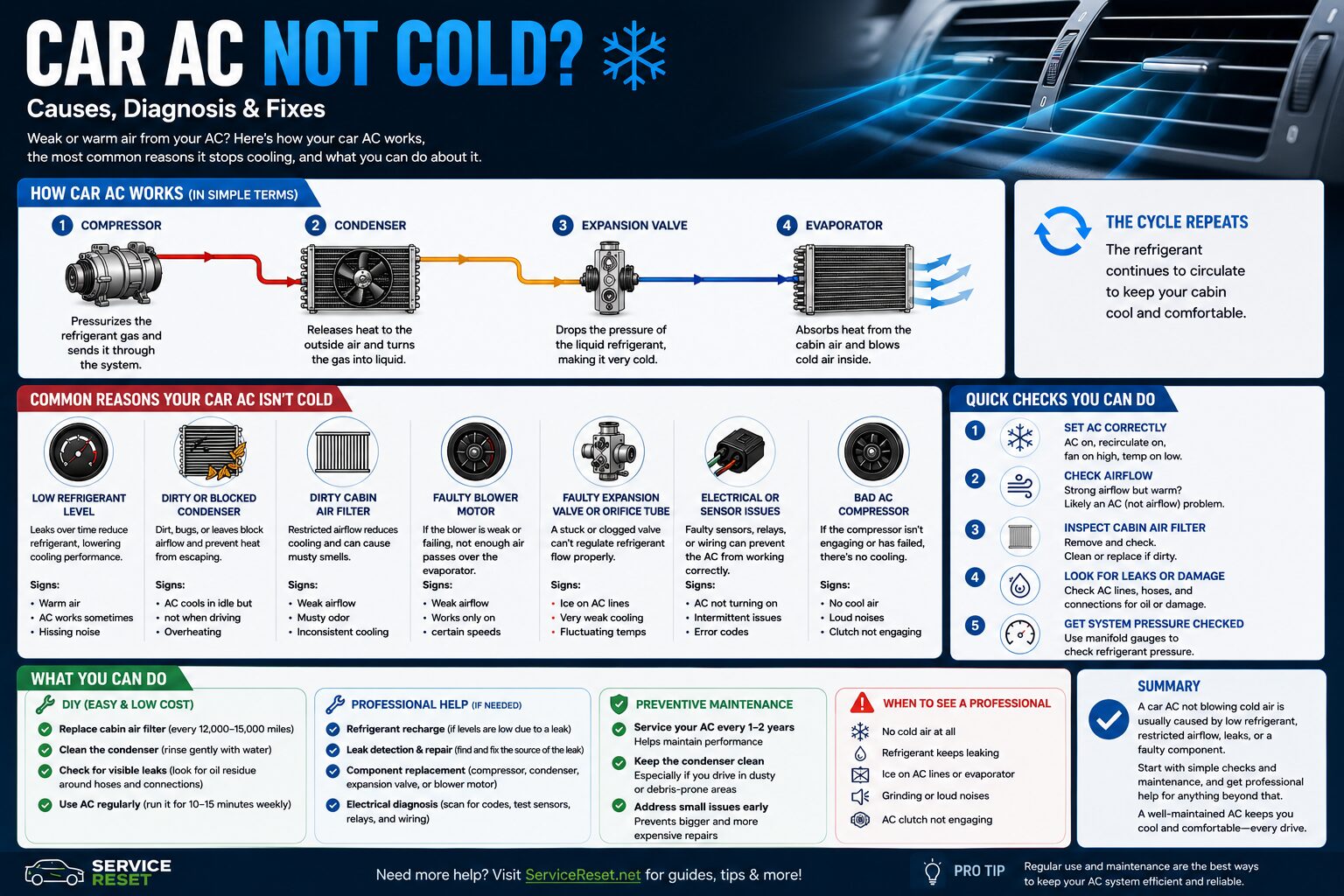
Quick checks before you book a garage
Before assuming the worst, run through these five checks — they take a couple of minutes and rule out the simple things that often masquerade as a broken A/C:
- Set the controls correctly. A/C button on, recirculation on, fan speed high and temperature at its coldest — a knocked setting is a common false alarm.
- Feel the airflow. Plenty of air but warm? The fault is on the refrigerant side. Strong airflow that never chills points away from a simple blower or filter problem.
- Check the cabin filter. A clogged pollen filter throttles airflow and traps damp, musty smells. It is cheap, and on most cars you can reach it behind the glovebox.
- Look for leaks or damage. Oily residue around the A/C pipes, hoses and unions is the tell-tale sign of escaping refrigerant carrying its lubricant with it.
- Have the pressures read. If everything above checks out, a technician can put gauges on the system in minutes and tell you whether the charge is low or a component has failed.
Air is cool but not properly cold
This is the classic sign of a low refrigerant charge, almost always caused by a slow leak. As the gas level drops, the system can still cool a little but never gets truly cold. The fix is a proper leak check followed by a re-gas — not a blind refill, which just wastes gas and hides the leak. This is a workshop job with the right equipment.
No cold air at all
If the vents blow only ambient or warm air, the likely causes are a completely empty system, a compressor or its clutch not engaging, or an electrical fault such as a blown fuse or a failed pressure switch. If the compressor never clicks in when you turn on the A/C, have it checked rather than adding gas.
Cold when driving, warm at a standstill
Cooling that works on the move but fades in traffic points to the condenser not getting enough airflow. At speed the airflow does the job; at idle the system relies on the cooling fan. A failing fan, or a condenser clogged with leaves and bugs, is the usual culprit. Clearing debris from the front of the car can help; a non-working fan needs attention.
A musty smell when you switch on
A damp evaporator combined with an old cabin (pollen) filter is the classic cause of that gym-bag smell. Moisture and bacteria build up on the cold surfaces. Renewing the cabin filter and running the fan (with A/C off) for the last few minutes of a journey to dry the system usually clears it. This one is genuinely DIY on most cars.
Hissing, or frost and ice on the pipes
A hiss when you switch off, or frost forming on parts of the system, can indicate moisture inside the circuit or an expansion-valve problem — the valve momentarily freezing and interrupting the flow. These are internal faults that a technician diagnoses with gauges; they are not something to chase with a top-up can.
Weak airflow (but the air that comes out is cold)
If the temperature is fine but very little air reaches you, the problem is on the ventilation side, not the refrigerant side: usually a blocked cabin filter or a failing blower motor. Start with the cabin filter — it is cheap and often the answer.
When to see a professional
Anything involving refrigerant — leak-finding, re-gassing, or replacing the compressor, condenser or expansion valve — is a workshop job. Handling refrigerant is regulated, and the newer R1234yf gas is mildly flammable. The jobs you can usually do yourself are renewing the cabin filter, clearing debris from the condenser, and running the system regularly to keep the seals healthy. If a climate-control warning light is on, the car has probably stored a fault code that points straight at the problem.
Frequently asked questions
Why is my car A/C blowing warm air?
Most often the refrigerant charge is low because of a leak, or the compressor is not engaging. Both need a workshop; adding gas without finding the leak is a temporary patch at best.
Can I fix weak A/C myself?
You can renew the cabin filter, clear the condenser and run the system regularly. Refrigerant work and internal component faults should be left to a technician.
Does A/C need topping up every year?
No. A sealed system should hold its charge for years. Regular “top-ups” are a sign of a leak that should be found and fixed.
Why does my A/C only work when I’m driving?
The condenser is not getting enough airflow at low speed — usually a failing cooling fan or a blocked condenser.
For the full picture of what each part does, see how car air conditioning works. Not sure which refrigerant your car takes? Read R134a vs R1234yf. And if the dashboard is showing a climate warning, decode the fault code on our sister site.
