Car air conditioning feels like magic on a hot day, but underneath it is a simple, closed loop that moves heat from inside your car to the outside. Understanding how that loop works makes it far easier to spot when something is wrong — and to know which jobs you can do yourself and which belong with a specialist. This guide walks through the whole system in plain language: what each part does, why one pipe runs hot and another cold, the different refrigerants your car might use, and what the common symptoms actually mean.
What your car’s air conditioning actually does
It is easy to think of A/C as a machine that “makes cold”. In reality it does the opposite: it removes heat and moisture from the cabin and dumps them outside. A special fluid called a refrigerant carries that heat away by repeatedly changing between a liquid and a gas as it flows around a sealed circuit. Because the system also pulls water vapour out of the air, it is just as useful for clearing a misted windscreen in winter as it is for cooling you in summer.
The refrigerant cycle, step by step
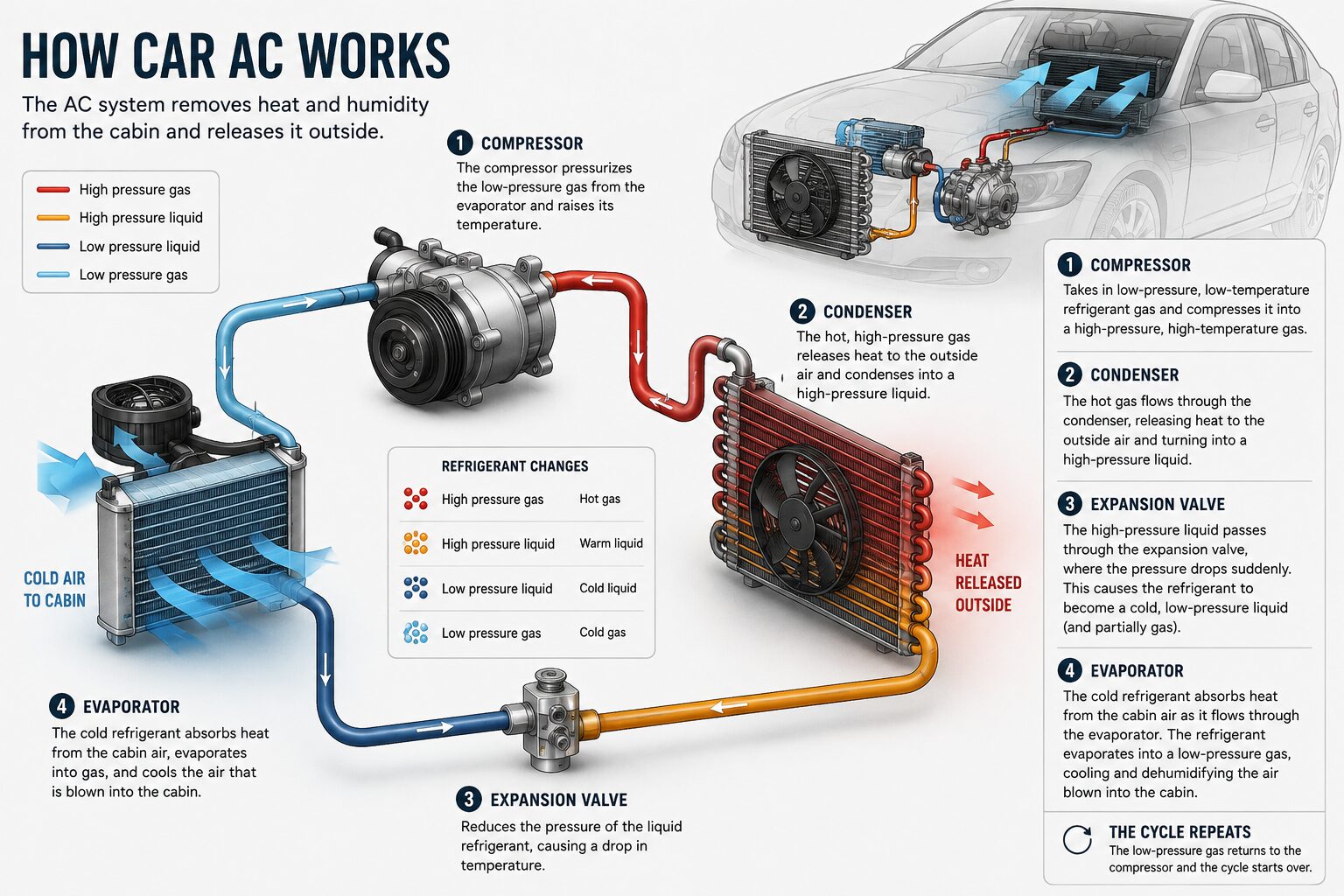
Four main parts do the work, and the refrigerant passes through them in a continuous loop:
- Compressor — driven by the engine, it draws in cool low-pressure refrigerant gas and squeezes it into a hot, high-pressure gas.
- Condenser — mounted at the front of the car (in the airflow, near the radiator), it lets that hot gas shed its heat to the outside air. As it cools, the refrigerant condenses into a warm high-pressure liquid.
- Expansion valve — the liquid is forced through a narrow restriction, and the sudden drop in pressure makes it turn cold as it begins to boil back into a gas.
- Evaporator — hidden behind the dashboard, this cold heat-exchanger absorbs warmth from the cabin air being blown across it. The refrigerant boils fully into a gas, the blower pushes the now-chilled, dried air into the cabin, and the gas returns to the compressor to start again.
The main components explained
- Compressor: the pump of the system, usually turned by the engine’s drive belt through an electric clutch so it can switch on and off.
- Condenser: a fine-finned heat exchanger up front that behaves like a small radiator, releasing heat to the passing air (helped by a cooling fan at low speed).
- Receiver-drier (or accumulator): a small canister that soaks up any moisture and traps debris, protecting the rest of the circuit from contamination.
- Expansion valve (or orifice tube): meters exactly how much refrigerant enters the evaporator and creates the pressure drop that makes it cold.
- Evaporator: the cold heat-exchanger behind the dash where the cabin air is chilled and dehumidified. The pollen/cabin filter usually sits just ahead of it.
Why one side is hot and the other is cold
The loop is split into two halves. The high-pressure side runs from the compressor, through the condenser, to the expansion valve — here the refrigerant is hot and under high pressure as it gives up its heat. The low-pressure side runs from the expansion valve, through the evaporator, back to the compressor — here it is cold and at low pressure as it absorbs heat from the cabin. That is why, with the engine warm and A/C running, you can often feel one pipe near the firewall that is hot and another that is icy cold.
Refrigerants: R12, R134a and R1234yf
Not every car uses the same refrigerant, and they are not interchangeable. Over the years three types have been common:
| Refrigerant | Typical era | Notes |
|---|---|---|
| R12 (Freon) | older classics | A CFC that damages the ozone layer; banned for servicing across the EU since the early 2000s. |
| R134a | roughly late-1990s to mid-2010s | Replaced R12; still found in a huge number of cars on the road today. |
| R1234yf | newer cars, from the mid-2010s | Chosen for its much lower global-warming impact, but it is mildly flammable and must be handled by trained technicians. |
Each refrigerant is designed to work with a specific lubricating oil, so mixing types — or topping up one system with another’s gas — contaminates the oil and can ruin the compressor. If an old R12 car is ever converted to R134a, the system has to be fully drained, flushed and fitted with compatible parts first; that is a workshop job, not a top-up.
How to tell which refrigerant your car uses
You don’t have to guess. There is a label under the bonnet, usually near the condenser or the service ports, that states the refrigerant type and the exact charge weight the system needs. As a rough guide, cars first registered from around 2017 in Europe are most likely to use R1234yf, while most vehicles built through the 2000s and early 2010s use R134a. When in doubt, a technician confirms it from that label and the fittings before touching the system.
When weak or warm air means something is wrong
A healthy A/C system holds its refrigerant for years — it is a sealed loop, so it should not need “topping up” as routine. If cooling fades, something has usually changed:
- Air is cool but not cold: most often the charge is low because of a slow leak. This needs a proper leak check and re-gas, not a blind refill.
- No cold air at all: could be an empty system, a compressor or clutch that isn’t engaging, or a blown fuse.
- Cold when moving, warm at idle: points to the condenser not getting enough airflow — often a failing cooling fan or a bug-clogged condenser.
- Musty smell when you switch on: a damp evaporator and an old cabin filter; running the fan to dry it out and renewing the filter usually clears it.
- Hissing or a warm/cold patch on the pipes: can indicate an expansion-valve or moisture problem inside the circuit.
Because the climate system talks to the car’s computer, many of these faults also store diagnostic trouble codes for the pressure sensors, blower or compressor clutch. Reading those codes narrows the search quickly — you can look up what they mean on our sister site, autodtcs.com.
Keeping your air conditioning healthy
- Run it regularly, even in winter — a few minutes now and then keeps the seals lubricated and stops them drying out and leaking.
- Change the cabin (pollen) filter on schedule — a blocked filter weakens airflow and causes smells. See our maintenance guides for your specific model.
- Have it serviced periodically — every few years a workshop can check for leaks and restore the correct charge with the right refrigerant.
- Leave refrigerant work to a professional — handling refrigerant is regulated, and R1234yf is flammable, so DIY recharge kits are best avoided.
Frequently asked questions
How often should I recharge my car’s air conditioning?
Not on a schedule. A sealed system should hold its gas for many years. If it needs recharging, it has almost certainly developed a leak that should be found and fixed first.
Is R1234yf refrigerant dangerous?
It is mildly flammable, which is why it is handled by trained technicians with the right equipment. In normal use inside a properly built system it is perfectly safe.
Why does my air conditioning smell musty?
Moisture collects on the cold evaporator and, together with an old cabin filter, can grow odour-causing bacteria. Drying the system by running the fan and renewing the filter usually fixes it.
Can I put R134a in a car that uses R1234yf?
No. The two must never be mixed — they use different oils and pressures, and the wrong refrigerant can damage the compressor and other parts.
Once you know how the pieces fit together, most A/C problems come down to a handful of causes: a leak, a lack of airflow, or a component that has stopped switching on. If your dashboard is also showing warnings, start by decoding the fault codes, then use our brand-by-brand maintenance guides to find the right procedure for your car. Working on the engine’s cooling side too? Our coolant & antifreeze mix calculator takes the guesswork out of getting the ratio right.
