These instructions apply to the Hyundai ix35 Mk1 (LM) 2010-2015.
For other models, please choose your vehicle here.
The tyre-pressure warning light tells you one or more tyres are running low. On the Hyundai ix35 (LM) there is no reset button — once you have set the correct pressures the system relearns them as you drive. You need to reset it after checking or adjusting the pressures, or after changing a wheel or tyre.
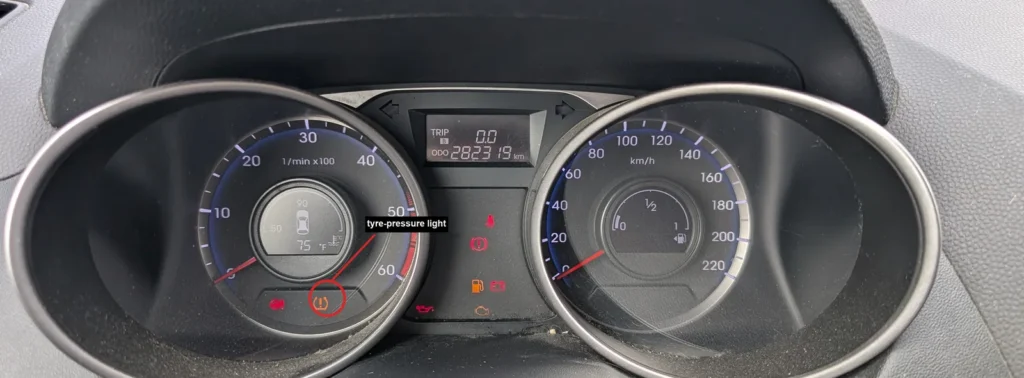
- Set every tyre to the correct cold pressure shown on the placard in the driver’s door opening.
- Turn the ignition on and start the vehicle.
- Drive the vehicle for about 10 minutes.
- Keep the speed above 25 km/h (15 mph) during that time so the system can relearn the pressures.
- The tyre-pressure warning light goes out once the system has updated to the new pressures.
Good to know
Always set the pressures correctly before you set off, because the system simply learns whatever it reads while you drive. If you reset against a tyre that is still low, that low reading becomes the new baseline.
If the warning light stays on after a proper 10-minute drive, one tyre is probably still below its target pressure, or a wheel sensor may be faulty and need checking. A tyre-pressure light that flashes rather than glowing steadily usually points to a sensor fault, not simply low pressure.
FAQ
How do I reset the ix35 tyre-pressure light?
Set all four tyres to the correct cold pressure from the door-opening placard, then drive for about 10 minutes while keeping above 25 km/h (15 mph). The light clears itself once the system has relearned the new pressures.
Is there a reset button for the tyre-pressure monitor?
No. The ix35 has no SET button for this system — it relearns automatically by driving after you have corrected the pressures.
The light stays on after I reset it. What now?
Recheck each tyre against the placard, as one is likely still low. If they are all correct and the light remains on, a wheel sensor may be faulty and should be checked.
Why is my tyre-pressure light flashing?
A flashing light usually indicates a sensor fault rather than simply low pressure, so the monitoring system itself needs checking.
Independent guide — not affiliated with Hyundai. Always follow your official service manual and safety precautions. Read our full disclaimer.