These instructions apply to the Hyundai i10 Mk1 (PA) 2008-2013.
For other models, please choose your vehicle here.
Verified specifications for the Hyundai i10 (PA, 2008-2013), covering the 1.1 (G4HG) and 1.2 (Kappa) petrol engines sold in Europe.
Each column is one specific vehicle — a single engine or motor and, where shown, body style. Dimensions and several weights are specific to that body and drivetrain; other body or powertrain versions differ, so match the column to your own vehicle.
| 1.1 (G4HG) PetrolEU | 1.2 (G4LA Kappa) PetrolEU | |
|---|---|---|
| Length | 3,565 mm | 3,565 mm |
| Width (excl. mirrors) | 1,595 mm | 1,595 mm |
| Height | 1,540 mm | 1,540 mm |
| Wheelbase | 2,380 mm | 2,380 mm |
| Track (front / rear) | 1,400 / 1,385 mm | 1,400 / 1,385 mm |
| 1.1 (G4HG) PetrolEU | 1.2 (G4LA Kappa) PetrolEU | |
|---|---|---|
| Kerb weight | — | 1,005 kg |
| Gross vehicle weight | 1,405 kg | — |
| Payload (approx.) | — | — |
| Max axle load, front | 750 kg | — |
| Max axle load, rear | 740 kg | — |
| Towing (braked trailer) | 700 | — |
| 1.1 (G4HG) PetrolEU | 1.2 (G4LA Kappa) PetrolEU | |
|---|---|---|
| Engine code | G4HG | G4LA |
| Fuel | Petrol | Petrol |
| Cylinders / layout | 4, in line | 4, in line |
| Displacement | 1,086 cc | 1,248 cc |
| Max power | 49 kW (67 PS) @ 5,500 rpm | 57 kW (78 PS) @ 6,000 rpm |
| Max torque | 98 Nm @ 2,800 rpm | 118 Nm @ 4,000 rpm |
| Aspiration | Naturally aspirated | Naturally aspirated |
| Emission standard | Euro 4 | Euro 4 |
| 1.1 (G4HG) PetrolEU | 1.2 (G4LA Kappa) PetrolEU | |
|---|---|---|
| 0–100 km/h (0–60 mph) | — | — |
| Top speed | 151 km/h | 164 km/h |
| Drive | Front-wheel drive | Front-wheel drive |
| Transmission | 5-speed manual | 5-speed manual |
| 1.1 (G4HG) PetrolEU | 1.2 (G4LA Kappa) PetrolEU | |
|---|---|---|
| Fuel consumption (combined) | 5.0 l/100km (NEDC) | 5.0 l/100km (NEDC) |
| Urban / extra-urban | 6.1 / 4.4 l/100km (NEDC) | 6.3 / 4.3 l/100km (NEDC) |
| CO₂ (combined) | 119 g/km (NEDC) | 119 g/km (NEDC) |
| Fuel tank | 35 L | 35 L |
| Drive-by noise | — | — |
| 1.1 (G4HG) PetrolEU | 1.2 (G4LA Kappa) PetrolEU | |
|---|---|---|
| Front brakes | Ventilated discs | Ventilated discs |
| Rear brakes | — | — |
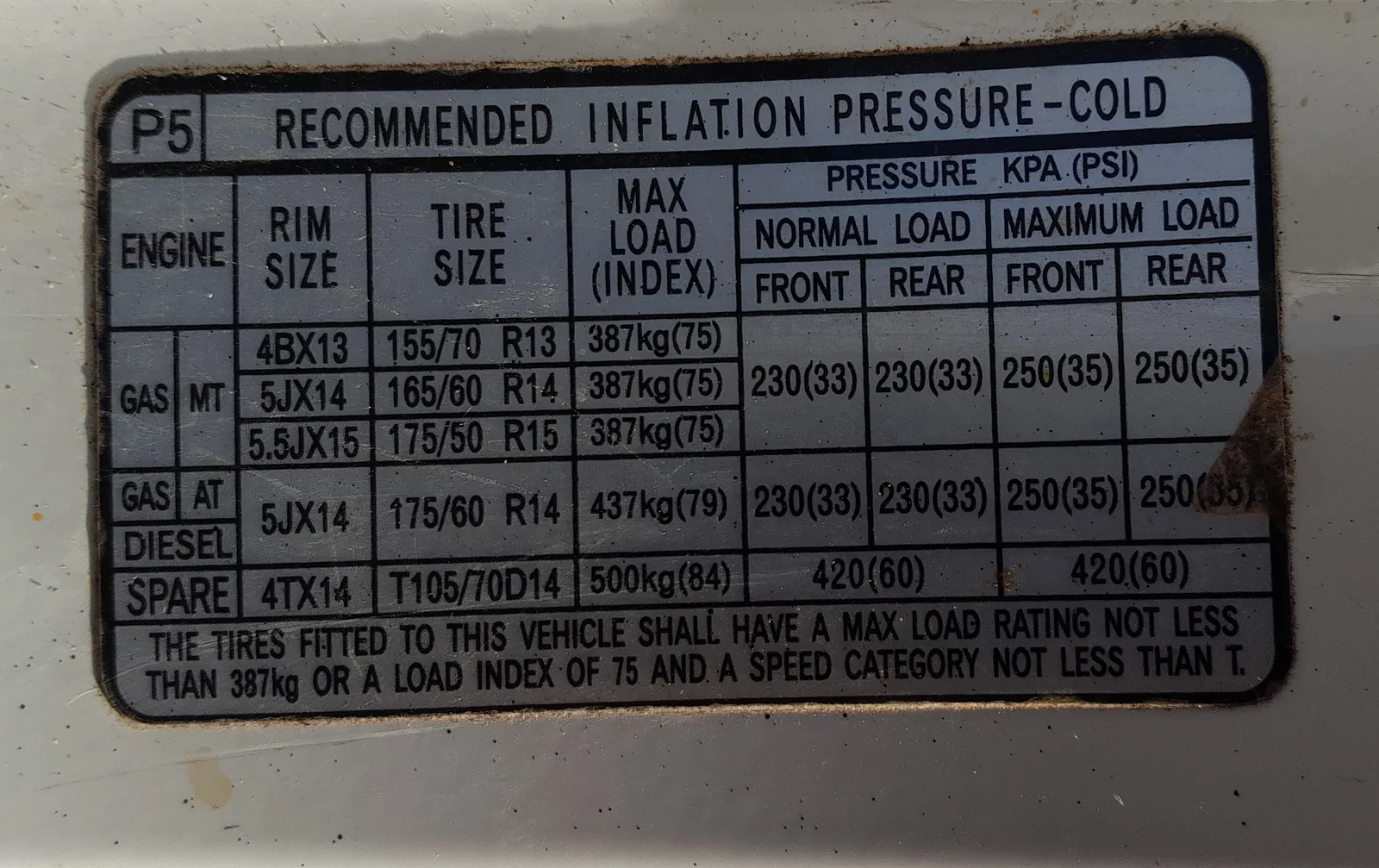
| Tyre sizes | 165/60 R14 (155/70 R13 and 175/50 R15 also fitted) | 165/60 R14 (155/70 R13 and 175/50 R15 also fitted) |
| Rim sizes | 5J x 14 (4B x 13 / 5.5J x 15) | 5J x 14 (4B x 13 / 5.5J x 15) |
| Tyre pressures, normal (front / rear) | All fitted sizes, up to 3 occupants: 2.3 bar / 33 psi front and rear | All fitted sizes, up to 3 occupants: 2.3 bar / 33 psi front and rear |
| Tyre pressures, laden (front / rear) | Full load: 2.5 bar / 35 psi front and rear · compact spare T105/70 D14: 4.2 bar / 60 psi | Full load: 2.5 bar / 35 psi front and rear · compact spare T105/70 D14: 4.2 bar / 60 psi |
| Wheel-nut torque | 88-107 Nm | 88-107 Nm |
| 1.1 (G4HG) PetrolEU | 1.2 (G4LA Kappa) PetrolEU | |
|---|---|---|
| Engine oil (with filter) | 3.0 L · API SL or above / ACEA A3+ | 3.5 L · API SL or above / ACEA A3+ |
| Coolant | Ethylene-glycol based long-life coolant | Ethylene-glycol based long-life coolant |
| Gearbox oil (manual) | 1.9 L · API GL-4 SAE 75W/85 (fill for life) | 1.9 L · API GL-4 SAE 75W/85 (fill for life) |
| 12 V battery | 40 Ah | 40 Ah |
| Air-con refrigerant | R-134a | R-134a |
| Spark plugs | — | — |
| Spark-plug gap | — | — |
Sources: Owner's manual · Workshop data. Where an owner’s manual or homologation figure exists it takes precedence; workshop data fills only what those omit.
Dimensions, engine, economy, recommended tire pressures and fluid capacities above are drawn from the EU owner’s manual, the car’s type-approval and tire-pressure labels, and manufacturer data. The air-conditioning refrigerant charge weight will be added in a later update.
Need to reset the service light or a warning after work? See our other Hyundai i10 guides, or look up a fault code on autodtcs.com.
Independent guide — not affiliated with Hyundai. Always follow your official service manual and safety precautions. Read our full disclaimer.