These instructions apply to the Suzuki Swift Mk2 (RS) 2004-2010.
For other models, please choose your vehicle here.
Turn the key in your Suzuki Swift and the dashboard lights dim, the starter just clicks, or nothing happens at all? That is the classic sign of a flat 12-volt battery. This guide follows Suzuki’s own jump-starting sequence for the Mk2 Swift (2004–2010), covering the 1.3, 1.5 and 1.6 Sport petrol engines and the 1.3 DDiS diesel.
The Swift’s 12-volt battery sits in the engine bay. A quick check first: turn the ignition to START with the headlights on. If the lights go dim or die, the battery is flat (or a terminal is loose). If they stay bright but the starter is silent, you may have a fuse or electrical fault instead, not a flat battery.
Before you start: safety checks
- Never jump-start a battery that looks frozen, cracked or is leaking — it can explode.
- Use only a 12-volt donor battery. A 24-volt supply will damage the Swift’s electrics.
- No smoking, flames or sparks near either battery — batteries give off flammable hydrogen gas.
- If the donor battery is in another car, make sure the two vehicles do not touch each other, and set the parking brake firmly on both.
- Keep your hands and the jumper leads clear of the drive belts, pulleys and cooling fans.
- Never try to push- or tow-start a Swift. Suzuki warns this can permanently damage the catalytic converter — always use jump leads.
How to jump-start a Suzuki Swift
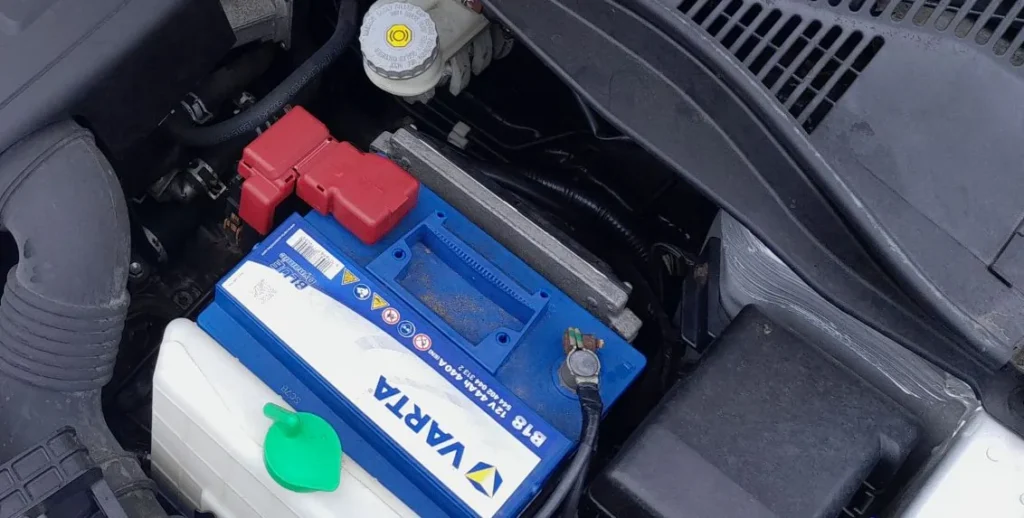
- Position the donor car close enough for the leads to reach both batteries, without the two cars touching. Apply the parking brake fully on both cars and switch off both ignitions.
- Turn off all accessories — air conditioning, stereo, heated rear screen — leaving on only what you need for safety, such as headlights or hazard lights.
- Connect one end of the first (red) lead to the positive (+) terminal of the flat battery in your Swift.
- Connect the other end of that red lead to the positive (+) terminal of the donor battery.
- Connect one end of the second (black) lead to the negative (−) terminal of the donor battery.
- Make the final connection to a clean, unpainted heavy metal part of your Swift’s engine — Suzuki specifies the engine lifting hook. Do not clamp it to the negative terminal of your dead battery; connecting there can cause an explosion.
- If the donor battery is in another car, start that car’s engine and let it run at a moderate speed.
- Start your Swift’s engine. If it does not fire within a few seconds, wait a moment and try again rather than cranking continuously.
- Once your Swift is running, remove the leads in the exact reverse order: the ground point on your engine first, then the donor negative, then the donor positive, and finally your Swift’s positive terminal.
After a jump-start, drive for at least 20–30 minutes (or run the engine) so the alternator can put some charge back into the battery before you switch off again.
If your Swift goes flat repeatedly for no obvious reason, Suzuki advises having the vehicle inspected rather than jump-starting it each time. A battery that keeps dying usually points to an aging battery, a parasitic drain, or a charging-system fault — have the battery and alternator tested, and watch for the battery/charge warning light staying on while driving.
Frequently Asked Questions
Where do I connect the earth clamp on a Suzuki Swift?
Connect the final (negative) clamp to a clean, unpainted heavy metal part of the engine — Suzuki’s manual points to the engine lifting hook. Do not connect it to the negative terminal of the flat battery. Grounding away from the battery keeps any spark clear of the hydrogen gas the battery gives off, which is why Suzuki warns an explosion can occur if you clamp onto the dead terminal.
Why does my Swift keep going flat?
If the battery drains repeatedly for no clear reason, have the car checked rather than just re-jumping it. Common causes on the Mk2 Swift are a battery near the end of its life, a parasitic draw (an interior light, boot light or aftermarket accessory left live), or an alternator that is not charging. Ask a workshop to load-test the battery and check the charging voltage. A battery warning light that stays on when driving is a strong clue the alternator is not keeping up.
Can I jump-start a Swift automatic or 1.3 DDiS diesel?
Yes — the lead sequence is identical for every Mk2 Swift, petrol or diesel, manual or automatic. On the 4-speed automatic there is one extra point: when the 12-volt battery is dead, the electric park-lock can stop you shifting out of P. Suzuki notes that jump-starting usually clears this. The 1.3 DDiS diesel uses glow plugs, so after a jump-start wait for the glow-plug light to go out before cranking.
If a warning light stays on after you get the Swift started, read the stored fault code to see what the car is flagging — our sister site autodtcs.com explains what each OBD-II trouble code means.
This guide is for general information only. Always follow the procedures in your own Suzuki owner’s manual, and consult a qualified mechanic if you are unsure. ServiceReset is not affiliated with or endorsed by Suzuki.
Independent guide — not affiliated with Suzuki. Always follow your official service manual and safety precautions. Read our full disclaimer.