These instructions apply to the Toyota Yaris Mk3 (XP130/P13) 2011-2020.
For other models, please choose your vehicle here.
The third-generation Toyota Yaris (XP130/P13, 2011–2020) has one-touch up and down on the driver’s window across all trims and on all four windows from the 2014 facelift’s mid- and high-spec variants. After any event that interrupts power to the door module — battery disconnection, fuse work, a window regulator replacement — the one-touch feature stops working and the anti-pinch protection runs in safety-default mode. The fix is a 20-second per-window procedure that you run from inside the car with the door closed and the ignition on.
Before you start
The Mk3 Yaris uses a Toyota-typical “press up to close, press down to open” switch action, with a second detent for one-touch. The window control module sits inside each door — there is no central window ECU as such — so each door initialises independently. Hybrid variants (1.5 1NZ-FXE) share the same window hardware as the petrol cars and run the procedure identically.
- Battery voltage matters. A motor running on a sagging 12 V supply will appear to stall before the true top-of-travel; the module reads this as the upper end-stop and the resulting calibration is wrong. If the car has been stood for a week, run the engine for 5 minutes before starting.
- Sit in the car with the door closed. Many owners try to run the procedure from outside with the door open and get inconsistent results — the door’s tilt position affects window movement just enough to confuse the calibration.
- Don’t run the procedure if the door wiring loom has not been fully reseated after door card removal. A connector that’s only partially clicked will make the windows behave but lose initialization within a few key cycles.
Tools required
None for the procedure itself. Useful diagnostics:
- Multimeter to confirm battery rest voltage of 12.4 V or higher
- Scan tool with body module access — only needed if the manual procedure refuses to take
Initialization procedure — driver’s side
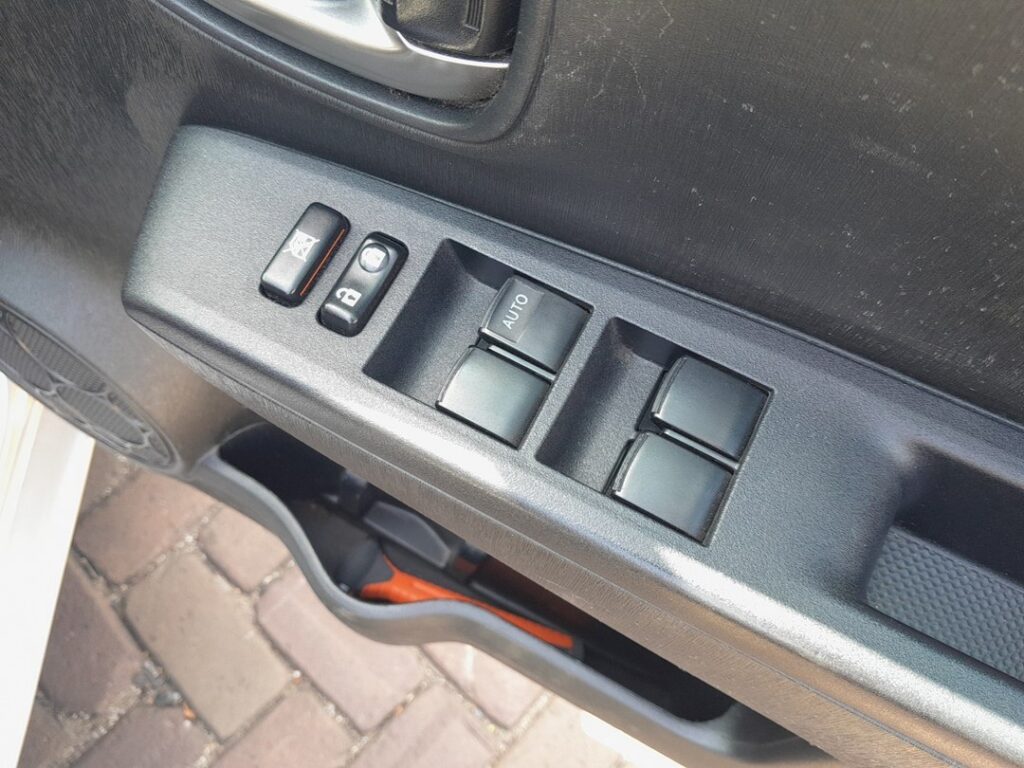
- Switch the ignition to ON (push the START button once without your foot on the brake, on cars with push-button start; key to position II on cars with a mechanical key).
- Press the driver’s window switch fully down (second detent) and release. The window should travel all the way to fully open in auto mode. If it stops half-way, hold the switch in the first detent until fully open.
- Pull the driver’s window switch fully up (second detent) and release. The window should travel all the way closed.
- Once the window reaches the top, hold the switch in the up position for at least 1 second. This is the calibration trigger — the module records the position as the upper end-stop.
- Release. Test one-touch up and down with short presses to confirm both directions work in auto mode.
Initialization procedure — other windows (facelift four-window cars)
On cars with one-touch on all four windows, repeat the procedure from each individual door switch — the master panel on the driver’s door can move the other windows but cannot calibrate them.
- From inside the relevant door, press down to fully open, release.
- Pull up to fully close, hold for 1 second at the top, release.
- Test with short presses to confirm one-touch.
How to verify it has worked
- A brief press in the second detent should make the window travel its full range without you holding the switch.
- An obstruction at the seal — your hand on the top of the glass as it closes — should make the window reverse by approximately 10 cm. This is the anti-pinch confirming.
- The “global close” function via the key fob (hold lock button, all windows close — only on certain trim levels) should still work. If it doesn’t, the BCM has not received the new calibration and you need to re-run the per-window procedure with the door closed.
If Something Goes Wrong
Window goes up halfway then reverses on its own. The anti-pinch is triggering on phantom resistance. Two likely causes: dry window felt (silicone-spray the channel and cycle five times), or a slipped glass in the regulator (audible “creak” — the glass needs re-tightening to the lift channel).
One-touch down works but one-touch up does not. The upper end-stop did not register. Repeat the procedure but hold the switch up for 3 seconds instead of 1 once the window is fully closed. If still no luck, the issue is electrical: a corroded earth at the door hinge boot (rocking the door several times often briefly restores function — definitive fix is to dismantle the harness and re-pin the affected wires).
The procedure works on the driver’s window but not on others on a facelift car. The cabling between the driver’s master panel and the other door modules carries data; a corroded pin can pass switch movement but block the calibration handshake. Run the procedure from each individual door’s own switch, with the door closed.
The window slams shut hard at the top instead of slowing as it reaches the seal. The soft-close ramp is part of the calibration. Re-run the procedure and pay attention to step 4 — the 1-second hold at the top is what the module uses to record the soft-close ramp.
Initialization works briefly but vanishes after the next start. The window ECU is losing power between key-cycles, usually because of a damaged wire in the door-pillar rubber boot. The driver-side boot on this generation has a known failure point at the second-from-bottom flex point; FORScan or an aftermarket OBD tool will log B-codes if the door module sees intermittent power.
Frequently asked questions
Why does the Toyota Yaris need this procedure when older cars didn’t?
Older cars without anti-pinch protection just ran the motor to a current spike, then stopped. The Yaris Mk3 (and almost every car from 2011 onwards) uses a Hall-effect motor encoder to count position pulses against a learned upper end-stop. When the encoder loses power, the count is gone and the module has to re-learn where the top is.
Do hybrid Yaris cars run a different procedure?
No. The 1.5 hybrid uses identical window hardware to the 1.0, 1.33, and 1.5 petrol variants. The procedure works the same way on all of them.
Will the windows continue to work without initialization?
Yes — they go up and down while you hold the switch, in what’s effectively manual mode. You lose: one-touch in either direction, anti-pinch protection, and the global-close function via the remote. There is no risk of damaging the window mechanism; it just behaves like a car from 1995.
How often will I need to do this?
Only after a power interruption — battery disconnection, fuse pulled, window module unplugged, or a heavy electrical fault. A normal Yaris in normal use will hold its calibration for the life of the car.
Can I disable anti-pinch on the Yaris?
Not from the cabin. The setting is fixed in the firmware. You can suppress it momentarily by holding the switch in the up position continuously while obstructed (the motor will still stop on hard mechanical resistance, but won’t reverse as readily) — this is the legitimate way to free a stuck or frozen window.
For B-prefixed diagnostic trouble codes that won’t clear after re-initialization, see autodtcs.com.
Independent guide — not affiliated with Toyota. Always follow your official service manual and safety precautions. Read our full disclaimer.