These instructions apply to the Toyota Yaris Mk3 (XP130/P13) 2011-2020.
For other models, please choose your vehicle here.
The third-generation Toyota Yaris (XP130/P13, 2011–2020) has a conventional 12-volt electrical architecture on petrol variants and a 12-volt plus 144 V high-voltage system on the hybrid (1.5 1NZ-FXE). Disconnecting the standard 12-volt battery is straightforward on either, but the post-reconnect re-learns vary by trim — and a careless reconnection on a hybrid can leave the car with a permanent fault light that needs Toyota Techstream to clear. This guide covers safe disconnect/reconnect on the petrol Yaris (1.0 1KR-FE, 1.33 1NR-FE, 1.5 2NR-FKE), with hybrid-specific notes where they differ.
Before you start
The 12-volt battery on the petrol Yaris sits in the engine bay front-right corner (RHD UK/IRL spec) or front-left (LHD EU spec), held by a single 10 mm hold-down clamp at the base. On the hybrid, the same 12-volt auxiliary battery is in the boot, under the floor on the driver side, and a separate high-voltage traction battery sits under the rear seat — only the 12 V battery is involved in this procedure.
- Pyrotechnic safety wait — 90 seconds. The airbag capacitors discharge within 90 seconds of negative-terminal removal. Don’t touch airbags, pretensioners, or the steering column before then.
- Open a window before you start. If the central locking gets confused after reconnection, you’ll need to manually unlock from outside; an open window gives you a route in.
- Hybrid only: ensure the READY light is fully extinguished and the power button has been pressed twice to confirm the car is in OFF mode, not standby. Disconnecting the 12 V battery on a hybrid that hasn’t fully powered down can log “loss of 12 V” in the hybrid control unit and trigger a non-clearable warning.
- Smart charger if possible. A memory-saver lead through the OBD-II port preserves the radio presets, clock, and ECU adaptations.
Tools required
- 10 mm spanner or socket
- Optional: memory-saver with 9 V supply, terminal brush, terminal grease
- Hybrid only: insulated gloves recommended for any work near the orange high-voltage cables (the procedure here only touches the 12 V circuit, but it’s good practice)
Disconnect procedure
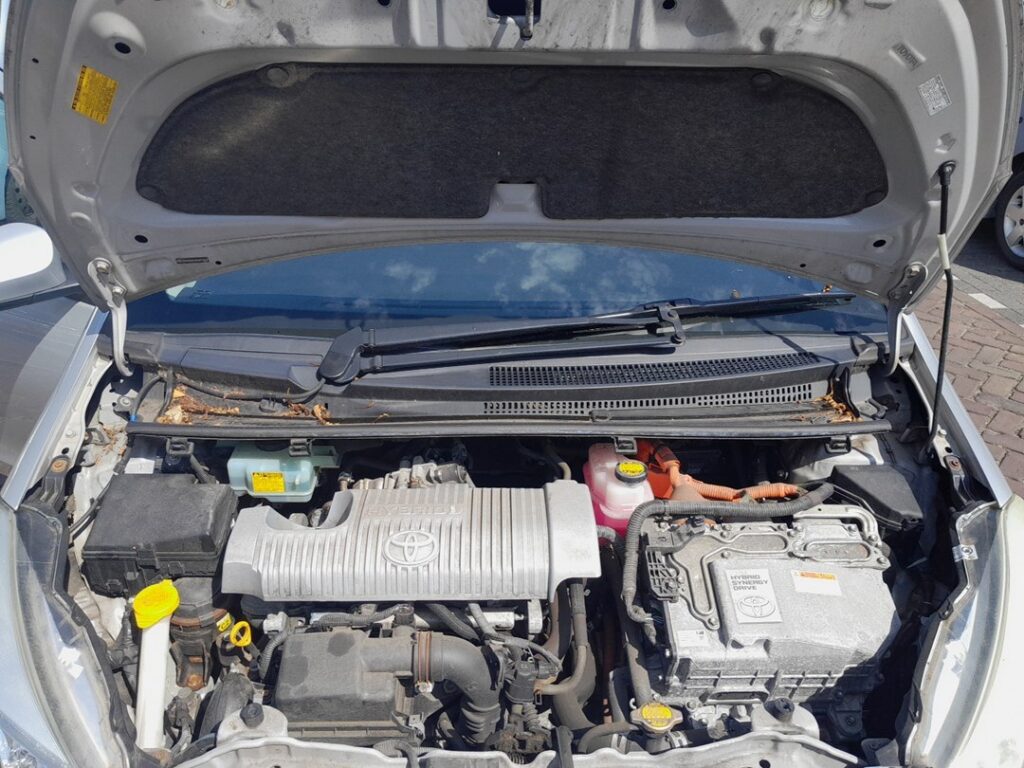
- Switch the ignition OFF and remove the key (or press the power button to OFF on push-button-start cars). Wait one full minute for control modules to enter sleep state.
- Open a front window, then open the bonnet (on the petrol car) or the boot floor (on the hybrid).
- Loosen the negative (−, black) terminal nut with the 10 mm. Lift the clamp clear of the post.
- Loosen the positive (+, red) terminal nut. Cover the exposed positive post with a clean rag if the work will take a while.
- If removing the battery: undo the hold-down clamp (single 10 mm bolt at the base) and lift the battery straight up. The petrol car battery weighs about 11 kg; the hybrid auxiliary battery is smaller (around 8 kg).
Reconnect procedure
- Clean both posts and clamps with a wire brush until they are bright.
- Fit the battery and secure the hold-down clamp before any cable work.
- Connect positive (+) first. Tighten to 5 Nm.
- Connect negative (−) second. Tighten to 5 Nm.
- Apply a thin film of terminal grease on the outside of the joint to keep moisture out.
- Switch ignition ON without starting and observe the cluster. Most lamps illuminate briefly and clear. The airbag lamp may stay on for 2–3 seconds.
Post-reconnection tasks
- Set the clock via the trip-meter button on the cluster (hold to enter the menu, briefly press to advance digits).
- Reset the trip meters A and B if you track fuel economy.
- Re-pair the head unit if needed. The Toyota Yaris factory head unit on this generation does not require a radio code — Toyota dropped that requirement around 2010 — but it will lose its station presets and Bluetooth pairings.
- Re-initialize the electric windows — see Toyota Yaris electric windows initialize. Without this, one-touch up/down doesn’t work.
- Re-initialize the Start & Stop system (on equipped petrol variants) — see Toyota Yaris Stop & Start initialize. The system will be disabled until the BMS has re-sampled the 12 V battery state of charge through a drive cycle.
- Drive in a straight line at 30 km/h or above for at least 1 minute to allow the steering angle sensor to re-zero. Then slowly full-lock left, return centre, slowly full-lock right. This clears the ABS/VSC lamp pair that often appears after a battery disconnect.
- Hybrid only: the hybrid control unit re-checks the 12 V auxiliary battery for the first 15–20 minutes of driving. A “HV system fault” warning that appears during this period and clears within 5 minutes is normal. If it persists past 30 minutes of driving, a scan with Techstream is needed.
- For TPMS-equipped cars (most Yaris from 2014 onwards): the indirect TPMS re-learns wheel rotational speeds automatically over the first 20 minutes of driving. Check tyre pressures cold before this drive so the system learns clean data.
When It Won’t Cooperate
Warning lights stuck on after reconnection. Most common: ABS and VSC together, caused by the steering angle sensor needing a re-zero. Drive straight for a minute, then full-lock both ways. Second most common: the airbag lamp from a momentary terminal short during the work — clears with one normal drive cycle, or sooner with a generic OBD-II tool that supports body codes (Carista or OBDeleven work; basic generic ELM327 readers don’t).
Engine cranks but won’t start. Unique to push-button-start cars: the smart key may have lost sync. With the brake pedal pressed, touch the smart key directly to the START button (cars from 2015 onwards have a backup induction antenna in the button) and press. This forces a direct authentication.
The Start & Stop system shows “A OFF” permanently. Normal for the first 20–30 minutes of driving while the BMS re-samples. If it persists past one full drive cycle, the battery state of charge is too low to satisfy the system’s gate. Put the car on a smart charger overnight and try again.
Hybrid: dashboard shows triangle warning and “Stop the vehicle in a safe place”. Stop, switch off, and wait 30 seconds. Restart. If the warning persists, the hybrid control unit has logged a 12 V supply fault that needs Techstream to clear. Don’t continue driving — call a recovery service. This is rare but specific to hybrids where the 12 V battery dropped voltage mid-disconnect.
Idle is high (1,300+ rpm) for the first 5 minutes. Normal — the ECU is re-learning idle adaptation. Let it idle from cold for 3 minutes (no accessories), then drive normally.
Frequently asked questions
Does the Toyota Yaris need battery registration after replacement?
No — neither petrol nor hybrid variants of the Mk3 have a “battery type” coding requirement. Fit any battery that meets the original Toyota specification (typically 45–50 Ah, 360–430 A CCA for 1.0 and 1.33 petrol; 45 Ah for the hybrid auxiliary battery; EFB for Stop & Start variants from 2014 onwards) and it will work.
Can I jump-start a hybrid Yaris from another car?
Yes — the hybrid Yaris has the same 12 V jump-start procedure as a petrol car. The 12 V auxiliary battery in the boot is what gets jump-started; the high-voltage hybrid pack is unrelated. Use the dedicated positive jump-start post under the bonnet (red plastic cover, marked “+”) and a chassis earth point — do not connect directly to the auxiliary battery terminals in the boot.
What’s the OEM 12 V battery spec for the Yaris Mk3?
1.0 1KR-FE (manual): 45 Ah, 360 A CCA, type EN45 (LB1). 1.33 1NR-FE (manual): 45 Ah. 1.33 1NR-FE (MultiDrive S CVT): 50 Ah, 400 A CCA. Stop & Start petrol: 45–50 Ah EFB. Hybrid 1.5 1NZ-FXE auxiliary: 45 Ah, EN45. All can be 12 V flooded; EFB is required for Stop & Start cars.
How long can I leave the battery disconnected?
Indefinitely on the petrol car — nothing degrades. On the hybrid, leaving the 12 V auxiliary battery disconnected for more than 4 weeks can cause the hybrid pack’s battery management to log a “long-term loss of communication” code; clearing this requires Techstream.
Should I use the battery charger while it’s still connected to the car?
On the Yaris Mk3, yes — the electronics tolerate a smart charger’s 14.4–14.7 V output. Use the dedicated 12 V jump-start point under the bonnet rather than reaching to the battery terminals, especially on the hybrid where the battery is in the boot.
For DTCs that won’t clear after the disconnect, see autodtcs.com.
Registering or Coding the New Battery
Usually not. Most models here manage the battery without a coded registration, so a like-for-like replacement needs only a short relearn drive. Some newer models with a battery current sensor benefit from a reset via a diagnostic tool — check your handbook.
Independent guide — not affiliated with Toyota. Always follow your official service manual and safety precautions. Read our full disclaimer.