These instructions apply to the Toyota Yaris Mk3 (XP130/P13) 2011-2020.
For other models, please choose your vehicle here.
The Tire Pressure Monitoring System (TPMS) on the Toyota Yaris XP130 (2011–2020) warns you on the cluster when one or more tires drop below the safe pressure threshold. After tire maintenance — adding air, swapping wheels, rotating tires, or fitting a new set — the system needs a manual re-initialization so it has a fresh baseline to monitor against. The Yaris uses a single TPMS reset button rather than a menu-based procedure.
Toyota Yaris recommended tire pressures (2011–2020)
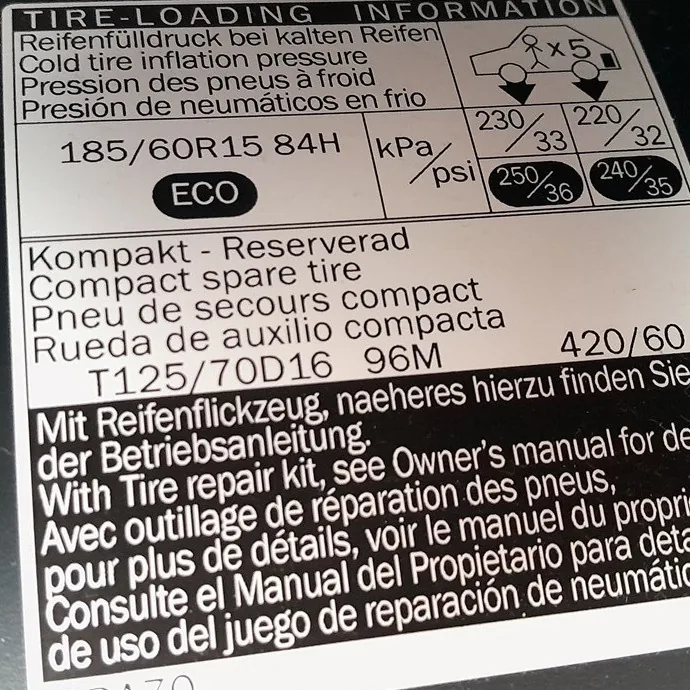
Most Toyota Yaris XP130s run 33 psi (2.3 bar) at the front and 32 psi (2.2 bar) at the rear when the tires are cold, on the common 15-inch wheels — and the figures are the same for the petrol and hybrid models. The 16-inch wheel runs a little lower at the rear, and some cars carry a higher “ECO” option, so check the table and your door placard.
| Tire size | Front (cold) | Rear (cold) |
|---|---|---|
| 175/65 R14 | 2.2 bar (32 psi) | 2.2 bar (32 psi) |
| 175/65 R15 | 2.3 bar (33 psi) | 2.2 bar (32 psi) |
| 185/60 R15 | 2.3 bar (33 psi) | 2.2 bar (32 psi) |
| 195/50 R16 | 2.2 bar (32 psi) | 2.0 bar (29 psi) |
| Space-saver spare | 4.2 bar (60 psi) | |
Standard cold pressures from the Toyota owner’s handbook — identical for petrol and hybrid Yaris. Some cars also show a higher “ECO” pressure on the door label, about 2.5 / 2.4 bar (36 / 35 psi), for better economy. On 195/50 R16, raise to 2.4 / 2.1 bar (35 / 30 psi) for sustained speeds above 160 km/h (99 mph); add 0.2 bar (3 psi) when towing. Check pressures cold; the placard in the driver’s door jamb is the authority for your exact car.
When a TPMS Reset Is Required
- After adjusting tire pressures (even just topping up one wheel).
- After replacing one or more tires or wheels.
- After rotating tires between axles or side-to-side.
- After a seasonal swap between summer and winter wheels.
- After a battery disconnect if the warning light comes on incorrectly.
Before You Begin
- Inflate all four tires to the cold pressure listed on the door-jamb placard. The placard pressure is a cold figure — set it before the car has been driven, or after it’s been parked for at least three hours.
- Park on a level surface with the engine off.
- Locate the TPMS reset button — on most Yaris XP130 trims it’s under the steering wheel, low on the dash, marked with the tire cross-section icon.
What You’ll Need
- An accurate tire-pressure gauge (digital pencil gauges are reliable; the gauges built into petrol-station compressors are often inaccurate by ±3 psi).
- A compressor or foot pump to set pressures cold.

TPMS Reset — Step-by-Step
- Park on a level surface with the engine off.
- Turn the ignition to ON (do not start the engine).
- Press and hold the TPMS reset button until the TPMS warning light on the cluster blinks slowly three times (about 3 seconds of holding).
- Release the button.
- Switch the ignition OFF.
- Turn the ignition ON again. The TPMS light should be off — or in some cases flash for a few minutes while the system stores new readings.
Verify the Reset Worked
After the reset, drive a few miles at normal speed. The TPMS light should stay off. If your Yaris is fitted with the multi-info display, individual tire pressures (or just the warning status) will show normal values once each wheel sensor has reported in — usually within the first kilometer.
Verification With a Diagnostic Tool (Optional)
If you have access to a Toyota Techstream or an OBD-II scan tool with Toyota module support, you can confirm the reset by:
- Connecting the scan tool to the OBD-II port (under the steering wheel on the Yaris XP130).
- Selecting the Tire Pressure Monitoring module from the system menu.
- Choosing Monitoring Data or equivalent.
- Confirming the system status shows Complete or Calibrated.
For owners without a scan tool, the cluster warning light is the authoritative indicator — there’s no need to verify with diagnostics in normal use.
If Something Goes Wrong
- Warning light comes back on within a few miles. The reset succeeded but at least one tire is genuinely losing pressure. Check pressures cold again the next morning; a tire that’s dropped by more than 2–3 psi overnight has a slow leak that needs investigating.
- Reset button can’t be found. On some Yaris trims (notably the hybrid and certain JDM/EU variants) the reset is done through the multi-info display menu instead of a dedicated button. Navigate: Menu → Tire Pressure → Set using the steering-wheel info-display controls.
- Warning light won’t go out at all. A sensor may be missing or failed. If you’ve recently fitted aftermarket wheels with non-OEM sensors, check that the sensors are compatible with the Yaris’s protocol (315 MHz Toyota, not the European 433 MHz used on some other brands).
- Reset works but the light returns every cold morning. Tire pressure drops about 1 psi per 5 °C drop in temperature. If pressures were set on a warm day and you’re now in winter, all four tires may genuinely be below the threshold — top them up to the placard value and reset again.
Frequently Asked Questions
Does the Yaris use direct or indirect TPMS?
It depends on the model year and market. Early XP130 (2011–2014) European-market Yaris used indirect TPMS (calculated from ABS wheel-speed sensors, no wheel-mounted transmitters). 2015+ and most non-European markets use direct TPMS with a sensor in each wheel. The reset procedure above works for both — the underlying difference matters only for hardware diagnostics.
How long after the reset does the system need to “learn”?
On indirect TPMS, the system learns over the first 10–20 minutes of normal driving above 30 km/h. On direct TPMS, the system updates within the first kilometer. Either way, drive normally after the reset — there’s no special calibration drive needed.
Why does my Yaris’s TPMS warning come on in cold weather even with no leak?
Tire pressure drops as temperature falls. A 10 °C drop = roughly 2 psi loss. If you set tires to 32 psi on a 25 °C summer day and the temperature drops to 0 °C overnight, you’re now running 27 psi — below the warning threshold on most trims. This is the system working correctly; top up to the placard value and reset.
Does the spare wheel count toward TPMS?
On the Yaris XP130, the temporary “space-saver” spare doesn’t have a TPMS sensor and isn’t monitored. If you’re running the spare on the road, the system will continue to monitor the three real tires and show a sensor-missing warning for the wheel that’s been removed.
Independent guide — not affiliated with Toyota. Always follow your official service manual and safety precautions. Read our full disclaimer.