These instructions apply to the Toyota Yaris Mk3 (XP130/P13) 2011-2020.
For other models, please choose your vehicle here.
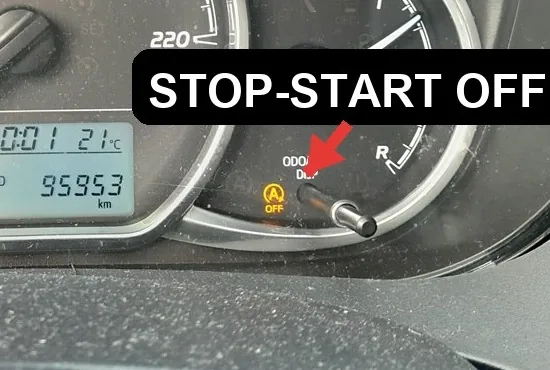
If your Toyota Yaris Mk3 (XP130/P13, 2011–2020) has had its 12-volt battery disconnected, replaced, or reconnected after a fault, the Stop & Start system often disables itself until the engine control unit and battery management system have re-learned the new battery’s state of charge. The dashboard usually shows the Stop & Start “A OFF” icon illuminated, or the system simply never triggers a stop at a red light. This is not a fault in the strict sense — it is the car waiting for evidence that the battery can support a restart cycle reliably. With a normal drive pattern, the Yaris re-initializes itself; below is what to do, how long it usually takes, and how to verify that it has worked.
Before you start
The Yaris Mk3 uses a relatively simple Stop & Start implementation compared to premium-brand systems, but it still relies on three conditions being satisfied before it will arm itself for the first auto-stop after a battery event:
- Battery state of charge ≥ ~75%. A freshly fitted battery rarely arrives full; one that was disconnected for hours may also have self-discharged. Top up with a smart charger overnight if the car has been sitting.
- Engine coolant warmed to operating temperature. The system will not arm with the temperature gauge below mid-scale.
- No active diagnostic faults. If a warning lamp came on during the battery work — ABS, airbag, electric power steering — the Stop & Start ECU will suppress auto-stops until that fault is cleared.
Most Mk3 Yaris cars on UK/EU specification share the same logic regardless of engine — 1.0 1KR-FE, 1.33 1NR-FE, 1.5 1NZ-FXE hybrid, or the 1.5 2NR-FKE in the 2017 facelift — although hybrid models manage the 12-volt auxiliary battery differently and do not have a conventional Stop & Start at all (the engine simply cycles via the hybrid system).
Tools required
None for the standard re-initialization. Optional for diagnosis:
- Smart charger capable of an absorption/maintenance cycle (CTEK MXS 5.0 or equivalent) — useful if the battery sat without load for more than a day.
- Digital multimeter — to confirm a healthy 12.6 V at rest before driving.
- OBD-II scanner with live data — only needed if the system does not re-initialize after the procedure below.
Re-initialization procedure
- Verify the battery. With the ignition off and the car untouched for at least an hour, measure battery voltage at the terminals. A healthy 12-volt battery rests between 12.5 V and 12.8 V. Anything below 12.3 V will not satisfy the Stop & Start state-of-charge gate, and the system will refuse to arm no matter how far you drive.
- Start the engine and let it idle for about a minute. Do not switch on heated rear screen, air conditioning compressor, or heated seats during this minute — they place a large load on the battery and skew the BMS reading.
- Drive normally for at least 20 to 30 minutes. The vehicle needs a mix of conditions — accelerating, cruising, and at least a few idle periods at junctions or traffic lights. A short urban hop will not give the BMS enough sample points; equally, a pure motorway run is too one-dimensional. A combined run is ideal.
- Leave the climate control set to a moderate target. Defrost mode on full power keeps the air conditioning compressor engaged, which prevents Stop & Start from arming and can stretch the re-init period unnecessarily. Set the temperature to about 21 °C and let the system manage itself.
- End the drive with a normal key-off cycle. Do not disconnect the battery again, do not pull fuses. The BMS needs the final sleep-current reading to confirm the battery is sound.
How to verify it has worked
The unambiguous test:
- On your next drive, with the engine fully warm, the gearbox in neutral (manual) or D with foot on brake (automatic), come to a complete stop at a red light or junction. The engine should shut down within one to two seconds.
- Releasing the clutch (manual) or lifting off the brake (automatic) should restart the engine in well under a second.
- The “A OFF” warning on the dashboard should no longer be illuminated.
If the system stops the engine once or twice but then refuses for the rest of the drive, that is normal cold-day behaviour — the BMS suppresses Stop & Start when it predicts the next start will draw the battery below its working threshold, particularly below about 3 °C ambient.
If Something Goes Wrong
The “A OFF” light stays on after 30 minutes of driving. Most likely cause: battery state of charge still below threshold. Put the car on a smart charger overnight and re-drive the next day. Second most likely: a stored fault code in another module (commonly the steering angle sensor after a battery disconnect) is suppressing Stop & Start at the network level.
The engine stops at red lights but won’t restart cleanly. This is not a Stop & Start initialization issue — it points to the battery itself, the starter, or the crankshaft position sensor. Stop using the system (press the “A OFF” button on the dashboard) and have the battery load-tested.
Stop & Start worked yesterday but won’t arm today. The Yaris BMS re-evaluates the battery on every key cycle. A cold morning, a short trip the day before, or accessories left on overnight can all suppress the system temporarily. This is normal protective behaviour, not a fault.
You fitted a new battery and the system still won’t arm. Some pattern-part batteries arrive with a state-of-charge as low as 60% and need a full conditioning cycle on a smart charger before they will pass the SoC gate. Toyota-specification batteries (EFB or AGM, depending on trim) also need to be the correct type — fitting a standard flooded battery to a car originally specified with EFB will leave Stop & Start permanently disabled, even though the engine itself runs fine.
Frequently asked questions
Do I need a scan tool to re-initialize Stop & Start on the Mk3 Yaris?
No — the standard driving cycle above is enough on this generation. A scan tool is only needed if the BMS rejects the battery (wrong type, wrong capacity) or if a stored fault code in another module is blocking the system.
How long does the BMS take to fully calibrate?
The Stop & Start function itself usually returns within 20 to 30 minutes of mixed driving. The BMS continues to refine its model of the battery for the next two to three weeks, but you will not notice this from the driver’s seat.
Can I damage anything by driving without Stop & Start during this period?
No. The engine, gearbox, and electrics all behave exactly as on a Yaris that was never specified with Stop & Start. Fuel consumption is marginally higher in city driving (a few percent) and otherwise identical.
Does fitting an AGM battery to a non-AGM-specified Yaris help?
Not without coding. The Mk3 Yaris does not have a user-accessible battery-type setting; the BMS expects whatever type the car left the factory with. Mis-matching the battery type leaves Stop & Start permanently disabled and can shorten the new battery’s life because the charge profile is wrong.
Is the auto-stop wearing out my starter motor?
The Yaris Mk3 uses a heavy-duty starter and a reinforced flywheel ring gear designed for hundreds of thousands of stop/start cycles. The system is not a measurable contributor to starter wear under normal use; it is far more important to keep the battery in good condition.
For diagnostic trouble codes that won’t clear and could be blocking Stop & Start re-initialization, see the related guidance at autodtcs.com.
Independent guide — not affiliated with Toyota. Always follow your official service manual and safety precautions. Read our full disclaimer.