These instructions apply to the Audi Q2 Mk1 (GA) 2016-Present.
For other models, please choose your vehicle here.
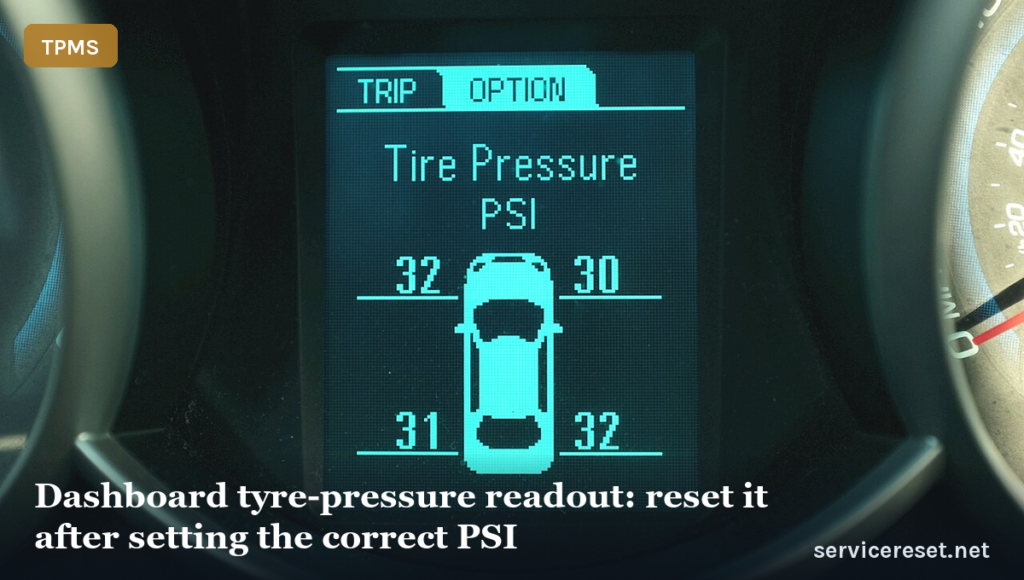
The Audi Q2 (GA, 2016–present) stores a reference set of tyre pressures, so after you inflate or change a tyre you tell it the new values are correct. You do that through the MMI menu. Here’s how. The amber tyre-pressure symbol that prompts this — a cross-section of a tyre with an exclamation mark — is not a breakdown warning in itself. It means the car is now seeing pressures that differ from the reference it last stored, which usually traces back to a soft tyre, a cold spell, or a wheel that has been swapped. Set the pressures correctly, store a fresh reference, and the light goes out.

How the System Works on This Model
The Q2’s tyre-pressure monitor generally works by comparison: it watches how fast each wheel turns through the ABS sensors and flags a tyre that starts rotating differently from the others. A tyre losing air has a slightly smaller rolling radius, so it spins fractionally faster, and the car notices. Because the monitor compares wheels against a stored reference rather than reading an exact PSI, it has to be told what ‘correct’ is after any pressure change — which is what storing the new values in the MMI does. Until you re-store, it keeps measuring against the old baseline.
Before You Begin
- Check pressures cold — before driving, or after the car has stood a few hours, since warm tyres read high.
- Set all four to the figure on the driver’s door-pillar label, using the laden value if you are carrying a heavy load.
- Confirm with your own gauge any tyre a garage has inflated.
- If a space-saver or a different wheel is fitted, set it to its correct pressure first.
- Have the ignition on and the car stationary before opening the MMI menu.
How to Store the New Pressures
- Adjust the pressures, then switch the ignition on.
- On the MMI, open ‘Vehicle’ (or the car/assist menu).
- Select ‘Service & checks’ → ‘Tyre pressure monitoring’ (wording varies by software).
- Choose ‘Store tyre pressures’ / ‘SET’ and confirm. A message confirms the new reference is saved.
If the Light Stays On
- Re-check every tyre with a gauge — the system compares wheels, so one low corner triggers it, and a 4–5 PSI drop is easy to miss by eye.
- Always re-store after inflating — the Q2 needs the new baseline saved before it will consider the pressures correct.
- Give it a short drive. The monitor gathers rolling data as you drive, so the light may take a few minutes of normal driving to clear.
- Cold snap? A sharp overnight drop can shed a couple of PSI — top up to the label figure and store again.
- Space-saver fitted? A narrow spare rolls at a different rate and can keep the warning lit until the full-size wheel is refitted.
- Same corner keeps dropping? Suspect a slow puncture and inspect the tyre and valve before storing over it.
- If pressures are correct and it still won’t clear, a wheel-speed/ABS sensor fault can upset the monitor and is worth scanning for.
After the Reset
With the new reference stored and a short drive completed, the warning should go out and stay out for the trip. The system now compares against the fresh baseline, so it will only warn again if a tyre genuinely drifts from where you set it. If the light returns within a day or two on the same wheel, treat it as a real leak rather than a glitch and have the tyre inspected.
Frequently Asked Questions
How do I reset the tyre pressure light on an Audi Q2?
Set all four tyres cold to the door-pillar figures first, then with the ignition on open the MMI and go to Vehicle → Service & checks → Tyre pressure monitoring and store the new values. Exact wording varies with the software version, but the option to save or ‘SET’ the current pressures as the reference is always there.
Do I need a tool?
No — the Q2 stores the reference through its own menu; no garage equipment is needed. There is nothing to plug in and no valve procedure. All you really need is an accurate gauge and a source of air so the pressures you save as ‘correct’ genuinely match the label figure before you store them.
Why does the light come on in cold weather?
Pressures drop as temperature falls — roughly 1–2 PSI for every 5 °C — so a cold morning can push a borderline tyre under the threshold. Top up to the label figure and re-store the reference. As long as the tyres are not actually leaking, the warning should stay off once you have set them correctly while cold.
It came on after a wheel change — why?
You moved the reference. Changing, rotating or replacing a wheel alters what the system sees, so re-run the store so the new pressures become the baseline. The same applies after a puncture repair or when switching between your summer and winter wheel sets.
Do I have to re-store after rotating the tyres?
Yes, it is worth doing. Even at the same pressures, swapping wheels between axles changes the rolling pattern the system has learned, so saving a fresh reference afterwards keeps the monitor accurate and prevents a nuisance warning appearing a few miles later. It only takes a moment in the same MMI menu.
Can I keep driving with the warning on?
You can drive, but check the pressures at the earliest safe chance. The light means a tyre may be low, and running underinflated harms handling, braking and tyre life. If a tyre is visibly deflating or the car feels unstable, stop and inspect it rather than continuing on a possibly damaged tyre.
If a fault code is stored, look it up on autodtcs.com. To clear a service reminder, see our Q2 service reset.
Independent guide — not affiliated with Audi. Always follow your official service manual and safety precautions. Read our full disclaimer.