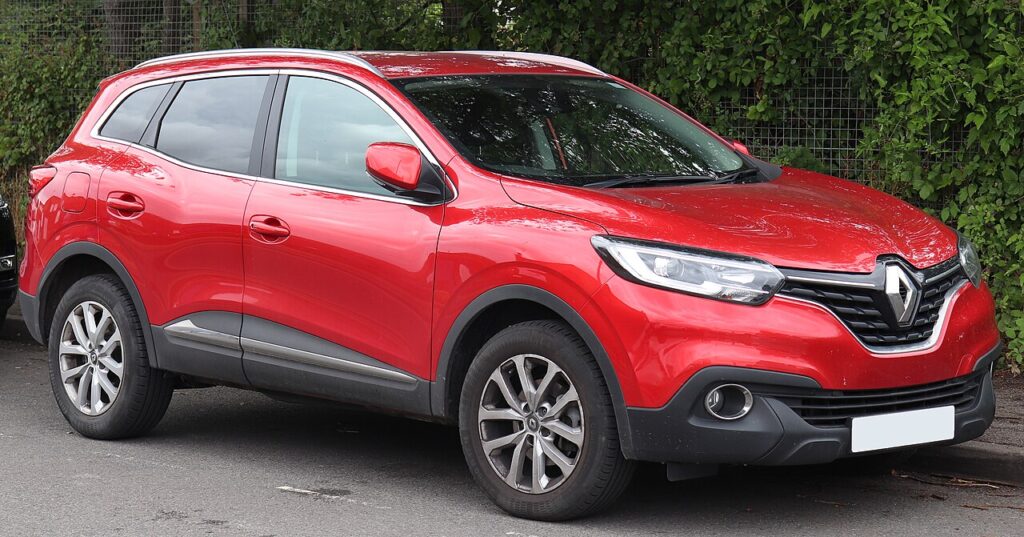
These instructions apply to the Renault Kadjar Mk1 (XFE) 2015-2022.
For other models, please choose your vehicle here.
If your Renault Kadjar (2015–2022) only unlocks when you hold the card right against the door handle, no longer lets you start hands-free without touching the card to the start button, or has flashed a “Card battery low” warning in the instrument cluster, the cause is almost always a flat coin cell inside the RENAULT card. The Kadjar doesn’t use a traditional bunch-of-keys fob at all — it uses Renault’s flat key card, supplied either as a standard (button) card or a hands-free card on higher trims. Both are the same physical card, both open the same way, and both take the same battery. Here is exactly how to tell a dying cell from a real fault, the cell you need, and how to swap it in a couple of minutes on your kitchen table.
How to Tell the Card Battery Is Dying
- Shrinking range. You have to stand right next to the Kadjar — or press the card against the door handle — before it will lock or unlock. This is the classic first symptom.
- Hands-free stops working. On keyless cards, walking up and pulling the handle no longer unlocks the car, and the push-button start won’t recognise the card until you hold it directly against the start button.
- A “Card battery low” message. The Kadjar shows a low-card-battery warning in the dash display once the cell voltage drops. It won’t always clear the instant you fit a new cell — more on that below.
- Cold-weather dropouts. Buttons that work at midday but not on a frosty morning point to a cell that is near the end of its life and sagging in the cold.
A card cell in a Kadjar typically lasts around two to four years. Renault’s own advice puts a well-used card at roughly two years, so if yours is that age and showing any of the signs above, change the cell before suspecting the car’s receiver or immobiliser.
The Battery You Need
Both the standard card and the hands-free card use a single CR2032 — the common 3-volt lithium coin cell, about 20 mm across, sold in every supermarket, hardware shop and phone-accessory counter. There is only one battery to worry about across the whole Kadjar range; you do not need to know which trim or card type you have before buying. Choose a good-quality branded cell — cheap cells can sag under the brief burst of current the transmitter draws and give poor range even when they read as “new”.
How to Replace the Kadjar Card Battery
- Free the integrated emergency key first. Slide the small catch on the end of the card and pull out the hidden metal blade. Removing it releases the rear casing so it can slide.
- Slide the rear cover off. With the RENAULT logo facing up, press gently on the marked area at the blade end and slide the rear casing downwards (away from the buttons) until it comes away. Some cards then have a small inner battery cover you lift off by its tab.
- Lift out the old cell. Press the retaining tab to one side and ease the coin cell up and out. Note which face points up as it comes free — the template moulded inside the compartment shows the same orientation.
- Fit the new CR2032 positive (+) side up, matching the marking inside the compartment and the way the old one sat. Handle it by the edges; avoid touching the flat faces or the card’s exposed circuit and contacts.
- Reassemble. Refit any inner cover, slide the rear casing back on until it clicks, and push the emergency blade home until it latches.
⚠️ Get the polarity right. Fit the CR2032 the wrong way up and the card will not transmit, and a reversed cell can slowly discharge — always copy the orientation of the cell you removed and the “+” template inside the holder. Take care not to press on the card’s electronics while the case is open.
Did It Work?
Stand back a few metres and lock, then unlock, the Kadjar — full range should return straight away. If the dash was showing “Card battery low”, it may not clear on its own: stand close to the car and press one of the buttons on the card four times, or simply drive a short distance, and the message should disappear once the car reads a healthy card. On a hands-free card, confirm that walking up to the door and pulling the handle unlocks the car without you touching any button.
If a Fresh Cell Doesn’t Fix It
- Re-check polarity and seating. An upside-down or loosely-seated cell is by far the most common reason a “new” battery changes nothing — the coin must sit flat and firm against clean contacts.
- Wipe the contacts. A film of finger grease or a little corrosion on the terminals is enough to cause dropouts; clean them with a dry cloth before blaming the card.
- Warning still showing? Give it the four button presses close to the car, or a drive cycle, to clear. If the message keeps returning with a known-good cell, the card itself may be failing.
- Car slow to respond generally? A weak 12 V vehicle battery can mimic key faults — if the Kadjar itself is sluggish to wake or its dash flickers on unlock, look at the car battery rather than the card.
New Card or Spare — Why It’s a Dealer Job
Changing the coin cell keeps the card’s existing coding, so nothing needs to be reprogrammed and the card works the moment you refit it. Adding a spare card or replacing a lost one is a different matter: a blank Renault card has to be ordered against the car’s VIN, cut for the emergency blade, and then coded to the Kadjar’s immobiliser with diagnostic equipment — and a hands-free card must also be synchronised to the car. That makes it a job for a Renault dealer or an auto-locksmith, not a driveway task. Keep the battery in your spare card fresh too, so you are never down to a single working card.
Frequently Asked Questions
What battery does a Renault Kadjar key card take?
A single CR2032 3-volt lithium coin cell. The standard button card and the hands-free card both use the same CR2032, so there is only one battery to buy whatever your trim.
Which way up does the battery go?
Positive (+) side up, matching the “+” template moulded inside the holder and the way the old cell sat. Fitting it upside down stops the card transmitting and can flatten the new cell.
Do I need to reprogram the card after changing the battery?
No. A battery swap doesn’t touch the card’s coding, so it works straight away. Only a brand-new or replacement card needs coding to the car.
How do I clear the “Card battery low” message?
After fitting the fresh CR2032, stand close to the Kadjar and press one of the card buttons four times, or drive a short distance. The warning clears once the car reads a card with a healthy battery.
How long should a Kadjar card battery last?
Roughly two to four years. A hands-free card left sitting near the car wakes and “talks” to it constantly, which can shorten battery life compared with a standard card you only press when needed.
Can I still get in and start the car if the card is completely dead?
Yes. Use the integrated emergency blade hidden in the card to unlock the driver’s door, then hold the card flat against the start button (the car reads it at very close range even with a flat cell) and press the button to start. A dead card battery won’t strand you.
If your Kadjar’s card stopped responding suddenly — right after the 12 V battery was disconnected, say, rather than fading gradually — the cause is more likely a pairing or stored-fault issue than the coin cell; you can look up any related code on autodtcs.com.
Independent guide — not affiliated with Renault. Always follow your official service manual and safety precautions. Read our full disclaimer.