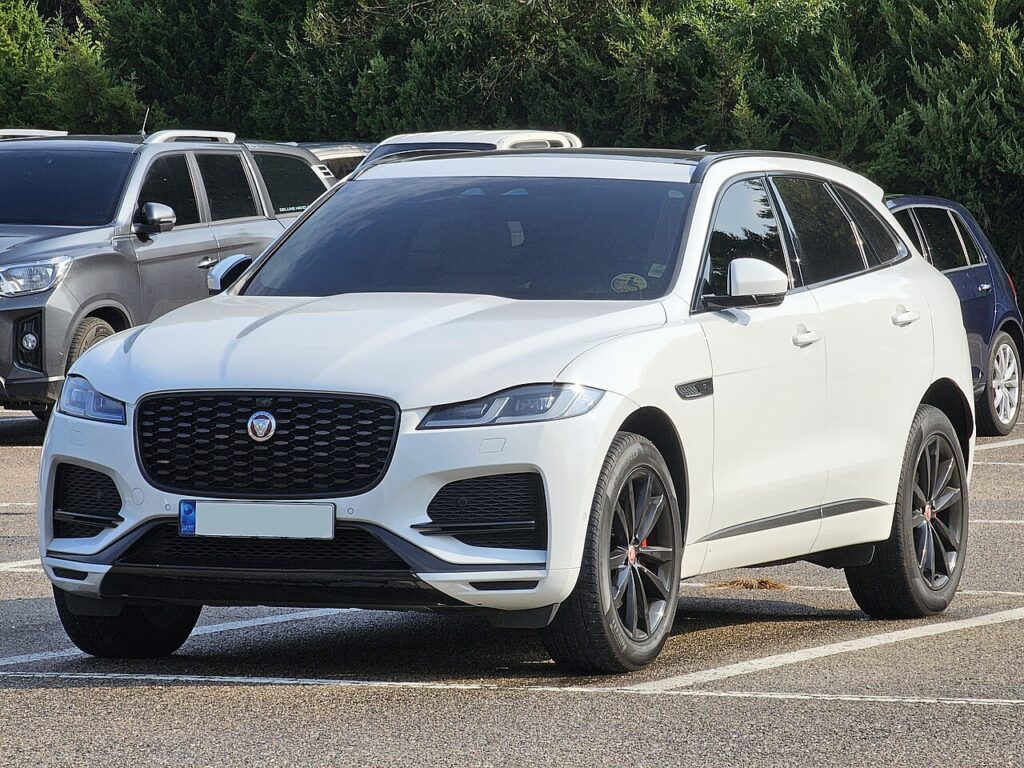
These instructions apply to the Jaguar F-Pace Mk1 (X761) 2016-Present.
For other models, please choose your vehicle here.
After the battery on your Jaguar F-Pace (2016–present) has been disconnected or gone flat, the one-touch function on the windows often stops working — the glass only moves while you hold the switch. Re-initialising each window restores it in seconds, with no tools. This is completely normal after any loss of power, and it is not a fault with the motor, the switch or the glass — the electronics have simply forgotten where the top and bottom of travel are and have dropped back to a safe hold-to-move mode until you teach them again.
When You Need This
Each window motor stores its fully-open and fully-closed positions, and that memory is cleared when the 12 V battery is disconnected or runs flat. The fix is a quick relearn from the door switch.
How It Works on Your F-Pace
Every door with an auto (one-touch) window has its own control module that counts the motor’s rotation to know exactly where the glass sits. That count is what lets the window run to the top on its own, stop cleanly at the seal, and reverse if it senses something in the way — the anti-pinch safety feature. When power is cut, the stored count is wiped. The window still raises and lowers because the basic circuit is intact, but only while you hold the switch, and the automatic stop and anti-pinch stay disabled until the module has seen the full closed and full open positions again. Re-initialising simply drives the glass to both hard stops so the module can re-reference them.
Getting Ready
- Sit inside with the door closed — the glass must reach its true sealed position against the frame.
- Switch the ignition on (engine running is fine) so the window circuit stays powered throughout.
- Make sure the battery is healthy; a weak or still-charging battery can drop voltage mid-learn.
- Do one window at a time using that door’s own switch, and keep hands and fingers clear of the glass path.
- Check the glass slides freely first — wipe grit from the rubber run channels if it feels sticky.
Re-initialising a Window
- Pull the switch up to fully close the window, and keep holding for a moment after it stops, then release.
- Press the switch down to fully open the window, again holding briefly after it stops, then release.
- Pull up to fully close once more, holding a few seconds at the top, then release.
- Test that one-touch up and down now work, and repeat for each window that lost the function.
If It Still Won’t Auto-Close
- Hold the switch past the end stop in each direction — the motor must feel the limit to learn it; releasing early aborts the relearn.
- Check the glass runs freely — a sticky or gritty channel can stall the motor before it reaches the true stop.
- Make sure the door is shut so the glass seats fully at the top; a door held ajar changes where the seal sits.
- Re-check the battery — if it was only just reconnected, let the car sit powered for a minute before trying again.
- Try the sequence twice — occasionally the first pass only part-registers and a clean second run completes it.
- Persistent fault? A window-module or switch issue can store a code — look it up on autodtcs.com.
What Happens Next
Once the relearn takes, a single tap of the switch runs the window all the way up or down on its own, it stops cleanly at the seal, and the anti-pinch reversal is active again. The setting is stored permanently, so it stays put through normal driving and locking — you would only need to repeat this after the next time the battery is disconnected or goes flat.
Frequently Asked Questions
Why did my F-Pace windows stop auto-closing?
The one-touch memory is cleared when the battery is disconnected or goes flat — the relearn restores it. It can also happen after a fuse in the door circuit is pulled or blows. The motor and switch are usually fine; the module has just lost the stored end-stop positions and needs to see them again.
Do I need tools?
No — it’s done entirely from the window switch. There is no menu, code reader or workshop equipment involved. You only need to sit in the car with the ignition on and run each affected window fully up and fully down, holding briefly at each end.
Which order, up or down?
Fully close and hold, fully open and hold, then fully close and hold again. Holding for a moment past each hard stop is the important part — that pause is what lets the control module register the top and bottom limits and re-enable one-touch and anti-pinch.
Do I have to do every window?
Only those that lost one-touch, though it’s quick to do them all after a battery job. If some windows still tap up and down normally, leave them; if in doubt, running the sequence on a working window does no harm and simply re-confirms its limits.
Why won’t the window reverse on something in the way now?
Anti-pinch relies on the same learned limits, so while the memory is cleared the safety reversal is inactive. That is exactly why re-initialising matters — completing the up-down-up sequence restores both the automatic stop and the anti-trap function together.
Could it be a blown fuse instead?
If a window is completely dead — no movement even while holding the switch — suspect a fuse or the switch rather than lost memory. Lost initialisation still lets you raise and lower the glass manually; it only removes the one-touch and anti-pinch behaviour, not all movement.
Just reconnected the battery? Our F-Pace battery disconnect/reconnect guide lists the windows among the items to re-initialise.
Independent guide — not affiliated with Jaguar. Always follow your official service manual and safety precautions. Read our full disclaimer.