These instructions apply to the Genesis GV70 (JK1) 2020-2024.
For other models, please choose your vehicle here.
If the tyre-pressure warning has come on in your Genesis GV70 (JK1, 2020–2024) after you’ve adjusted the pressures or changed a wheel, the system relearns by driving — there’s no button to press. Here’s how it works. Most of the time the amber tyre symbol simply means a pressure has slipped below the reference the car holds, not that anything has failed, and it will go out on its own once the corrected pressures have been read.

What the Warning Means on the GV70
The tyre-pressure light is a monitoring warning, not a fault in its own right. It lights when a tyre falls below the reference the car holds, and the usual causes are a genuine slow leak, a nail or screw in the tread, a cold snap that has dropped every pressure overnight, or a recent inflation or wheel swap that moved the readings. The GV70 is a heavy premium SUV running firm pressures and often larger wheels with lower-profile tyres, so even a modest loss shows up quickly — it is worth checking all four corners before you clear the light.
How the System Works
The GV70 uses a direct system: each wheel carries its own sensor that reports the actual pressure, and the driver display can show a live figure for every corner. Because the readings come from the wheels rather than being estimated from wheel-speed, there is no manual “store” button — once the tyres are set correctly the car reads the new values as you drive and drops the warning by itself. A tool is only needed when brand-new sensors are fitted and have to be paired to the car.
Before You Begin
- Check the tyres cold — before driving, or after the car has stood for a couple of hours. Warm tyres read high and give a false setting.
- Find the correct figures on the driver’s door-pillar label (or in the on-board menu); don’t guess, and note any higher fully-laden values.
- Set all four tyres, including any different front/rear values, and don’t forget a temporary spare if one is fitted.
- Have a reliable gauge handy — forecourt airlines are often out by a few psi.
When It Relearns
- After checking or adjusting the tyre pressures.
- After changing one or more wheels or tyres.
Completing the Procedure
- Park level and set all four tyres to the correct cold pressures.
- Drive the vehicle for about 20 minutes at over 25 km/h (15 mph).
- Stop the vehicle — the warning clears once the system has read the corrected pressures.
If the Warning Stays On
- Recheck every tyre — one corner still below spec keeps the warning on.
- Complete the learn drive — a couple of short trips may not give the system enough steady running to read all four wheels.
- Look for a slow puncture — if the same tyre keeps dropping, there is a leak; have it inspected.
- Cold mornings can trip the light again if you set the pressures on the low side — aim for the exact label figure.
- After a wheel swap, make sure the fitted wheels actually carry working sensors and are correctly located.
- Still showing with correct pressures? A sensor may have a flat internal battery — look up any stored code on autodtcs.com.
After the Reset
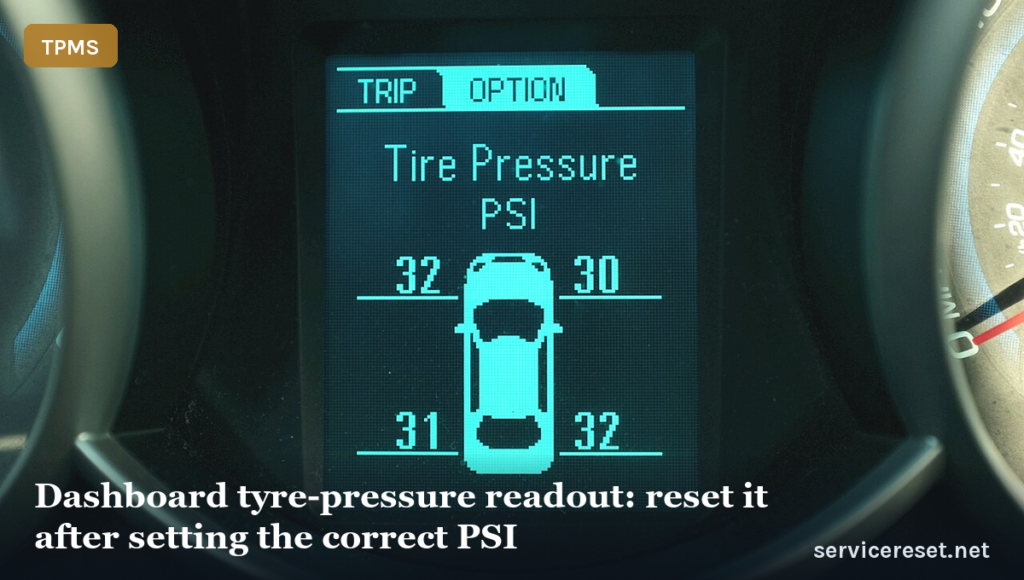
Once the corrected pressures have been read on the drive, the amber tyre symbol goes out and stays off for the rest of the journey and beyond. If you open the pressure page in the driver display you should see all four corners reading close to the label figure. There is no confirmation chime or message — the light simply disappears, which is the sign the relearn is complete.
Frequently Asked Questions
How do I reset the tyre pressure light on a Genesis GV70?
Set all four pressures to the correct cold figures, then drive for about 20 minutes at over 25 km/h. There is no button to press — the direct sensors report the corrected pressures and the warning clears itself once they have been read.
Is there a reset button?
No. Unlike some cars that have a physical “set” switch, the GV70 relearns automatically as you drive. Your only job is to get the pressures right first; the system does the rest without any menu step or button hold.
Do I need a tool?
Not for a normal relearn. A diagnostic tool is only needed when new pressure sensors are fitted and have to be paired to the car, or when you want to read a specific fault from a sensor that has stopped responding. Everyday resets after inflating are tool-free.
How long is the learn drive?
About 20 minutes of normal driving at over 25 km/h is usually enough. Steady running at road speed lets the car hear all four sensors; a short crawl through town may not be, so if the light lingers, take a longer continuous drive.
Why does the light keep coming back in winter?
Tyre pressure falls by roughly 1 to 2 psi for every 10 °C drop, so a cold night can pull a correctly-set tyre below the threshold. Top every tyre back up to the label figure on a cold morning and the warning should stay off once you drive.
One tyre keeps losing pressure — what should I do?
Repeatedly topping up the same corner points to a slow puncture, a leaking valve, or a rim that isn’t sealing. Clearing the warning won’t fix the leak; have the tyre checked and repaired. If a sensor code is stored alongside the light, decode it on autodtcs.com.
If the warning came on with other lights, or a fault code is stored, decode it on autodtcs.com.
Independent guide — not affiliated with Genesis. Always follow your official service manual and safety precautions. Read our full disclaimer.