These instructions apply to the Tesla Model X (2016-2021).
For other models, please choose your vehicle here.
If the tyre-pressure warning has come on in your Tesla Model X (2016–2021) after you’ve adjusted the pressures or changed a wheel, the system relearns by driving — there’s no button to press. Here’s how it works.

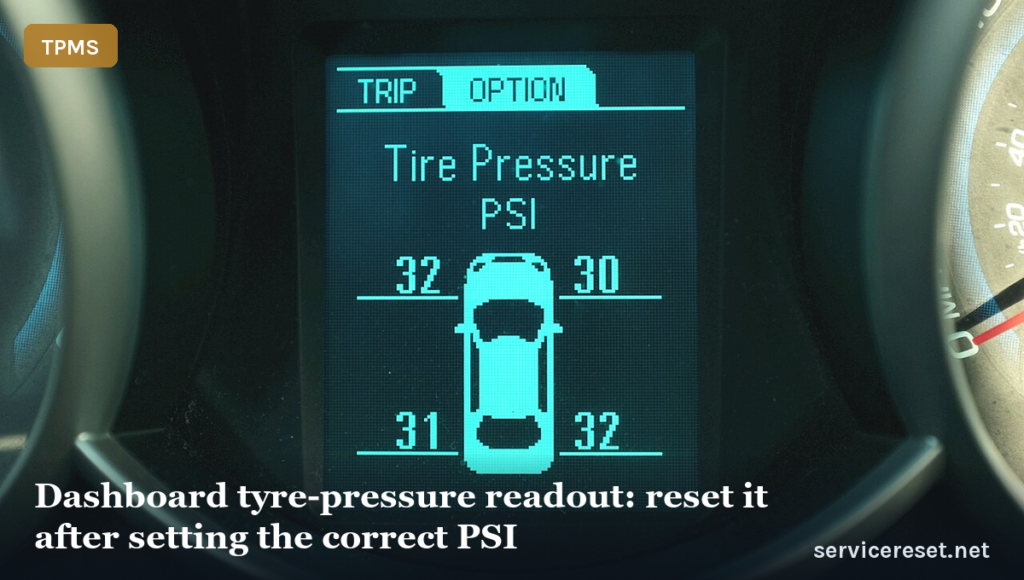
The amber tyre-pressure symbol — a horseshoe outline with an exclamation mark — is the Model X telling you one or more tyres has drifted below the pressure it expects. Most of the time this is completely normal: cold weather, a top-up, or a wheel change is enough to trigger it. It isn’t a fault with the car, and the touchscreen will show you the actual pressure at each corner so you can see which one is low. Once the pressures are corrected and you’ve driven a little way, the warning clears itself.
How TPMS works on the Model X
The Model X uses a direct system: each wheel carries a battery-powered sensor that transmits its real pressure to the car, which is why you get a live per-wheel readout on the touchscreen. There is no menu reset or relearn button — the car simply reads the sensors continuously and updates its reference as you drive. Correct the pressures, drive, and the stored values catch up on their own.
Before You Begin
- Set pressures cold — before driving, or after the car has sat for a few hours. Warm tyres read a few psi high.
- Use the recommended figures on the driver’s door-pillar placard, and match the touchscreen readout to them.
- Correct every low corner, including any wheel you’ve just fitted or a temporary spare.
- Park level and be ready to drive a continuous stretch, not a series of short hops.
Completing the Procedure
- Park level and set all four tyres to the correct cold pressures (placard at the driver’s door pillar).
- Drive the vehicle for about 10 minutes at over 25 km/h (15 mph).
- The warning clears once the system has read the corrected pressures. Live pressures show on the touchscreen.
Frequently Asked Questions
How do I reset the tyre pressure light on a Tesla Model X?
Set all four pressures correctly, then drive about 10 minutes above 25 km/h — no button press is needed.
If the Warning Stays On
- Recheck every tyre with a gauge. One corner below spec keeps the warning on even when the others are perfect — the touchscreen shows which.
- Drive long enough. Short trips may not give the system time to re-read all four; a continuous run of ten minutes or more is usually needed.
- Set them cold. Pressures set while the tyres are warm drop below spec once they cool, re-tripping the light.
- Cold morning? Pressure falls about 1–2 psi per 10°C drop, so a cold snap can set it off on its own — top up to the placard figure.
- Fitted a spare or a different wheel? A wheel without a working sensor will read as missing or low until the sensored road wheel is refitted.
- Comes back after a day or two? That points to a slow puncture — have the tyre inspected rather than just re-inflating it.
- Correct pressures but still lit? A sensor with a depleted battery can’t report and needs a workshop check.
After the Reset
With the pressures right and the drive complete, the warning goes out and the per-wheel readout on the touchscreen shows steady, in-spec figures. It should stay off for the rest of the journey. If it returns, treat it as real — a genuine leak or a failing sensor — rather than a glitch to be reset away.
Is there a reset button?
No — the system relearns automatically as you drive; live pressures show on the touchscreen.
Do I need a tool?
Not for a normal relearn; a tool is only needed when new pressure sensors are fitted.
Where do I find the correct pressures?
On the placard at the driver’s door pillar, and on the touchscreen.
Why does the light keep coming back in winter?
Cold air lowers tyre pressure, so a tyre that read correctly in mild weather can fall below spec overnight. Check and top up to the placard figure while the tyres are cold; if it only appears on the coldest mornings and clears as the day warms, it’s a temperature effect, not a leak.
Can I keep driving with the warning on?
You can drive to a safe place to check and inflate, but don’t ignore it. A low tyre affects handling and range and can overheat at speed. Correct the pressure promptly, and if a tyre keeps losing air have it inspected for a puncture.
If the warning came on with other alerts, decode the code on autodtcs.com.
Independent guide — not affiliated with Tesla. Always follow your official service manual and safety precautions. Read our full disclaimer.