These instructions apply to the Chrysler 300 Mk1 (LX) 2004-2011.
For other models, please choose your vehicle here.
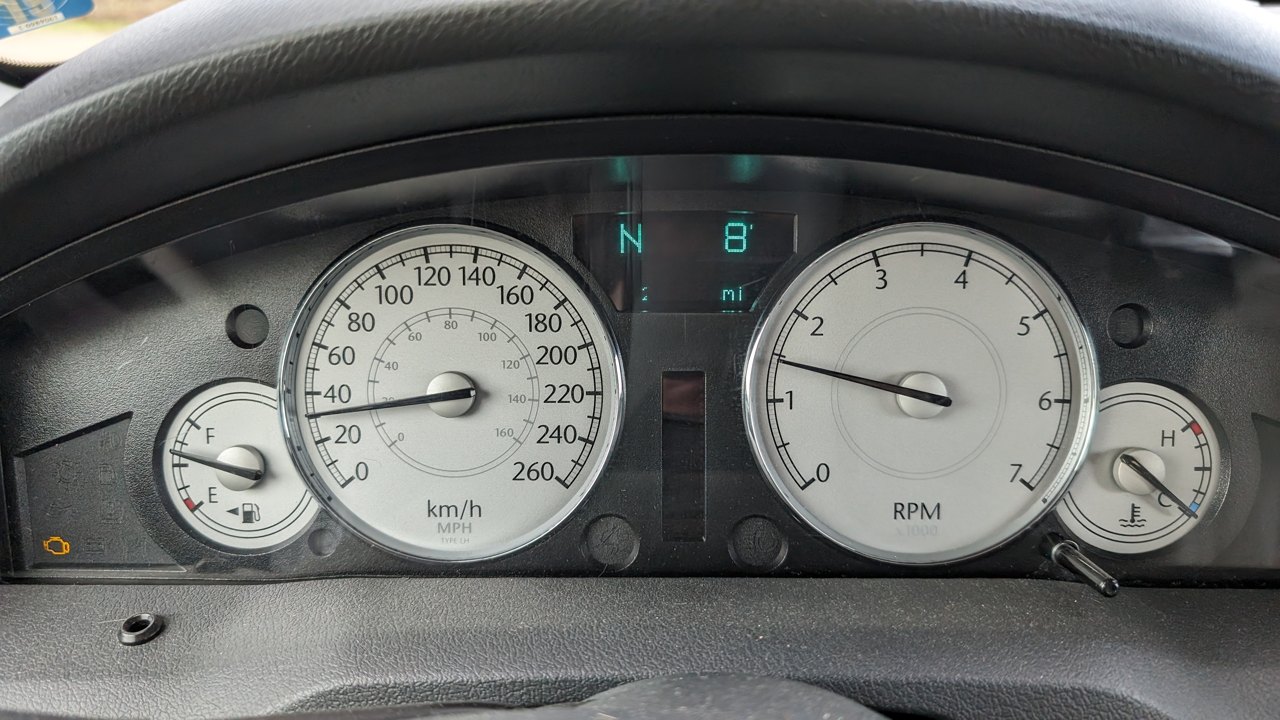
The tyre-pressure warning light on your Chrysler 300 (LX) is not cleared with a reset button — this generation has none. The system is automatic: you set every tyre to the correct cold pressure, drive a short distance, and the light switches itself off.
Before you start
- Use an accurate tyre-pressure gauge — the built-in pump dials on many air lines read high.
- Check pressures COLD: after the car has sat 3+ hours or been driven under about a mile, so the readings are true.
- Find the recommended cold pressures on the driver’s door-jamb placard — use those figures, not the number moulded on the tyre sidewall.
Turning Off the Warning Light — Step by Step
- Open the driver’s door and read the cold inflation pressures printed on the door-jamb placard (front and rear may differ).
- With the tyres cold, check all four with your gauge and inflate any that are low to the placard figure. If your 300’s spare is one of the monitored road wheels, set it to spec too.
- Recheck each tyre with the gauge to confirm it is exactly at the cold pressure — not a little under, not over.
- Drive the car for several minutes at more than about 15 mph so the sensors re-read and transmit the new pressures.
- The low-pressure telltale (and the EVIC “Tire PSI” readout, if fitted) turns itself off once the system sees all tyres at or above spec. No button press is needed.
Why There’s No Reset Button
The 300’s TPMS on the LX platform is fully automatic. Each wheel has its own pressure sensor that reports to the car continuously, so there is nothing for the owner to reset or relearn — the telltale simply reflects live pressures. When every tyre is back at the correct cold value, the warning goes out on its own. If you have been hunting the dashboard or menus for a “reset” option, that is why you cannot find one: it does not exist on this car.
If the Light Stays On
- One tyre is still below spec — a slow puncture from a nail or a leaking valve can drop a tyre faster than you refilled it. Recheck all four cold.
- You set the pressures while the tyres were warm. Warm tyres read roughly 3–4 psi high, so they end up under-inflated once cold and the light comes back — always set cold.
- A sensor is failing. The wheel sensors run on internal batteries that typically last around 5–10 years; a dead or faulty sensor keeps the warning on even with correct pressures.
- The telltale is FLASHING rather than steady. A flashing indication signals a TPMS fault, not low pressure, and needs to be read with a diagnostic tool.
Frequently Asked Questions
Where is the TPMS reset button on the Chrysler 300?
There isn’t one. The LX-generation 300 has no owner reset or relearn procedure — you correct the tyre pressures and the system clears the light itself after a short drive.
Why did the light come back after I aired the tyres up?
Usually because a tyre is still losing air (a slow puncture) or because you inflated the tyres while they were warm, leaving them under the placard figure once they cooled. Recheck all four cold and look for a leak.
Does cold weather set the light off in winter?
Yes. Tyre pressure falls about 1 psi for every 10°F drop, so a cold snap can push a correctly-set tyre below spec and trigger the telltale. Top the tyres back up to the cold placard pressure.
What’s the difference between a steady and a flashing light?
A steady telltale means at least one tyre is low — fix the pressures. A flashing telltale means the TPMS itself has a fault (such as a failed sensor) and needs diagnosing rather than simply re-inflating.
If the light is flashing or a warning stays on after correct cold inflation, the system may have logged a fault code — you can look up what a stored TPMS or related trouble code means on autodtcs.com.
Independent guide — not affiliated with Chrysler. Always follow your official service manual and safety precautions. Read our full disclaimer.