These instructions apply to the Hyundai i20 Mk2 (GB) 2014-2020.
For other models, please choose your vehicle here.
When the tire-pressure warning light comes on in your Hyundai i20 Mk2 (GB, 2014–2020), it usually just means the system needs to relearn your current pressures after a check, top-up or wheel change. On the i20 GB you clear it by first setting the correct pressures and then holding the tire-pressure SET button — the cluster itself prompts you to do exactly that.
Hyundai i20 Cold Tire Pressures (2014-2020)
Recommended cold pressures for the second-generation i20 (GB), taken from the Hyundai owner manual. Set them cold and treat the label in the driver’s door jamb as the final word for your car.
| Tire size | Normal (front / rear) | Full load (front / rear) |
|---|---|---|
| 185/65 R15 | 2.5 / 2.3 bar (36 / 33 psi) | 2.5 / 2.5 bar (36 / 36 psi) |
| 195/55 R16 / 205/45 R17 | 2.35 / 2.15 bar (34 / 31 psi) | 2.4 / 2.6 bar (35 / 38 psi) |
| Space-saver spare (T125/80 D15) | 4.2 bar (60 psi) | |
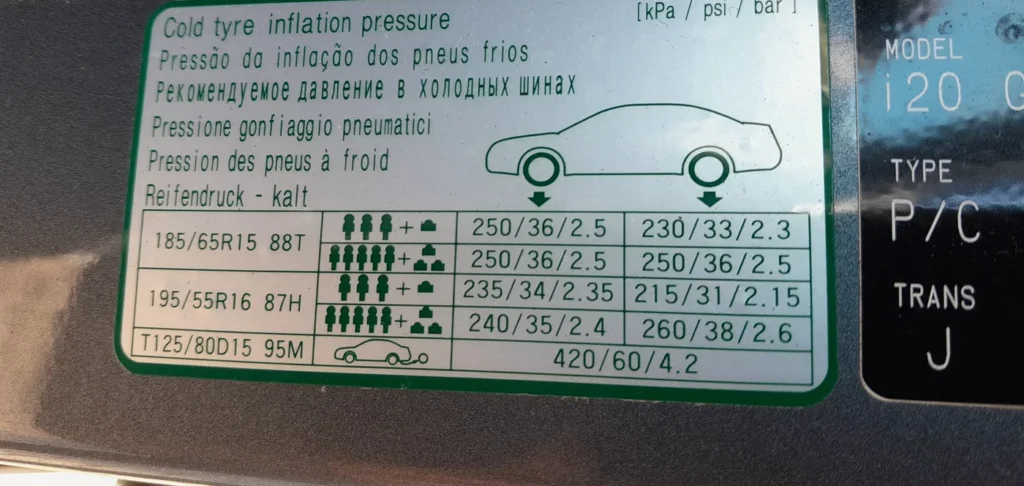
Fuel-economy (ECO/Blue) versions run higher, at 2.6 bar (38 psi) front and rear. The compact spare takes 4.2 bar (60 psi). “Full load” means four or five people plus luggage. After adjusting pressures, reset the monitor using the steps below.

How the i20 System Works
The Mk2 i20 uses a direct tire-pressure monitoring system. When a pressure is out of range it lights the warning and shows the message “Tire pressure low! Check tires, then hold tire pressure SET button for 3 secs.” Once the pressures are correct, holding the SET button tells the system to relearn the new baseline, and it confirms over a short drive.
When the Light Comes On
- After a tire-pressure check or adjustment.
- After changing one or more wheels or tires.
- After rotating the wheels.
- In cold weather, when pressures drop naturally.
Set Your Pressures First
The system learns from whatever is in the tires, so they must be correct before you reset. Set all four (cold) to the figures on the placard in the driver’s door aperture, using the laden column if you are carrying a full load. Do not try to clear the light while a tire is still low — fix the pressure first.
How to Reset the i20 TPMS
- Check and adjust all four tire pressures (cold) to the placard figures.
- Switch the ignition on (or start the engine).
- Find the tire-pressure SET button in the driver’s lower dash switch panel — the same cluster as the headlight-levelling dial and the ESC OFF button, marked with a tire-and-exclamation symbol — and press and hold it for about 3 seconds until the cluster acknowledges.
- Drive the car for a few minutes, keeping the speed above roughly 25 km/h (15 mph) for part of the drive so the system can compare the wheels and finish relearning.
- The warning light goes out once the system has confirmed all four pressures are correct.
If the warning comes back, check the tires again; if they are fine, drive about 20 km and repeat the SET step.
Light Won’t Go Out? Work Through This
- A tire is genuinely low: the system is doing its job — find and fix the leak, re-inflate to the placard figure, then reset again.
- You didn’t hold SET long enough: keep the button pressed for a full 3 seconds until the cluster acknowledges, then drive.
- Big front-to-rear pressure split: set them to the placard figures so the wheels read evenly.
- Flashing (not steady) light: a flashing TPMS light points to a sensor or system fault rather than a low tire. The car may store a code — you can look it up on autodtcs.com.
Frequently Asked Questions
Is there a TPMS reset button in the i20 Mk2?
Yes — there is a tire-pressure SET button in the driver’s lower dash switch panel, alongside the headlight-levelling dial and the ESC OFF button. After correcting the pressures, hold it for about 3 seconds; the cluster message even prompts you to do this.
How fast and how far do I need to drive after pressing SET?
A few minutes of normal driving including some time above 25 km/h (15 mph) is enough for the system to confirm the new baseline.
Why does the light return after a few days?
Either a tire is slowly losing air or it was a little low when you reset. Re-check all four cold pressures against the placard and repeat the SET step.
Can cold weather set it off?
Yes — pressure drops about 1 psi per 5 °C, so a cold snap can trigger the warning. Re-inflate to the placard figure and reset to clear it.
After tire or seasonal-wheel work it is worth confirming the service reminder is clear — see our Hyundai i20 Mk2 service indicator reset guide.
Independent guide — not affiliated with Hyundai. Always follow your official service manual and safety precautions. Read our full disclaimer.