These instructions apply to the Kia Rio Mk3 (UB/QBR) 2011-2018.
For other models, please choose your vehicle here.
The Kia Rio III (UB, 2011–2017) has two fuse boxes: one in the cabin, behind a pull-off cover at the driver’s end of the lower dash, and one in the engine bay, next to the battery. The fuse map is printed on the inside of each lid — match the symbol on your lid to the tables below to find any fuse and its rating.
Verified on this vehicle: Kia Rio 1.25 CVVT petrol (G4LA), 2012, EU market, left-hand drive — both lids photographed on the car. The part numbers are 91117-1W300 (cabin lid) and 91950-1W420 (engine-bay lid). Diesel (CRDi) and stop-start (ISG) cars retag or add a few positions, so always read the legend on your own car’s lid.
Cabin fuse box (driver’s side)
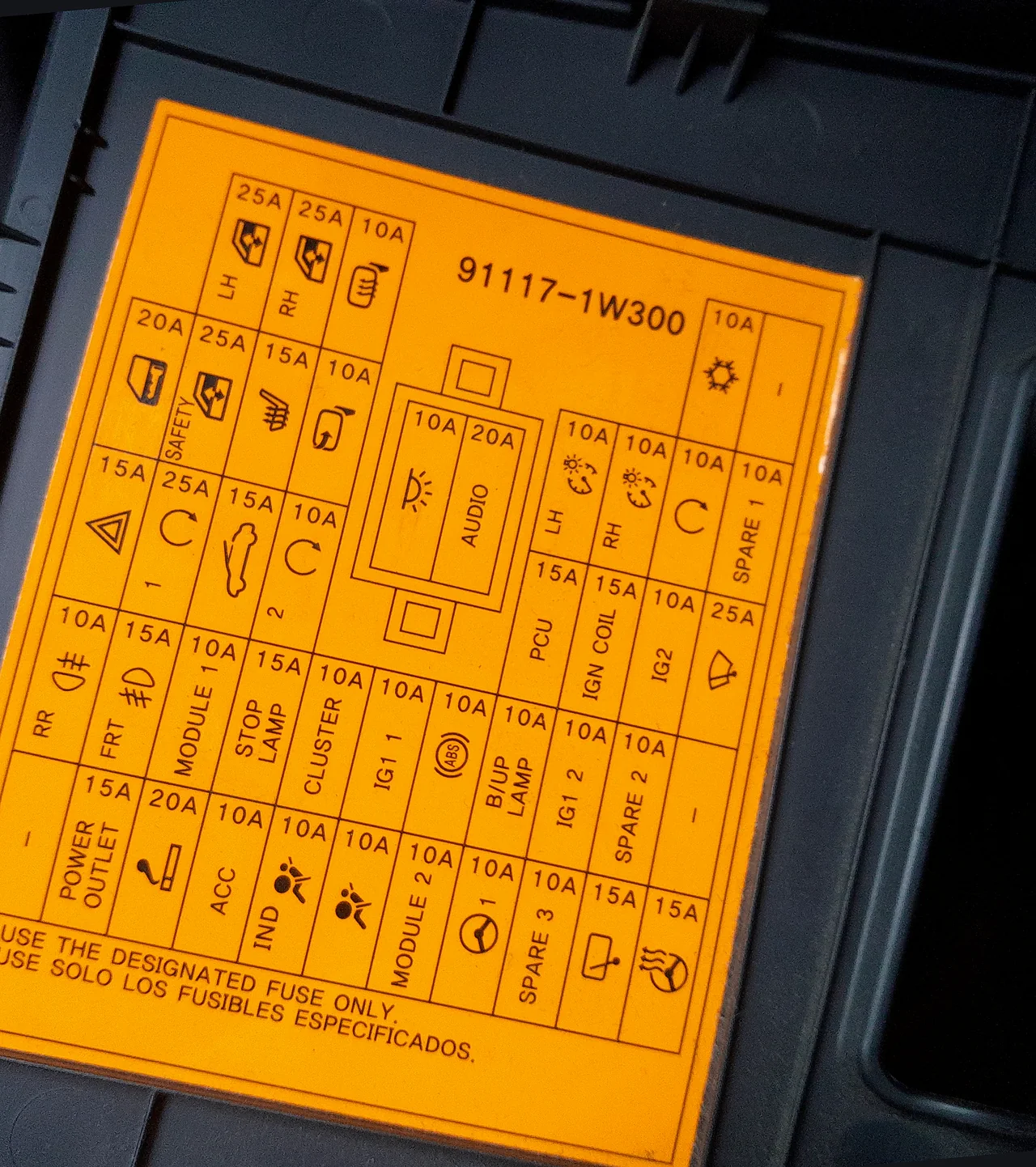
| Symbol | Fuse | Rating | Protects |
|---|---|---|---|
| P/WINDOW LH | 25 A | Driver (left) power window | |
| P/WINDOW RH | 25 A | Passenger (right) power window | |
| Blower | 25 A | Heater / A-C blower motor | |
| Safety (SRS) | 20 A | Airbag & seat-belt pretensioner power | |
| ACC | 20 A | Accessory / ignition-ACC feed | |
| Power outlet | 15 A | 12 V accessory (cigarette-lighter) socket | |
| Front wiper | 25 A | Front wiper & washer motor | |
| — | Stop lamp | 15 A | Brake / stop-light switch |
| — | Front fog | 15 A | Front fog lamps |
| — | Hazard | 15 A | Hazard-warning flashers |
| IGN coil | 15 A | Ignition coils (petrol) | |
| — | PCU | 15 A | Powertrain / ETACS control feed |
| Audio | 20 A | Head unit / radio main feed | |
| Audio (ACC) | 10 A | Head unit ignition-ACC feed | |
| Door lock | 10 A | Central door locking & actuators | |
| Head lamp LH | 10 A | Left low-beam headlight | |
| Head lamp RH | 10 A | Right low-beam headlight | |
| — | Rear fog | 10 A | Rear fog lamp |
| — | Back-up lamp | 10 A | Reversing lamp |
| — | Cluster | 10 A | Instrument cluster |
| — | IG1-1 / IG1-2 | 10 A | Ignition-1 switched feeds |
| ABS | 10 A | ABS / ESC control module | |
| — | Module 1 / Module 2 | 10 A | Body / control-module feeds |
| — | Indicator (IND) | 10 A | Turn-signal flasher |
| — | Memory / clock | 25 A | Always-live memory, clock, alarm |
| — | IG2 | 10 A | Ignition-2 switched feed |
| — | Spare 1 / 2 / 3 | — | Spare fuse holders |
Engine-bay fuse box


| Symbol | Fuse | Rating | Protects |
|---|---|---|---|
| ALT | 125/150 A | Alternator main — 125 A petrol / 150 A diesel | |
| Multi-fuse | 80 A | Main battery distribution link | |
| B+1 | 50 A | Junction-block main supply 1 | |
| B+2 | 50 A | Junction-block main supply 2 | |
| — | ECU (GSL/DSL) | 40/50 A | Engine-control main — 40 A petrol / 50 A diesel |
| RR HTD | 40 A | Heated rear window | |
| — | Inverter | 40 A | ISG alternator management (stop-start) |
| Blower | 40 A | Heater / A-C blower relay | |
| — | IG1 | 40 A | Ignition-1 main feed |
| — | IG2 | 40 A | Ignition-2 main feed |
| ABS 1 | 30 A | ABS / ESC pump motor | |
| — | Glow / PTC (DSL) | 30 A | Diesel glow plugs / pre-heater |
| ABS 2 | 20 A | ABS / ESC control | |
| F/PUMP1 (GSL) | 20 A | Fuel-pump relay (petrol) | |
| Head lamp hi LH | 20 A | Left headlight high-beam feed | |
| Head lamp hi RH | 20 A | Right headlight high-beam feed | |
| F/PUMP2 | 15 A | Fuel-pump / injector feed | |
| Injector | 15 A | Fuel injectors | |
| Head lamp LH | 10 A | Left headlight high/low | |
| Head lamp RH | 10 A | Right headlight high/low | |
| Wiper | 10 A | Wiper control / relay | |
| Horn | 10 A | Horn relay | |
| — | Back-up lamp | 10 A | Reversing-lamp feed |
| — | IND | 10 A | Charge / indicator sensing |
| — | ECU_VM | 10 A | ECU vacuum / valve module |
| — | Sensors 1-6 | 10 A | ECM sensors & solenoids (10–20 A each) |
The higher-rated fuses in this box (30 A and up, shown with a grey rating) are cartridge / J-case fuses and fusible links, not standard blade fuses — they follow a different color code, so go by the printed rating, not the color.
How to check and change a fuse
- Switch off the ignition and the circuit that has failed.
- Open the right cover and find the fuse: match its symbol or label on the lid (or in the tables above) to its position in the box.
- Pull it straight out with the plastic puller clipped inside the engine-bay box — never a screwdriver or metal tool, which can short the terminals.
- Hold it up to the light: a blown fuse has a visibly broken metal strip.
- Fit a new fuse of the exact same amperage (the number on top, and usually color-coded). Never fit a higher rating — that defeats the protection and can start a fire.
- If the new fuse blows again straight away, stop — there is a fault in that circuit that needs diagnosing, not another fuse.
In a pinch you can borrow a fuse of the same rating from a circuit you don’t need right then (such as the cigarette-lighter socket). A main-fuse or fusible-link failure (the ALT link, 80 A multi-fuse, or 125/150 A alternator feed), where nothing electrical works at all, needs a Kia dealer — don’t bridge it.
Leave these to a specialist
Fuses for the airbags/SRS, ABS, engine ECU and other safety systems should not be swapped as a trial — a repeated blow there points to a fault that needs proper diagnosis. If you spot an error in the table above, or your lid differs, let us know and we’ll check it against the manual.
Independent guide — not affiliated with Kia. Always follow your official service manual and safety precautions. Read our full disclaimer.