These instructions apply to the Kia Rio Mk3 (UB/QBR) 2011-2018.
For other models, please choose your vehicle here.
The third-generation Kia Rio (UB chassis, 2011–2018) is fitted with a Tire Pressure Monitoring System (TPMS) on most trims from 2014 onwards in the EU and across the range in the US.
The Rio uses an indirect TPMS — pressure is inferred from wheel rotational speed via the ABS sensors rather than measured by valve-stem transmitters. This means there are no batteries to fail in the wheels, but it also means a manual reset is needed after inflating tires or after a battery disconnect.
The reset is owner-method: no scan tool, no relearn drive in a specific shape, just an inflation check and a short drive.
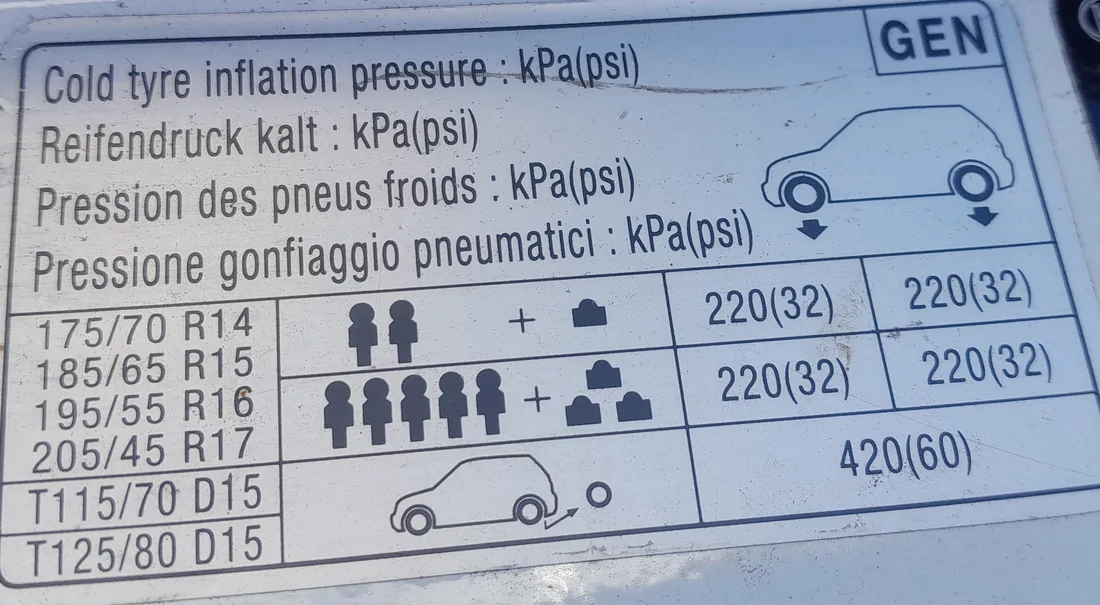
Kia Rio Tire Pressures (Cold)
On the petrol Rio the recommended cold pressure is 2.2 bar (32 psi) front and rear. The stop-start diesel (ISG) runs a higher front pressure — 2.4 bar (35 psi) front, 2.2 bar (32 psi) rear. US cars use 32 psi all round. Always set to the label on your driver’s door pillar, which overrides any chart.
| Tire size | Front | Rear | Applies to |
|---|---|---|---|
| 175/70 R14 | 2.2 bar (32 psi) | 2.2 bar (32 psi) | Petrol / base (EU) |
| 185/65 R15 | 2.2 bar (32 psi) | 2.2 bar (32 psi) | Petrol (EU & US) |
| 185/65 R15 | 2.4 bar (35 psi) | 2.2 bar (32 psi) | Diesel with stop-start (ISG), EU |
| 185/65 R15 | 2.6 bar (38 psi) | 2.6 bar (38 psi) | ECO / fuel-saver pack, EU |
| 195/55 R16 | 2.2 bar (32 psi) | 2.2 bar (32 psi) | EU & US |
| 205/45 R17 | 2.2 bar (32 psi) | 2.2 bar (32 psi) | EU & US |
| Compact spare | 4.2 bar (60 psi) | 4.2 bar (60 psi) | Temporary use only |
On the Rio the door placard lists the same pressures for a light load and a full load, so there is no separate fully-laden figure — inflate to the values above whether the car is empty or packed. Re-check cold (before driving), and reset the TPMS after any adjustment as below.
Before you start
The Rio’s indirect TPMS samples ABS wheel-speed data continuously and looks for asymmetry. A tire with low pressure has a slightly smaller rolling radius and therefore turns slightly faster per kilometer than its correctly-inflated neighbors.
The algorithm compares each wheel against the others and triggers the warning when one is 25% lower than the others (a ~7 psi / 0.5 bar drop in a typical Rio summer tire). After re-inflation, the algorithm needs to be told that the new pressures are the new baseline.
- Check all four tires cold — meaning the car has been stationary for at least 3 hours or driven less than 1 km. Warm tires read higher than their true cold value and produce a baseline that’s wrong once the car cools overnight.
- Pressure gauge. Forecourt gauges are often miscalibrated; a £15 dial gauge from a parts shop is much more accurate. If you only have a forecourt gauge, take the same reading at two different stations to spot inconsistency.
- If you’ve changed tire size (e.g., upgraded from 14″ to 15″ wheels), the TPMS baseline is invalidated by the new rolling circumference. Reset and re-drive to establish the new baseline.
Tools required
- Accurate tire pressure gauge (digital or dial)
- Compressor or foot-pump (forecourts are fine as long as you check the gauge with your own)
When to reset the TPMS
- After inflating any of the four tires to the correct pressure.
- After rotating or replacing any tire or wheel.
- After a battery disconnect, if the TPMS warning illuminates and won’t clear with a normal drive.
- After changing to seasonal wheels (e.g., swapping summer rims for winter rims with different tire size).
Reset procedure
- Check the driver’s door-jamb placard for the cold pressures. Note both the front and rear targets (they can differ on some Rio trims).
- Inflate all four tires cold to the placard pressures, measured with your own gauge.
- Switch the ignition ON. If your car has the “Reset” or “Set” option for TPMS in the cluster menu (some Rio trims do, accessed via the trip-meter button), select it now and hold to confirm.
- Start the engine and drive normally.
- Maintain at least 25 km/h (15 mph) for 10 minutes of mixed driving. A motorway stretch is ideal; pure stop-go in town is less effective because the algorithm needs sustained rotational data.
- The TPMS warning light should extinguish automatically once the system has sampled enough wheel-speed data to recognize the new baseline as “correct”.
How to verify it has worked
- The TPMS warning light is no longer illuminated.
- No “Check tire pressure” message in the cluster’s text display.
- Wheel-speed monitoring is now baselined on the correct pressures — drive normally for a few more days; the light should not return.
If Something Goes Wrong
Light stays on after 10 minutes of driving above 25 km/h. Most common cause: one of the four tires is still under-inflated. Re-check all four with your own gauge — even a small (3–5 psi) deviation can keep the warning active. Second most common: the cluster menu’s “Reset” option wasn’t selected after re-inflation; some Rio trims need that explicit reset before the algorithm baselines on the new pressures.
Light flashes for 1 minute every time the engine starts. This is the “system fault” signal, not a low-pressure warning. It means the TPMS module has logged a stored fault, most often “implausible signal” from one of the ABS wheel-speed sensors. Read the ABS module with a Kia-aware scan tool (Carista, OBDeleven, or a generic OBD-II tool with manufacturer code support).
“Check TPMS System” text message appears. The module itself has a stored fault rather than a low-pressure reading. Scan with a Kia-aware tool.
The light returned 24 hours after the reset. A tire has lost pressure overnight — almost certainly a slow puncture. Recheck pressures cold and look for the offending tire. Common locations: a nail in the tread, a slow leak from the valve core, or a tiny bead leak (a film of soapy water around each tire’s bead will bubble at the leak point).
Light stays on even after the reset menu shows “Reset completed”. The cluster menu confirms the user input, but the baseline algorithm needs the subsequent drive to validate. Drive 10 minutes at over 25 km/h and the light should clear.
Frequently asked questions
Does the Kia Rio UB have a valve-stem TPMS instead of indirect?
Some US-market Rio trims and some 2017+ EU facelift variants do have valve-stem TPMS sensors (the “direct” variant). Cars with direct TPMS show a specific “Sensor not detected” message rather than the generic low-pressure warning when a sensor battery dies. If you can see TPMS pressure values per wheel in the cluster menu, you have direct TPMS; if you only get a single “low pressure detected” warning, you have indirect TPMS. The reset procedure is the same.
How long do indirect TPMS sensors last?
Indirect TPMS has no battery to fail — the ABS wheel-speed sensors that feed it last the life of the wheel bearings (typically 200,000+ km). Direct TPMS valve-stem sensors have an internal battery rated for 7–10 years, after which the sensor itself needs replacing.
Does cold weather cause false TPMS warnings?
Yes — tire pressure drops about 0.1 bar per 10 °C cooldown. A car that was set to placard pressures in summer can trigger the warning on the first cold morning of autumn. Top up to the placard pressures cold and the warning clears.
Should I reset after rotating tires front-to-back?
Yes. Indirect TPMS measures relative rotational speed, so rotating tires (which can have different wear) changes the baseline. After rotation, re-inflate to placard and run the reset procedure.
Will the system warn me about a fully flat tire, or only gradual deflation?
Both — a sudden complete deflation (puncture) shows up as a large asymmetry within a few seconds of driving and triggers the warning immediately. Gradual deflation takes longer to register but is also caught.
For TPMS-related DTCs that won’t clear with a drive cycle, see autodtcs.com.
Independent guide — not affiliated with Kia. Always follow your official service manual and safety precautions. Read our full disclaimer.