These instructions apply to the Kia Rio Mk3 (UB/QBR) 2011-2018.
For other models, please choose your vehicle here.
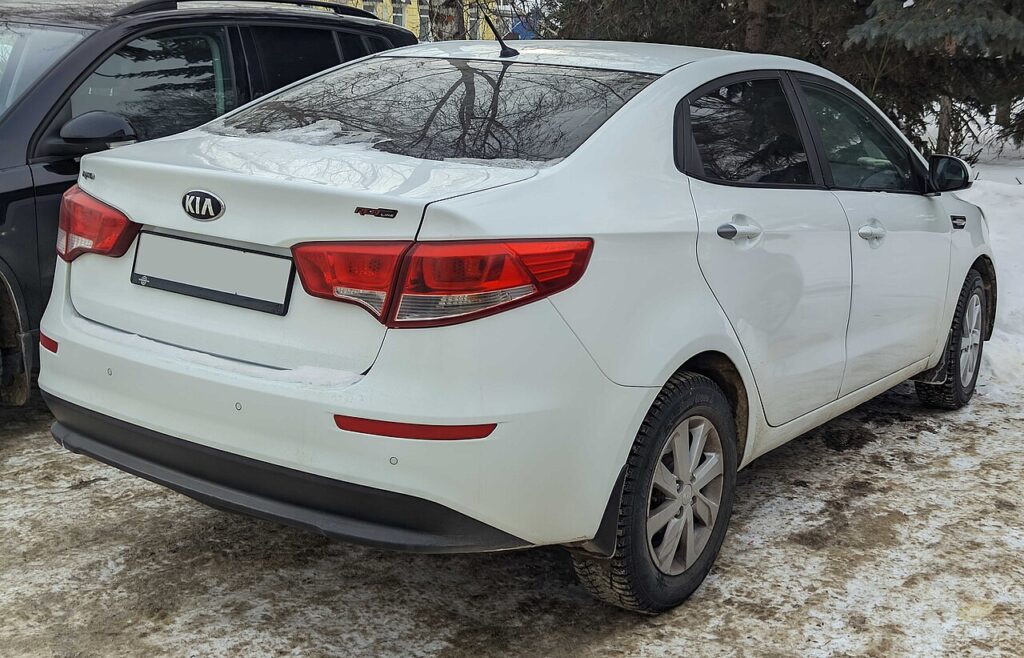
The automatic Kia Rio (2011–2018) will not normally let you move the gear selector out of P (Park) unless the engine is running and your foot is on the brake pedal. That interlock is deliberate, but it becomes a problem the moment the 12 volt battery goes flat or the shift-lock circuit develops a fault: the lever stays trapped in Park and the car cannot be pushed, loaded, or towed. For exactly these situations the Rio is built with an emergency park release — a small mechanical override beside the selector that lets you free the lever by hand. Using it is a designed-in function, not a sign that anything has been broken, and every automatic Rio of this generation has one.
Why the lever locks and what the override does
This car uses an electronic shift-lock solenoid that only releases the selector when it sees a valid brake-pedal signal with the ignition on. No power, no signal, no release — which is safe in daily driving but unhelpful when the battery is dead or a switch has failed. The emergency release simply pushes that solenoid out of the way mechanically, so the lever can pass through the gate without any electrical input. It is a one-off manual action to get the car rolling; it does not fix the underlying cause, so the fault still needs looking at afterwards.
Before You Begin
- Park on level ground if you possibly can, and keep everyone clear of the vehicle’s path before you unlock the lever.
- Apply the parking brake firmly first — once the selector leaves Park the car may want to roll.
- Have the mechanical key or a suitable flat-blade screwdriver ready to work the slot.
- Decide where the car needs to go before you release it, so it can be moved straight away and re-secured.
- If the car is on any kind of slope, chock a wheel as well as setting the handbrake.
Emergency Park Release Procedure
- Apply the parking brake firmly to prevent rolling.
- Turn the ignition OFF.
- Remove the small plastic cap beside the gear lever to expose the shift lock slot.
- Insert a flat screwdriver or the mechanical key into the slot.
- While pressing down in the slot, press the gear lever button and shift to N (Neutral).
- The car can now be moved or towed slowly.
If It Won’t Release
- Make sure you are pressing firmly down into the slot while you move the lever — the override needs steady pressure held throughout, not a quick jab.
- Keep the gear-lever thumb button pressed at the same time; the lever still has to clear its normal gate as well as the solenoid.
- Confirm you have found the correct slot under the cap next to the selector and not a trim seam — the tool should seat and meet spring resistance.
- If the steering column has locked, turn the key in the ignition to the ON position to release it before trying to steer or move off.
- If the lever still will not budge with the override held down, stop and have the car recovered rather than forcing it — something in the selector mechanism may be jammed.
After You’ve Moved the Car
Refit the plastic cap over the slot so nothing falls into it. Treat the release as a get-out-of-trouble measure only: if the trigger was a flat battery, charge or replace it and the interlock should work normally again once the car has power; if the lever locked with a healthy battery, the shift-lock switch or brake-pedal switch needs checking. When recovering the car, avoid towing it any distance with the driven wheels on the ground — a flatbed is kinder to the automatic transmission.
Frequently Asked Questions
Where exactly is the shift-lock release on the Kia Rio?
It sits on the centre console right next to the gear selector, hidden under a small removable plastic cap. Prise the cap off gently and you will see the slot beneath it. Insert the mechanical key or a flat screwdriver, press down, and the lever can then move out of Park.
Do I need the engine running to use the emergency release?
No. The whole point of the override is that it works with no power at all, which is why it exists for flat-battery situations. Turn the ignition off, apply the parking brake, then use the slot. You only need to switch the ignition to ON if the steering column has locked and you need to steer.
Is it safe to move the car after releasing Park?
Only over a short distance and slowly, with the parking brake ready to reapply. The release lets you push the car onto a flatbed or clear of an obstruction; it is not meant for driving. If the car has to be towed on its own wheels, keep it brief and slow to protect the automatic gearbox.
Why did my gear lever get stuck in Park in the first place?
The most common causes are a discharged 12 volt battery, a faulty brake-light switch that stops the interlock seeing your brake input, or a failed shift-lock solenoid. Because the override does not repair any of these, the lever may lock again next time until the actual fault is diagnosed and fixed.
Will using the release damage anything or set a warning light?
Used correctly it does no harm — it is a factory-fitted mechanical feature. Any warning lights you see afterwards usually relate to the original problem (a flat battery or a switch fault) rather than to the release itself. Once the car has power and the fault is cleared, the lights should go out.
Can I just leave the car in Park until help arrives?
If it is safely parked and not blocking anyone, yes — there is no need to force the lever. Recovery services can usually work with a car stuck in Park. The override is there for when you genuinely need to move or load the vehicle and normal shifting is unavailable.
If a warning lamp or stored fault code prompted the shift-lock problem, reading the codes helps pin down whether it is the battery, a switch, or the solenoid — our sister site autodtcs.com explains what common trouble codes mean and where they point.
Independent guide — not affiliated with Kia. Always follow your official service manual and safety precautions. Read our full disclaimer.