These instructions apply to the Honda Civic Mk10 (FK) 2016-2021.
For other models, please choose your vehicle here.
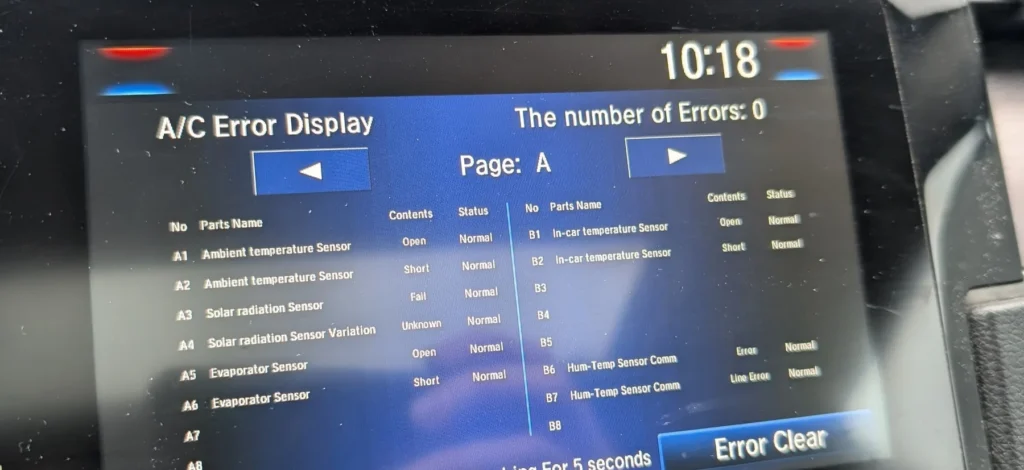
The Honda Civic (Mk10/FC·FK, 2016–2021) carries a hidden owner-accessible self-test built into its climate-control unit. Trigger the right button sequence and the panel runs a full HVAC health check, lights every segment, then blinks any stored fault codes back at you — all without a diagnostic scanner. It is one of the few genuine “secret” functions Honda never put in the handbook. Here is how to use it on the Mk10 Civic.
What the Self-Diagnostic Mode Does
Behind the touch-and-button climate panel sits a control module that monitors its own air-mix (temperature blend) motor, mode motor, blower, recirculation flap and the in-vent temperature sensors. The self-test cycles those actuators, confirms each sensor responds, and reports any Diagnostic Trouble Codes (DTCs) by blinking an indicator. It changes nothing and cannot harm the car — it simply reads out what the module already knows. The full routine is available on the automatic dual-zone climate control fitted to EX and Sport trims upward.
How to Enter Self-Diagnostic Mode
- Park, doors closed. Turn the ignition to LOCK (0), then back to ON (II) — engine off (on push-button cars, press START once without the brake to reach ON).
- Press and hold the climate ON/OFF button.
- Keeping it held, press and release the rear-window defogger button five times within 10 seconds.
- Release the ON/OFF button.
- The unit lights all segments, runs its actuators, then begins to blink the result.
How to Read the Codes
- No fault stored: the indicator does not blink — everything checks out.
- A fault present: the indicator blinks a numbered DTC; with several faults it cycles through them from the lowest number first.
- Common areas: air-mix motor circuit, mode (vent-direction) motor, blower motor circuit, evaporator/in-car temperature sensors and control-unit internal faults.
- Count the blinks carefully — that number is the code to look up.
How to Exit and Clear the Codes
To leave the test, turn the ignition to LOCK (0). To clear stored codes, repeat the entry sequence after fixing the fault, or disconnect the 12 V battery for a few minutes. Clearing only erases the memory — if the underlying problem is still live, the same code returns on the next self-test, so always diagnose the cause before wiping it.
Safety Note
This is Honda’s own factory self-diagnostic, run with the car stationary and the engine off. The blower and internal flaps will move during the test; that is expected. It is completely separate from the engine, airbag and brake systems, so you cannot break anything by running it. Keep the car parked throughout.
Frequently Asked Questions
Does the touchscreen-style climate panel still support this?
Yes. The Mk10 keeps physical ON/OFF and rear-defogger buttons, and the hold-ON/OFF-then-defogger-five-times sequence works through them.
What does pressing the defogger five times actually do?
It is the deliberate “unlock” pattern the module looks for. Five distinct presses inside 10 seconds tells it you want the hidden self-test rather than normal defogger operation.
The indicator never blinked — is that good or bad?
Good. No blink means no electrical HVAC fault is stored. Note that refrigerant-level or compressor problems may not log a code, so an A/C that blows warm can still test clean.
Will this fix my air conditioning?
No — it only reports faults, it does not repair them. Use the code it gives you to direct the actual repair.
Can I damage the climate system by entering the test repeatedly?
No. It is read-only and designed to be run as often as needed. Repeating it causes no wear beyond the brief actuator movement.
Since those flashing numbers are diagnostic trouble codes, you can decode what a specific HVAC or related fault means on autodtcs.com.
Independent guide — not affiliated with Honda. Always follow your official service manual and safety precautions. Read our full disclaimer.