These instructions apply to the Mitsubishi Outlander Mk3 (GF) 2012-2021.
For other models, please choose your vehicle here.
The Mitsubishi Outlander (Mk3/GF/GG, 2012–2021) — including the PHEV — uses Mitsubishi’s FAST Key keyless system with a START/STOP button, and stores a mechanical emergency key inside the fob. When the FAST Key’s coin cell goes flat the remote-lock buttons stop working, but the immobiliser still reads the key — you start the car by touching the fob to the START/STOP button.
Start the Outlander Mk3 with a dead fob
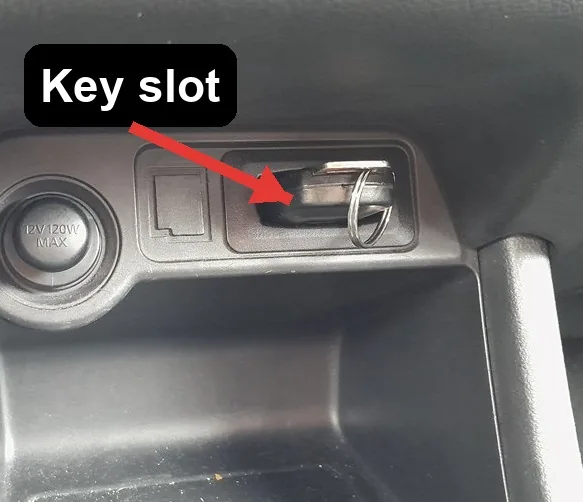
- Unlock and get into the car with the emergency key first (next section), sit in the driver’s seat and close the door.
- Press and hold the brake pedal with the selector in P. On the PHEV, the procedure is the same — foot on the brake, ready position.
- Hold the back of the FAST Key fob directly against the START/STOP button — the button carries a short-range coil that reads the fob when its battery is too weak to broadcast.
- With the fob still touching the button, press the START/STOP button. The car powers up to READY (PHEV) or the engine starts (petrol/diesel).
- If it does not respond first time, hold the fob flush to the button and try again — a nearly-flat cell needs the fob right on the switch.
Unlock the Outlander Mk3 with the emergency key
- Slide the release lever on the back of the FAST Key fob and pull the mechanical key blade out of the body.
- Insert the blade into the lock barrel in the driver’s door handle and turn to unlock.
- The alarm may sound until you start the car; powering up clears it.
Immobiliser note
The Outlander immobiliser reads a passive RFID transponder in the FAST Key, not the fob’s battery. The START/STOP button houses the back-up reader, powered by the car, so the system authorises even with a fully dead fob. Keep the fob touching the button as you press start — if it sits too far away on a very weak cell, the immobiliser cannot read the chip and the start sequence is interrupted. On the PHEV, the keyless and immobiliser circuits run off the small 12V auxiliary battery, not the high-voltage drive battery; if that 12V battery is flat the car will not wake regardless of the fob. A key warning that stays lit after starting points to a genuine fault.
Replace the fob battery
The Outlander Mk3 FAST Key uses one CR2032 3V lithium coin cell. Slide out the emergency key, then insert a small flat screwdriver into the slit at the corner of the fob and twist gently to separate the upper and lower halves. Lift the old cell out, fit the new one + side up, click the case shut and refit the key. Remote locking returns immediately.
Frequently Asked Questions
Where do I hold the fob to start the Outlander Mk3?
Directly against the START/STOP button. This generation has no key slot — the back-up reader is inside the button.
Does the dead-fob start work the same on the Outlander PHEV?
Yes. Touch the fob to the START/STOP button with your foot on the brake; the car powers to READY. The only extra requirement is a charged 12V auxiliary battery to wake the keyless system.
Which battery does the Outlander Mk3 FAST Key take?
One CR2032 coin cell, available in any supermarket or hardware shop.
Do I need a workshop tool to start it with a dead fob?
No. Touching the fob to the button is a built-in owner procedure; no diagnostic tool is required.
Why did the alarm sound when I used the emergency key?
Mechanical entry registers as a possible break-in until the transponder is read. Powering the car up cancels the alarm.
If a dashboard warning light stayed on after the no-start, look it up on autodtcs.com to confirm it was just the fob and not an immobiliser code.
Independent guide — not affiliated with Mitsubishi. Always follow your official service manual and safety precautions. Read our full disclaimer.