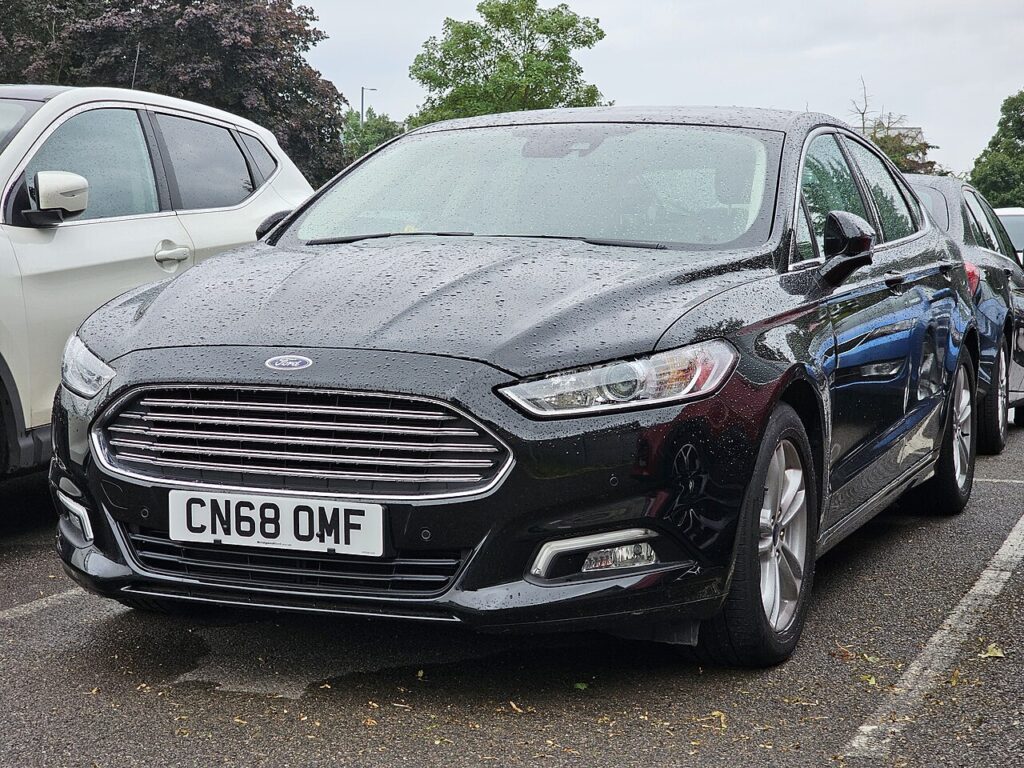
These instructions apply to the Ford Mondeo Mk5 (CD391) 2014-2022.
For other models, please choose your vehicle here.
If the remote on your Ford Mondeo (Mk5, 2014–2022) has gone dead and the car will not unlock or the dash shows “Key not detected”, you are not stranded. The fifth-generation Mondeo — the CD391 “global” Mondeo in saloon, hatch, estate and Hybrid — gives you a dedicated backup slot to drop the fob into so it can still start, plus the usual hidden emergency blade to get you through the door.
Most Mk5 Mondeos are keyless with the Ford Power START/STOP button, which makes the backup-slot procedure below the one nearly every owner needs when the coin cell finally runs flat. The Hybrid (HEV) works exactly the same way.
Start the Mondeo Mk5 With a Dead Fob (Backup Slot)
The Mk5 has a proper backup pickup so you do not have to balance the fob against the button. Do this:
- Get into the car first using the emergency blade (see the next section) — the door buttons are dead on a flat fob.
- Open the centre-console cubby (the armrest storage box). The backup key slot is inside it — a moulded recess shaped to take the fob.
- Insert the dead fob into the slot, typically with the buttons facing the dashboard so the transceiver can read the chip.
- Press the brake pedal, hold it, and press the START/STOP button. The immobiliser reads the passive chip and starts the engine.
- Once running, you can take the fob back out and drive; it does not need to stay in the slot.
If you cannot locate the slot, the fallback is to hold the flat face of the fob against the START/STOP button and press it through the fob — the backup transponder coil sits behind the button too.
Unlock the Mondeo With the Emergency Key Blade
A metal blade is folded inside the fob for getting through the door.
- Slide the release catch on the back of the fob and pull the metal emergency blade straight out.
- Go to the driver’s door. The lock cylinder hides behind a small plastic cap on the door handle. Slip the blade into the slot at the rear edge of the cap and prise the cover off to expose the barrel.
- Insert the blade and turn it to unlock the door — usually the driver’s door only; the interior central-locking button frees the rest once you are in.
Why a Flat Battery Does Not Lock You Out
The Mondeo’s immobiliser never relied on the coin cell to verify your key. Inside the fob is a passive transponder powered by induction from the car’s reader coil, the same way a contactless card works. The dead battery only kills the long-range radio that unlocks the car from a distance. Drop the fob in the console slot (or hold it to the button) and the short-range coil powers the chip directly, so the car still knows it is your key.
Replace the Key Fob Battery
- Slide out and remove the emergency blade first — this releases the case.
- Split the fob along its seam with a thin coin or plastic pry tool.
- Lift out the old cell. The Mondeo Mk5 fob uses a single CR2032 3V coin cell.
- Fit the new battery + side facing the same way as the old one, handling it by the edges.
- Clip the case together, refit the blade and test the buttons. A fresh cell lasts roughly 2–3 years.
Frequently Asked Questions
Where is the backup fob slot on the Mondeo Mk5? Inside the centre-console cubby under the armrest, as a moulded recess. Insert the fob (buttons toward the dash) and press start with your foot on the brake.
Does the fob have to stay in the slot while I drive? No. Once the engine is running you can take it out; the car only needs to read it at start-up.
Does the Mondeo Hybrid use the same method? Yes. The HEV shares the same fob and the same backup slot; pressing start with the fob inserted brings the system to “Ready”.
Where is the hidden door lock on the Mondeo Mk5? Behind a clip-off plastic cap on the driver’s door handle. Prise the cap from its rear edge to reach the barrel.
Which battery does the Mk5 Mondeo fob take? A CR2032, a standard 3V coin cell sold everywhere.
If a dashboard warning light stayed on after all this, you can look up what it means on our sister site autodtcs.com.
Independent guide — not affiliated with Ford. Always follow your official service manual and safety precautions. Read our full disclaimer.