These instructions apply to the Honda Civic Mk10 (FK) 2016-2021.
For other models, please choose your vehicle here.
The Honda Civic (Mk10/FC–FK, 2016–2021) uses an electronic parking brake (EPB) on most trims, with a small electric motor bolted to each rear caliper instead of a handbrake cable. Before you change the rear pads or discs, those motors have to wind their pistons fully open and stay there — that is what service (maintenance) mode does. Honda’s factory procedure expects the HDS scan tool, but owners can also reach maintenance mode on this generation using only the ignition and the EPB switch.
What service mode is and why you need it
Each rear caliper carries a geared electric motor that screws the piston in and out to apply the parking brake. If you push that piston back with a G-clamp or a wind-back tool while the system is live, you drive the screw backwards through the motor and strip the gearset. Maintenance mode retracts the motors and locks the EPB out so the pistons can be compressed safely. With it active the dash shows the brake-system warning and the EPB will not apply, giving you the clearance to fit thicker new pads.
Entering EPB service mode on the Civic Mk10
Park on level ground, chock a front wheel and make sure AUTO HOLD is switched off. Then:
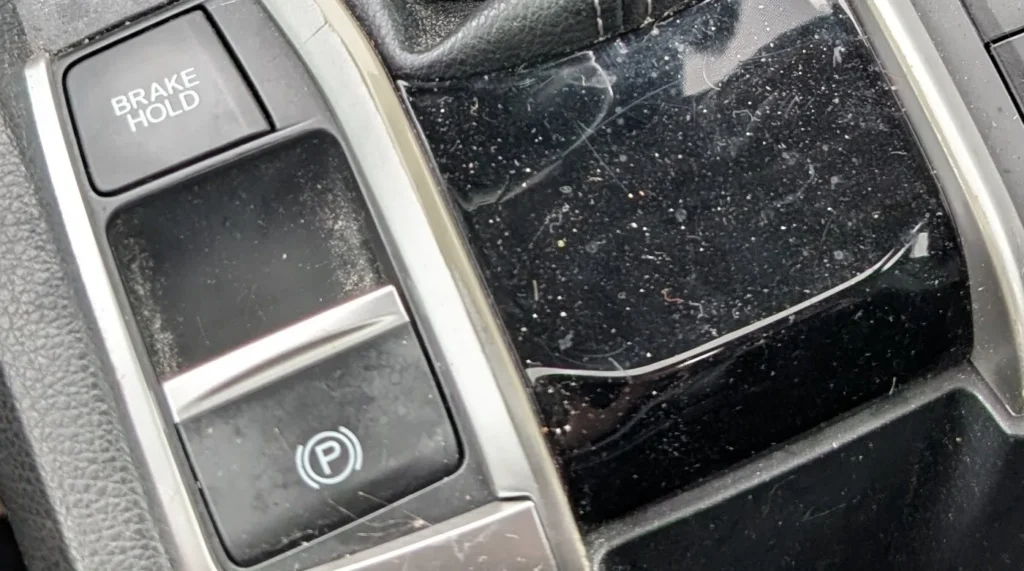
- Switch the ignition to ON (engine not running — press START once without the brake pedal).
- Keep your foot off the brake pedal for the whole sequence.
- Press and hold the EPB switch DOWN to the RELEASE position and keep holding it.
- While still holding the switch down, turn the ignition OFF, then back ON, then OFF again — slowly, one step at a time.
- You should hear the rear motors run and see a brake-system message; that confirms maintenance mode. Now release the switch.
The pistons are retracted and the EPB is locked out. You can lift the car and change the rear pads.
Never force the pistons back by hand
This is the rule you cannot break on an electric caliper: never wind or force the EPB pistons back with a clamp, a wind-back tool or by hand. The piston is driven by a geared motor, and forcing it backwards strips that gearset or burns out the motor — that means a new caliper, not a cheap fix. Once maintenance mode has retracted the piston, the new pads should seat with only light hand pressure. If a piston still feels tight, stop and confirm the car actually entered the mode rather than muscling it.
Exit and bed-in
With the new pads fitted and the wheels back on, exit by repeating the same switch-and-ignition sequence (hold the EPB switch, cycle the ignition), or simply switch the ignition ON and pull the EPB switch UP to apply, then push it down to release. Do that apply-and-release cycle two or three times so the motors re-learn the new, thicker pads and set their home position. Make sure the red brake-system warning goes out. Finish with a road bed-in: from about 30 mph (50 km/h) brake firmly but not to a stop, repeat eight to ten times with cooling gaps, then check the parking brake holds on a slope.
Frequently Asked Questions
Does every Civic Mk10 have the EPB? No. Higher trims and most European cars use the electronic switch with motor-on-caliper rear brakes; some base models kept a conventional handbrake lever. If your centre console has a small push/pull EPB switch rather than a lever, this procedure applies.
Do I need a Honda HDS or scan tool? Honda’s official procedure uses the HDS, but the ignition-and-switch sequence above lets owners retract the pistons without one. A generic OBD2 tool with an EPB “brake service” function is a reliable fallback if the manual entry will not take.
The car won’t enter maintenance mode — what’s wrong? The usual causes are AUTO HOLD left on, a foot resting on the brake pedal, or rushing the ignition cycle. Reset everything, keep off the brake, and step through the OFF/ON/OFF cycle slowly while holding the switch down.
Can I just leave the parking brake off and skip service mode? You can release the EPB and change pads if you manually wind the caliper motor out with the screw drive, but that is fiddly and risks damage. Maintenance mode is the safe, no-disassembly route.
The brake light is still on after I finish — is that normal? It clears once you complete the apply-and-release cycle and the EPB re-tensions on the new pads. If it stays on, repeat the cycle or scan for a stored EPB fault code.
If a warning lamp or stored fault code appears during the job, you can look up what it means on our sister site autodtcs.com.
Independent guide — not affiliated with Honda. Always follow your official service manual and safety precautions. Read our full disclaimer.